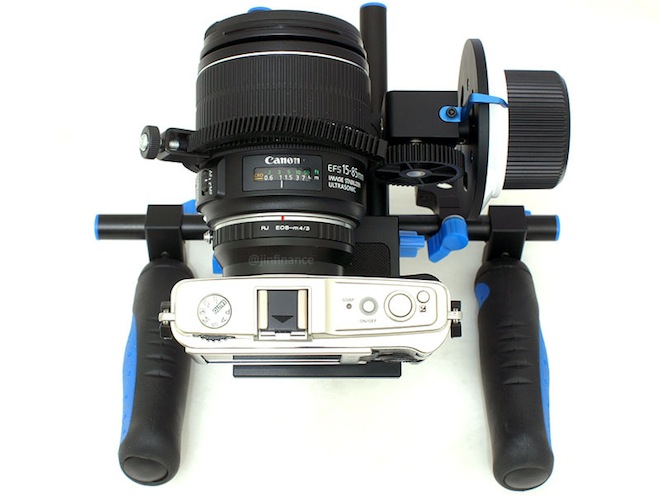


The 550D was released almost exactly 2 years ago and it was a great leveller of the playing field, since it brought similar video quality to the 7D down to a more reasonable price point.

The Swivi USA monitor costs just $330 on Amazon USA. (I picked mine up in Europe for 229 euros at MeinFoto in Berlin)
Here’s a monitor that plugs the hole left by Canon when they forgot to include an articulated screen and peaking on the 5D Mark III.
How does it perform and is it worth getting?

For me the OM-D is a superb stills camera with question marks for video. So satisfied I am with it as my main stills camera I’ve replaced both my Fuji X Pro 1 and NEX 7 with it for stills. Much better AF and the lens range were certainly a factor in that, but this camera also combines the retro good looks of the Fuji with the operational fluency and advanced featureset of the NEX 7, as well as offering superb 5 axis image stabilisation inside the body.
But how does it do for video?

There are two new cameras are on the DSLR video radar. The new NX20 is Samsung’s answer to the GH2 and similar in many ways (though crucially not one, as we’ll see in a moment).
A nice surprise is that it has a 1920×810 2.35:1 anamorphic cinemascope mode.
It is also interesting in that it’s one of the first ‘smart DSLR’ style cameras with features that make the iPhone and Galaxy S such a compelling photography tool.
The Nikon D3200 is a much improved (in video terms) entry level model for just $699, nevertheless featuring a spectacular 24MP sensor and Expeed 3 image processor from the $5999 D4!
Today I shot this comparison between the 5D Mark III and hacked Panasonic GH2 with EOSHD Unified Patch. The results are all in the video.
Now you just need to factor in overall aesthetics to your decision, which are important. Personally I’d say that full frame sensor aside there is no reason why I like the 5D Mark III’s cinematic image more than the GH2′s. But I do need a full frame camera! It is another look, another option.

Disclaimer: I usually say don’t wait – shoot with what you can get now, the best you can afford. But March 2012 is an unusual month because NAB 2012 is around the corner in April. The picture may change somewhat. Bear that in mind!
The candidates are:

Canon have been on the record to say that the only rival they fear is Fuji (because of their expertise in sensors). Canon want to fear them and I want to like them. If only the GH2 was this good looking.
Unfortunately I am having quite a hard time liking my X-Pro 1 when she is sitting side by side with the superb Sony NEX 7.
Does it offer enough over the Sony NEX 7 to justify the price tag?
The Leica M Noctilux which costs $11,000 is a full frame F0.95 photographic lens. The SLR Magic HyperPrime CINE T0.95 is a full frame F0.92 lens designed for cinematographers with Leica M mount which retails for $3,000 – a third of the Noctilux.
It is quite a different lens to the Voigltander Nokton 25mm F0.95 for Micro Four Thirds. It covers a full frame sensor and APS-C mirrorless cameras like the Sony FS100 and NEX 7 whilst the Nokton vignettes on anything larger than Micro Four Thirds. I shot the above film on the Panasonic GH2 with Iscorama 36 anamorphic attached to the SLR Magic CINE but I am also using it on my NEX 7 and Fuji X Pro 1.

It is a testament to how demanding the camera market place is of manufacturers at the moment that Canon could bring out a large sensor compact like the G1 X and for me to have quite a few major gripes about it.
This is the best image quality we’ve ever seen from a camera in the ‘compact’ class. Although the Panasonic GX1 with 14-42mm PZ comes pretty close for around the same price. Video wise, image quality at 1080/24p is actually rather detailed and can be almost DSLR standard but it is not a match for the GH2 because of heavy aliasing, a slow fixed lens and a lack of manual control.

For the vast majority of DSLR shooters these cameras are a lot of money so it is important to get the right one. Often it could be a small feature that sways it for your individual needs so it is never right to say that one camera is ‘better’ for ‘everyone’. It isn’t as cut and dry.
However it is possible to be objective about image quality. I’d say the 5D Mark III definitely has the better internal codec and resolution.
A great many have forgotten what an absolute beast the 5D Mark II is.
A power house of image quality with a massive sensor, Hollywood film sequences and entire episodes of prime time network TV have been shot on it purely for the way it looks. But it does have one big flaw.
This is now much reduced with the VAF-5D2.

Although the Canon 24mm F1.4L and Samyang 24mm F1.4 are superb lenses, the Canon is $1500 and the Samyang $800. Here EOSHD goes hands-on with 4 more affordable fast wides for the 5D Mark II. They are especially cheap if you pick them up used on eBay.
Minimum viewing recommendations: 40″ TV. Download the MP4 file.
The NEX 7 is a beautifully designed high end mirrorless camera with probably the most advanced CMOS sensor Sony have ever produced. As a stills camera it is superb (if you don’t mind adapting glass and manually focussing – because the current E-mount lens range is somewhat limited).
But does it topple the Panasonic GH2 and Canon 5D Mark II for video?
I have the idea to make a tense but beautiful low light, budget thriller with the Nikon J1. It is ideally suited to it. It has the least amount of rolling shutter for handheld camera movement of all the DSLRs and mirrorless cameras, and the smaller sensor (2.7x crop) makes it far easier to focus at fast apertures like F1.2 for low light. At that aperture on full frame you will have a nose in focus, but eyes off! Not much good.
Thanks mainly to the unexpected success of their NEX line of consumer mirrorless cameras, Sony are probably the only company to realise the truth about mirrorless and its future direction. Namely that it is the future, especially for video.

Whilst I still prefer the small size and ‘tourist’ stealth factor of DSLRs for the kind of shooting I do, I can recognise why a great many want a Canon C300. The handling, EF mount, image quality and low light performance – as well as built in ND, audio monitoring and build quality are worth the money to many professionals.
But actually there are some myths flying around about the C300 and the competition is far stronger sub $10,000, even sub $6,000 than people realise.

Where to buy - Acratech Levelling Base at Adorama in the US and Bob Rigby in the UK / Europe. Manfrotto 701HDV at Adorama US and Amazon UK.
In part 1 I began my quest for a small, light and compact video head with levelling capability to level off a shot quickly. Because I move around a lot on location I set a weight limit of 3kg including legs and to keep in the spirit of what DSLRs are all about, the price has to be as accessible as the camera.
Here’s what I settled on…
Note: the Sony A65 shares the same sensor, image processor and viewfinder as the NEX 7 and Sony A77. Image quality is 99% the same on all 3 models.
As part of my series of reviews on the Sony A65 I shot this comparison yesterday near Manchester, city of Oasis and Frank Sidebottom. The A65 represents the latest generation of Sony’s technology – 24MP APS-C CMOS sensor, ExmorHD image processor with 1080/60p and a 2.4MP OLED TruFinder. So is it any good?

EOSHD recommended lenses for the Sony A65 / A77
Amazingly Sony have got their flooded production going again and Sony A65s have found their way to England in time for Christmas. I’ve come to the UK to spend some time with family and in Manchester I picked up the Sony A65 with kit lens for £699… Considering how similar it is to the A77 that is a pretty competitive price by Sony and I am sure this is going to give the 600D / Rebel T3i something to think about over the next few months. But is it any good for video?