



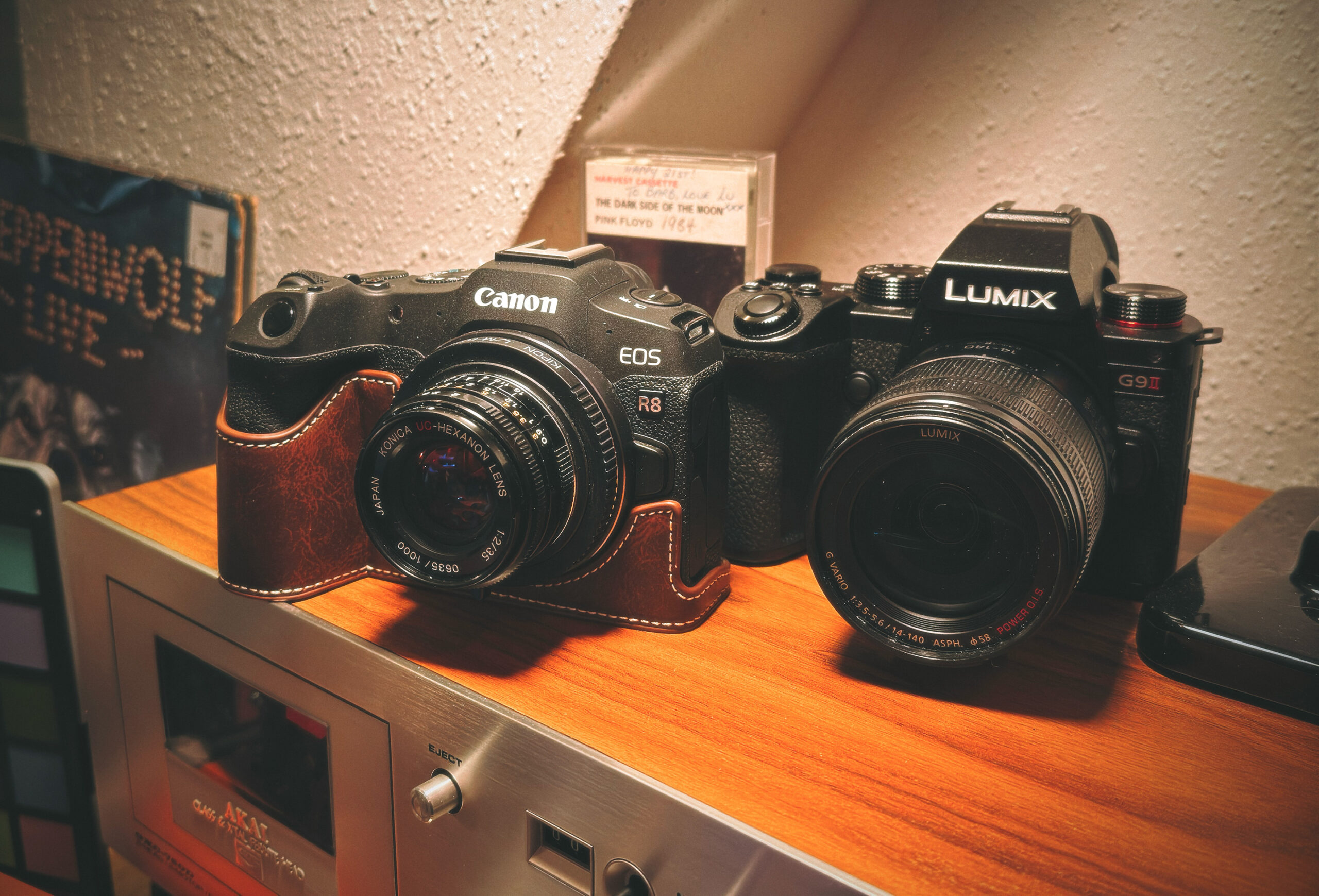
It’s like Canon 5D Mark II vs Panasonic GH1 all over again!
Canon got aggressive with the R8, and finally put the cripple hammer away. This is the bargain value for money full frame camera of our era, they had no choice but to do it – the Sony a7 IV exists. Indeed, the a7 V exists, but it lives in a higher realm of pricing – feature packed for sure, but does it actually offer a better image overall than the R8? I’d say… Debatable.
Then in the Lumix corner, we have the G9 II which on the face of it is not supposed to be a GH7, but it is.
And best of all, this Not A GH7 can be had for around 1200 euros, or less, if you shop around.
The G9 II is an underrated tool. The spec is more aligned with a flagship camera, like the Sony a1 II, than an enthusiast filmmaking tool, and it has far fewer compromises than the EOS R8. If you don’t mind the 2x crop sensor it’s the one to get – but it requires considerate thought in terms of glass. If you’re not careful it can end up looking a bit clinical, but that sensor – the same as the GH7 – is just such a bomb. It’s the closest Micro Four Thirds has ever been to full frame in dynamic range and low light performance, and surpasses all but the very best flagship full frame sensors in terms of speed. The quality of the 4K/120fps is outstanding.
The EOS R8 is a slower camera, and the most glaring omission is the lack of in body stabilisation. If you’re an avid collector of vintage glass or manual focus stuff, you might not miss it – the flagship R1 and R3 behave as if IBIS doesn’t exist when you’re not using native Canon RF mount lenses.
What I do like about the EOS R8 is the straight-forwardness of the body design, how small and thin it is, how good the ergonomics are – a big improvement on the RP – how decent the EVF is, how the cripple hammer was resisted in terms of autofocus and video – two areas where you can barely tell it apart from the much more expensive EOS R6 Mark II.
The lack of IBIS is in some ways a blessing – forcing you to get the sticks out and do stuff properly.
Whereas the G9 II is the closest you can get to the speed and specs of a flagship Sony A1 II, or Nikon Z8 for nowhere near as much money, and you’ll save on the lenses too – and the weight, and the size.
If I were to choose just one…
The EOS R8 does have the full frame image and all the advantages that brings, but to be honest it’s not all just about an ever more shallow DOF – it’s going out of fashion. The full frame advantage is in terms of lenses – a 35mm is a 35mm, a 50 is a 50. With Micro Four Thirds there’s always that nagging crop to factor in.
The G9 isn’t quite as good at very high ISOs, isn’t quite as creamy looking – but it’s a better documentary camera, faster, better battery times, far more feature packed.
And that’s why if I did pick one it would be the Lumix.
