


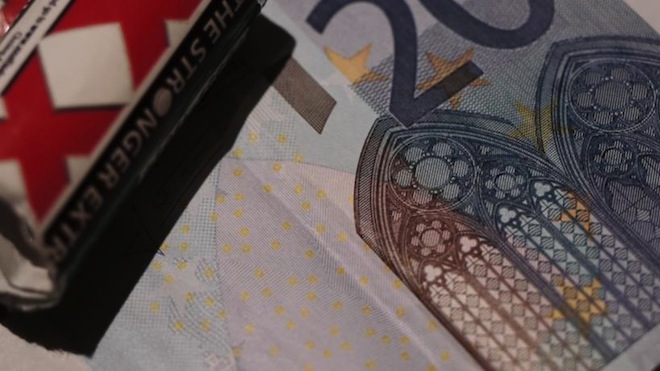
Image above is softened by my content management system’s JPEG compression. View the full 1080p GH1 frame (44mbit AVCHD) and Crew.tv’s Panasonic AF100 frame (100Mbit AVC-Intra) here
Do DSLRs really lack resolution compared to professional cameras? In the technical sense, yes. But in practical terms, not really.
It’s accepted knowledge that the poor scaling (like line skipping on the sensor), lack of raw and heavy compression of DSLR video makes for a soft image. Some say that DSLRs are only resolving roughly 720p in 1080p mode and some go as far as saying that DSLRs are not really full HD video cameras at all.
I have used quite a few DSLRs and now we’ve seen the first results from a professional large sensor video camera, abiet one still in production: the AF100. So can a DSLR frame grab stand up in the resolution stakes to the 100Mbit HD-SDI output recorded in one of the world’s best codec AVC-Intra?
YUP
At 600% under a microscope, with your eye close to a laptop screen the GH1’s AVCHD won’t hold up against AVCHD Intra but no audience watches footage in this way. Pixel peeping is a relevant science (especially to understand exactly what the camera is doing) but sometimes it can be misleading. What’s more the frame grab above which shows such incredible detail is shot with a Canon FD 50mm F3.5 macro lens whilst Crews.tv used expensive Zeiss primes on the AF100.
Previously, I found the GH1 to resolve slightly more detail than the 5D Mark II. But this always got smudged away with the slightest provocation due to the poor implementation of AVCHD and the original 17Mbit bitrate.
Here is a chart of the DSLRs I’ve had personal experience of using. Can’t speak for the Sony offerings.
In good light, DSLRs are in order of resolution from best to worst
1. Panasonic GH1 (hacked)
2. Panasonic GH2 (pre-production)
3. Canon 5D Mark II
4. Canon 7D
5. Canon 550D
6. Samsung NX10
The original non-hacked GH1 would fall between 3rd under the GH2 and 6th below all the Canons depending on how much you moved it!
In poor light the same chart is true but the GH1 trades places with the GH2 for 1st since the GH2 is much better at high ISOs. In fact at ISO 1600 the GH1 drops slightly behind the 5D Mark II since it’s noise levels are higher and more noise reduction is required, which smudges detail.
Can DSLRs be used by pros for professional work?
I was at the Canon Pro Photo Solutions show in London earlier this week, where I met Mike Owen, a manager in the Professional Imaging Marketing department at Canon. We talked about Canon’s 4K concept camera and how well the footage from Red Tails projected in Philip Bloom’s seminar – Shot on the 7D, there was no doubt about how well it projects onto a big screen and yet on a laptop screen where the viewer is but a couple of feet away every little flaw is magnified. I also spoke to Mike about the demand for a pro mirrorless solution along the lines of a pro Micro 4/3rds style body, because the mirror is just not needed for video. He asked me why I chose the GH1 over the 5D Mark II? I replied that the lens adaptability (i.e. cine PL and c-mount), the EVF as well as other mirrorless benefits like fast contrast detect AF in video mode, optimised video lens and better live view functionality were all useful for video purposes. More resolution and 4K? Not so much right now.
The refined image quality of, say, an Arri Alexa is better than DSLRs but you also need a projection system capable of doing it justice and even then, at the distance necessary for the human eye to see all of the screen, the fine pixel pitch is not discernible by the human eye.
Resolution hits the ‘retina display’ limit in terms of pixel density.
Sure a DSLR will look softer than an Alexa side by side, but not as much as the pixel peeping and specs sometimes lead us to believe. This is because the human eye is not good at resolving so much detail in a fast moving image many metres away. Try running a 4K Mac OSX desktop on an IMAX cinema screen and seeing if you can discern the the individual pixels from 30 metres away.
DSLRs can be used for professional productions, the proof is all around us.
A big thanks for Tony Tanza for very kindly donating the macro lens I happened to use for the resolution test shots above. Check out his video below.
[vimeo]14661848[/vimeo]