

Andrew - EOSHD
-
Posts
15,731 -
Joined
-
Last visited
Content Type
Profiles
Forums
Articles
Posts posted by Andrew - EOSHD
-
-
Right on cue the BMC Users are declaring GH4 as "horrible" and "atrocious". I feel like a peace keeper because i love both!
I stay off that forum, it's a total abject waste of my time to be involved in defending cameras. Defend a country! Defend a person. But not a bloody camera :)
-
Dilemma of the century. Do you take the advantages of raw or 4K? Do you take the full frame sensor or the crop? Do you take the DSLR form factor or the advantages for video of mirrorless?
This is something I've been really trying to draw a conclusion on in recent weeks for my own sanity!
Read the full article here- Julian, Christina Ava, Ergo Zjeci and 3 others
-
 6
6
-
When the new camera is coming Im always again and again surprised what a turd footage is used by manufacturers to promote it.
Once again... Panasonic are not using this Driftwood thing to promote the GH4.
-
I just miss the full frame sensor and 14bit colour.
You will see in my review if it is a big issue or not.
-
The 5D Mark III raw has a very similar look. I've shot with the GH4 and that side by side and the video is coming soon with the main review. There's nothing really 'wrong' with the colour, it just depends how you grade it. The main drawback for me is that it isn't full frame.
-
This isn't a centre piece for Panasonic's promotion of the GH4, it is just what Nick Driftwood wants you to believe. Because he presumably thinks there's some kind of career reward in being nice to big companies. The thing is there really isn't. Panasonic just want to sell cameras and make money, they're not really in the best position to be picking sensitive artists to give demo units to. I just walked past a DPReview gold badge on a GH3 box today, just randomly on a store shelf. I realised if it wasn't for me writing the GH3 video page in that review and putting my argument across to the editor that it deserved a gold reward because of the video capabilities (DPR felt it merited a silver, because as a stills camera it lacked any real outstanding spark) that badge wouldn't exist. I felt a bit sad that in some ways my review and my views were being commercialised to sell cameras, without any reward for me, and nor should there be as it would cause bias. That's why I prefer to get minimally involved with stunts like this and marketing. If I make a short film with the GH4 it will be because the camera suits the material, not because I want to score attention with Panasonic, because like I say, there's no real reward for doing so and it is not really what I want. I want attention from other filmmakers and the audience instead. You have to question Nick's motives for making this to be honest and trying to pass it off as a wannabe Panasonic promo video.
-
It all depends on what you want to do.
For some stuff I prefer the 5D Mark III and certainly raw video on it is mind-blowing for work involving rich colour saturation, heavy grading and low light. I also love the full frame rendering of my lenses.
The GH4 in terms of 4K and usability of course is a big win, but the smaller sensor and the stills are not up to 5D Mark III level. Still pretty good though... how much stills quality do you NEED? That's the question to ask, not so much whether the GH4 is rated that way or this way.
-
-
http://nofilmschool.com/2014/05/first-short-film-shot-on-4k-panasonic-gh4/
Check this out & read the comments. It seems it's common knowledge now that the GH4s image is very video-y and incapable of producing filmic images. I am stunned by the amount of comments saying this. I know it's pure crap and in the right hands it can produce a filmic image, maybe harder than say a Blackmagic but still do-able.This was shot on film...
Therefore I have decided film is incapable of producing a filmic image!
The first comment on nofilmschool kind of sums it up
If I was the CEO of Panasonic, I would buy this film and immediately take it down. Then tell these “filmmakers†to stop using the GH4.
Give a hack a camera, and a hack of a film comes out...
-
Why the hell is this kind of thing annoying?
-
RichG101, mtheory, jonpais, JohnBarlow and Andy Lee you are now mods :)
-
Andrew, not to the extent found on speedbooster.
And the question now is how much you need to stop down to get rid off purple fringing, corner softness and vignette ? if you end up at 1.8 then what's the point ? no full frame look on 2x crop sensor at 1.8, or at least not so much SDOF you would get on FX.
There is no cheating with speedboster, you eighter get the best lenses or a full frame sensor that shoots 4k.
I have seen speedbosters on gh3 and the purple fringing is wayyyy worse than a dedicated lens from Panasonic, the purple fringing is much thicker on speedboster and quite visible.
You're very confused aren't you.
It isn't all about aperture and you're really highly dramatising any issues. Soft corners, vignette, purple fringing, are really not much of an issue compared to the lens used normally wide open on a larger sensor. In fact the image in the centre of the frame gets sharper. I suggest you use one before critisising!
You do get true Super 35mm rendering of the lens with Speed Booster and that means all the characteristics of a larger sensor.
Instead of using a 25mm for example you can use a 35mm lens. Longer focal length = shallower depth of field.
-
Did anyone checked how heavy the chromatic aberrations are with a speedboster ? it's bad, purple fringing never leaves the image and you can't correct it in lightroom :).
Why bother, get a 1.2 lens or a nokton and lose the canon lens.
Hmm. Purple fringing at F1.2 on any lens is there. Even the Canon 50mm F1.2L. Same with the Nokton.
When you stop down on the Speed Booster chromatic aberrations and fringing disappear.
-

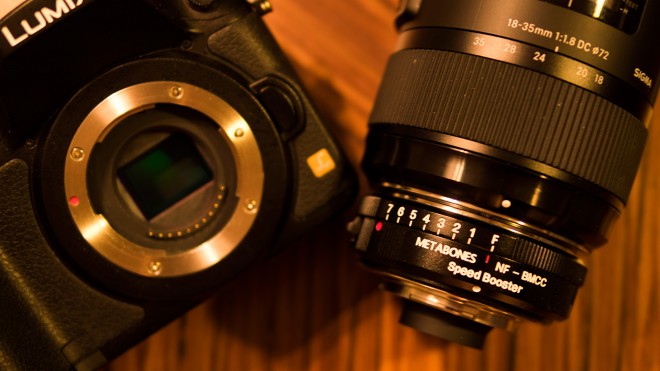
I had hesitated to try this for so long, but finally today a brave EOSHD reader sent me a tweet saying he had fitted his BMCC Speed Booster (with protruding rear-glass) on his GH4. It just goes straight on. First a BIG disclaimer. Speed Booster adapters have adjustable glass which can sit closer or further away from the sensor to fine tune infinity focus. On some adapters this will mean potentially it will clash against the inner housing of the mount and be damaged if used on a Micro Four Thirds stills camera. Therefore I do not take responsibility for any loss or damage if you try this.
Read the full article here -
lol what, you still need your earthquake?
Would Fukushima have happened without one?
-
There's no such thing as a "perfectly safe nuclear industry". Try saying that to people living in a 5000 mile radius round Tchernobyl or Fukushima.
There's not a single nuclear plant which has insurance, simply cos they can't find an insurance company willing to cover the risk.In Belgium, with it's "perfectly safe nuclear industry", 2 of the 3 plants have had to shutdown due to tiny microscopic cracks in the plant's core. Noone inside the perfectly safe nuclear industry knows how to solve it, or what to do with the core and the rest of the plant. The plants will very probably never startup again.
Nuclear energy creates a wonderful legacy for our children and great granchildren : nuclear waste. Which will be here at least as long as we are. Plenty of it was dumped in the oceans, is leaking now and we have no idea what to do with the rest of the waste that's stored all over the planet right now.
There's plenty of sustainable alternatives, the nuclear lobby is heavily subsidized (even after +40 years of development they can't function without heavy national and supranational funding). A recent EU report was censored because it mentioned how nuclear and fossil energy are subsidized more than sustainable forms of energy.I'd rather live nearby an ugly windmill than within 1000 miles of a nuclear plant.
Yes all correct.
But still no tsunami or magnitude 9 earthquake in central Germany. Odd.
-
Btw Thanks to continuous Fukushima disaster, hot topic is now Pacific sea food, tuna fish etc. Who is still eating Pacific catch? It may have low radiation and you can stop it by piece of paper, but if you eat it, it will stay in you and you will be exposed to the low emissions for the very long time, probably rest of your life, and that can be pretty serious. Cumulative radiation is harmfull.
This is a great thread, has been wonderful to read and actually thank you to the original poster because it is well intentioned and interesting.
Thank you even more though to the people curious enough to do some proper research, because hysteria is everywhere today and it is not constructive. Most people don't have any real threats effecting them, so they invent them. This is human nature. One example is the complete decommissioning of nuclear in Germany due to a one-in-1000 year 5000 mile away tsunami which happened to one plant on the coast of Japan combined with a magnitude 9 earthquake.
Clearly nuclear is very dangerous in such circumstances. As it would be in your kitchen.
So the Germans decided to kill their perfectly safe nuclear industry and become dependant on expensive, ugly windmills and Russian nuclear power (a whole lot less safe) because of the threat of a magnitude 9 earthquake and tsunami!
Logical?!
About as logical as being scared of a 35mm F2 :)
-
A day at the beach is more dangerous than owning 100 Thorium coated lenses. We should be thankful the Thorium makes for a sharper picture. The only reason Thorium was replaced in manufacturing was due to hazards related to the actual manufacturing with large quantities of the stuff, day in day out. I don't intend to grind down the rear element of my Asahi Takumar and drink it in a cocktail.
So I guess I'll just keep using it.
-
Pretty good example. Any lighting other than natural sun light?
-
I can see Junior's case for dangerous ingestion of thorium coating if the lens is smashed and dust ingested somehow, but in the case of just using or living around the lens your skin acts as a shield... the radiation doesn't go past it and the doses aren't enough to cause skin cancer so I honestly don't think there's much to worry about. Obviously the manufacturers (Canon, and plenty of other biggies) would have done a full recall in subsequent years if evidence came up that the lenses were dangerous. They have been around for 30-40 years and there's never been anything proved!
I'll remain open minded and see where the argument goes. I did once sell my radioactive FD 35mm F2.0 with concave front element and got the non-radioactive version. Might be a good subject for the A7 book to add in the specs an annual dosage ;)
- vaga, Junior and Sean Cunningham
-
3
-
-
10 μSv is the dose everyone just got from background radiation in the last 24hrs.
So 1 hour of cuddling the rear element of your radioactive lens = 1 normal day living on earth.
Just after Fukushima I went to Japan.
People there over the entire year had a 1,052 μSv dose of radiation based on Tokyo's readings.
That is still only 2% of what the US allows workers to receive per year at work!
So say you spent 5 hours shooting with your radioactive lens per day, EVERY DAY of the year. That is still only 1825 μSv exposure and still under 5% of the total limit which is considered 'safe' by the US authorities.
-
I do cover some Leica M, Pen-F and Contax G short flange lenses in the book and some pancakes as well.
-
Like I said, it's a matter of taste, and depends on your personal needs.
What are you arguing for then?
5D Mark III raw versus Panasonic GH4
In: Cameras
Posted
It was a good test in my opinion. It clearly shows that the Epic has a stronger OLPF and a softer result ungraded. Ungraded raw is very different to GH4 4K where a certain level of sharpening is already applied in-camera even with sharpness all the way down at -5.
Yes the Epic looks surprisingly soft, almost as soft as upscaled 1080p from the 5D Mark III raw footage.
But with a little sharpening in post it would have been much closer.
Am I the only one surprised at how well the 5D Mark III blow-ups look under the microscope at 4K? I expected there to be a bigger difference. My opinion is that in terms purely of detail, 4K vs 1080p depends on how you're going to present / show the end footage to the audience and even on the eyesight of the audience, but clearly taking a full pixel readout of the sensor in the GH4 for 4K has resulted in overall image quality leaping forwards, not just in terms of resolution. Said this all along.