
ac6000cw
-
Posts
696 -
Joined
-
Last visited
Content Type
Profiles
Forums
Articles
Everything posted by ac6000cw
-
Just added a graded, 8-bit Rec709 version of some of the clips to the folder - 'OMLog400 test graded 8-bit Rec709.mov'
-
Here is a collection of 10-bit OMLog400 and HLG files (and a couple of stills) from my OM-1 - https://drive.google.com/drive/folders/1527WMHFXJmDvTGI74QINJQdstgJPhXyt?usp=sharing All are FHD, using shutter priority ay 1/100s (auto-ISO and auto-aperture), auto WB (with the 'keep warm colors' option on) and C-AF set to a medium central area - so pretty much 'point and shoot' video. Lens was Oly 12-40 F2.8 pro. IBIS was sensor shift only, mostly on the maximum stability '+1' setting (which can cause jerky pans - the standard setting is '0').
-
For anyone interested, here is a collection of 10-bit OMLog400 and HLG files (and a couple of stills) from my OM-1 - https://drive.google.com/drive/folders/1527WMHFXJmDvTGI74QINJQdstgJPhXyt?usp=sharing All are FHD, using shutter priority ay 1/100s (auto-ISO and auto-aperture), auto WB (with the 'keep warm colors' option on) and C-AF set to a medium central area - so pretty much 'point and shoot' video. Lens was Oly 12-40 F2.8 pro. IBIS was sensor shift only, mostly on the maximum stability '+1' setting.
-
This is a good technical review (with some downloadable video samples) of the video side of the OM-1 - https://www.optyczne.pl/59.1-Inne_testy-OM_System_OM-1_-_test_trybu_filmowego_Wstęp.html
-
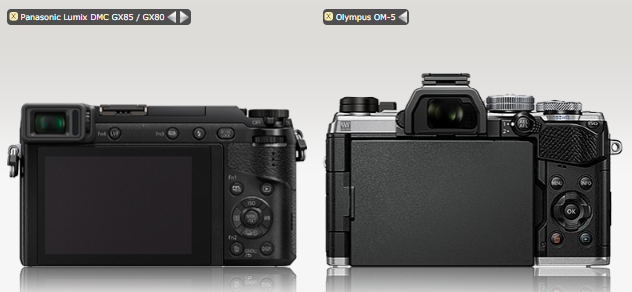
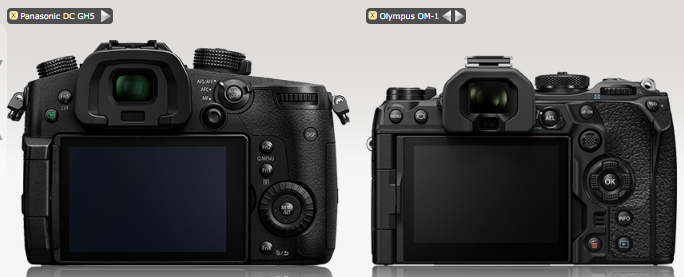
To add to what John has said, currently the best small (ish) Olympus/OM System camera is the OM-5 - that's basically the guts of an E-M1 iii in a smaller/lighter body (about the size of the GX85 if you ignore the viewfinder hump). I don't own one, but do own the E-M1 iii, so based on that: 8-bit video only, FHD is soft, UHD is OK, C4K is very good but is 24p only, video C-AF is good (uses PDAF), IBIS is excellent. The OM-1 is larger and rather more expensive, but smaller and lighter than the GH5. 10-bit 4:2:0 video is H265 Rec2020 in HLG and OMLog400 only, 8-bit video is H264 Rec709 in Flat, OMLog400 and any of the 'photo' profiles. 10-bit video modes are more detailed/higher resolution than equivalent 8-bit video modes - so for best quality go for 10-bit UHD/C4K in 24p/25p/30p (UHD/C4K 50p/60p is a bit softer, 10-bit FHD is rather better than 8-bit on E-M1 iii/OM-5). So far I've been quite pleased with the usable dynamic range on the OM-1 in 10-bit HLG and OMLog400 - the new sensor and 10-bit processing path is definitively a significant upgrade from the older E-M1 iii.

-
I bought a used OM-1 a while ago, and it's slowly turned into my favoured camera for video since then (despite some of its annoyances). I think part of the reason for that is because it has a very fast readout stacked sensor, with rolling shutter time around 5-7 ms in FHD & UHD, which seems to give a 'solidity' to the video combined with fluid motion handling (I normally shoot at 50p), compared to my G9 with about 12-15 ms rolling shutter. If my liking of the OM-1 video is due to low rolling shutter then maybe I'm subconsciously sensitive to the picture distortions created by rolling shutter (including interactions with the IBIS behaviour). But then I'm often filming subjects like trains which readily show up rolling shutter distortions, so maybe that's sensitised me to it?
-
After owning a variety of consumer/prosumer camcorders (starting with VHS-C in 1995, then several DV then HDV), I skipped DVD-based ones and decided that the memory-card based ones (that I could afford) were getting too small and light to hand-hold with reasonable stability. Also viewfinders were becoming rare other than on the higher-end camcorders. Having noticed that reasonable video was starting to appear as a feature in 'photo' cameras, I tried a Pana TZ7/ZS3 compact, then a Sony HX9V compact and Pana FZ100 superzoom. Decided that I preferred the form-factor/handling so moved on to a Pana G3 MILC - nice and compact, good to hold, with a decent viewfinder, video, audio and stills. Upgraded after a while to a G6 with 14-140mm lens (probably my all-time favourite lens) - much larger sensor than any consumer camcorder but still a fairly compact setup for something with a 10:1 zoom lens. As I'm very much a hybrid shooter, I prefer the m43 'compact MILC' form-factor (and the IBIS). The only 'icing on the cake' that I'd like is a quality power-zoom lens with a decent range - the (now obsolete) Oly 12-50 is about as close as m43 has ever got to that. So no, I wouldn't buy a 'camcorder' form-factor camera again. (When I look at some of my old VHS-C or DV footage, it just reminds me of how far consumer/prosumer video capture has improved over time...from less-than-SD resolution, interlaced, noisy, smudgy video to pristine 50p/60p UHD from a pocket-sized camera - wow!)
-
The Metabones micro43-EF Speedbooster product pages have info on certain types/models of manual focus lenses which are not compatible due to having rear protrusions which could damage the Speedbooster e.g.: General m43-EF Speedboosters: https://www.metabones.com/products/details/MB_SPEF-m43-BT3 https://www.metabones.com/products/details/MB_SPEF-M43-BT4 BM-only m43-EF Speedboosters: https://www.metabones.com/products/details/MB_SPEF-m43-BT8 https://www.metabones.com/products/details/MB_SPEF-M43-BT9 (scroll down to the 'Manual Focus Lens Compatibility' section near the bottom of the page) Yashica is not on the list.
-
One of the most common audio plugin formats.
-
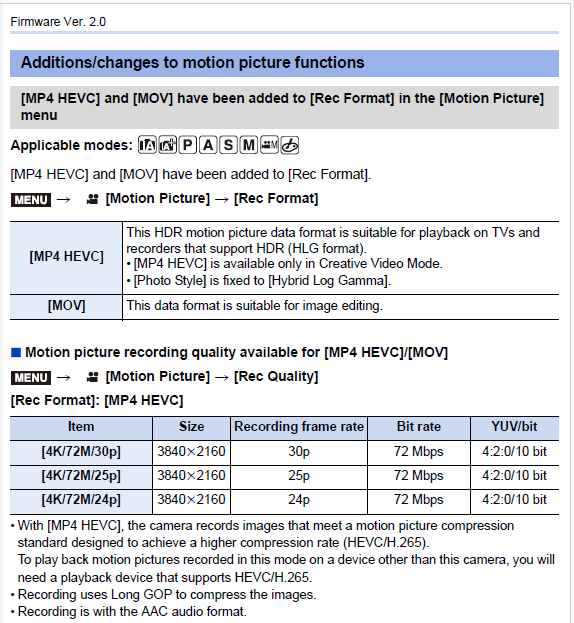
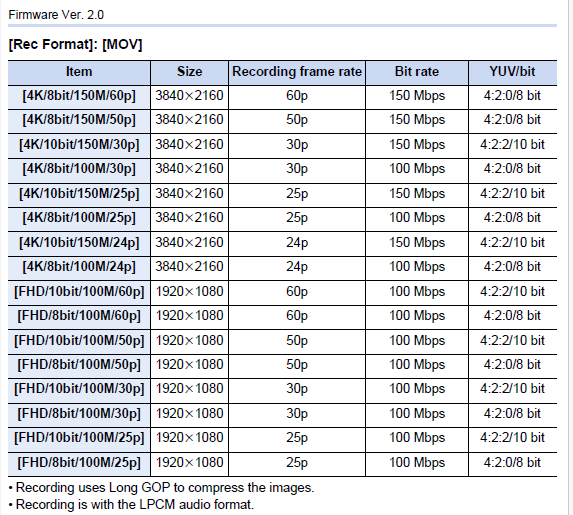
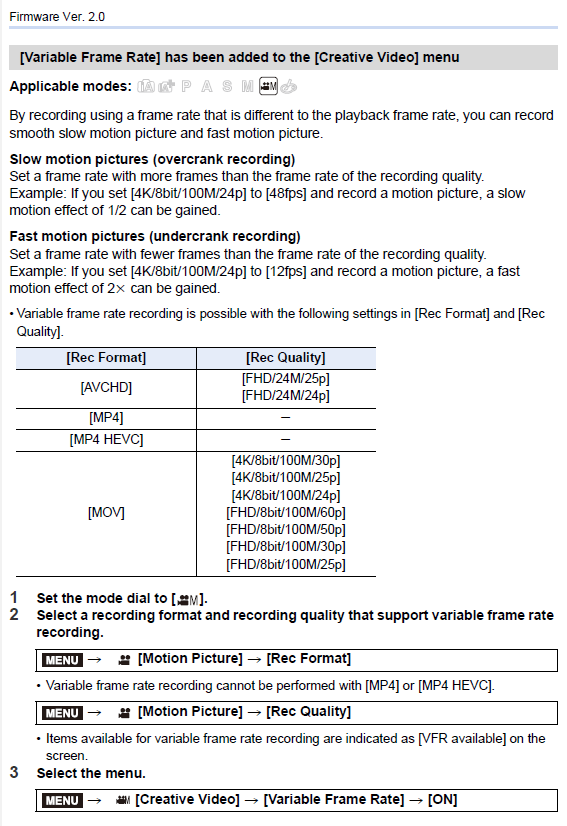
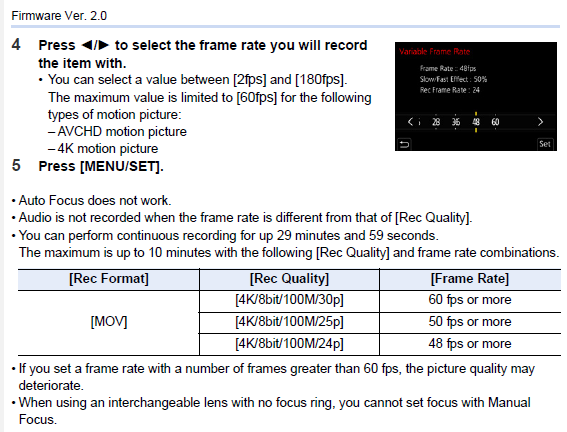
The G9 not only supports 10-bit video, it also supports 4:2:2 - below are the extra video modes added in the major FW 2.0 upgrade (plus variable frame rate recording, HLG support and adjustable video levels). MF linear focus control (with lenses that support it), 'red frame' record indication and vertical video support were added in later FW updates. Note it doesn't support DCI 4k or All-I compression (it's max 100Mbps for FHD, 150Mbps for 4k, long-GOP). All of that puts the G9 way ahead of the E-M1 ii for video quality and flexibility (but the E-M1 ii/iii and OM-1 are a bit smaller and better ergonomically, IMHO).
-
I'm definitely not convinced (to upgrade as an OM-1 owner) - I think it's too expensive at the launch price of £2200 in the UK, especially now the £1700 G9 ii is around. And as for that very large & heavy (for micro43) 150-600mm lens that's only F5 max aperture and costs £2500...what are they thinking - have they forgotten what micro43 is supposed to be about?
-
As far as I've found out to date, video related improvements are limited to support for vertical-format video and improved AF performance (inherited from the photo side, I assume). It also now directly supports being used as a USB webcam. I hope they might port the Mk 2 feature of allowing the 'menu' button to be re-assigned the 'trashcan' button in a firmware update for the original OM-1 (so that you can access and operate the menu system entirely with your right hand). This is a live intro and Q & A session I watched from yesterday, presented by David Smith from OMDS UK (who I've met a few times at open days/exhibitions and seems a very knowledgeable guy), which covered the basic changes and answered some questions (the video-related section starts around 46:23):
-
Yes (as the main audio - I'm just using it for amateur outdoor documentary stuff). It's the 32-bit float that is the attraction, as it makes audio input level adjustment on the recorder something else I don't have to worry about. Same reason I normally use shutter-priority auto exposure for video - it leaves me free to concentrate on framing and holding the camera still (or moving it smoothly). Yes - I want stereo ambient sound but the VP83F is mono super-cardioid (and somewhat larger in size). I prefer a 90 degree X-Y cardioid stereo configuration, as that gives me the sound-stage width I prefer. I often use a Tascam TM2X stereo on-camera mic (without the extension arm!) as the size versus quality balance of that works for me. I've tried others over the years (both mics and recorders) but that's the one I keep coming back to. What would be really nice is a mirrorless ILC camera with 32-bit float audio support...
-
No timecode support, but the new 'H1essential' also looks very interesting - 32-bit float recording for $99, in a package that's small enough to mount on a moderately sized camera. It'll be interesting to see how Tascam responds to this.
-
I've owned both (and the E-M1 iii, G80 and G9). 1. E-M1 ii is larger & heavier but has (for me) superb ergonomics and build quality. It's just a really nice camera to use. 2. E-M1 ii sound via the internal mics is way better than the GX85. It also has a mic input and headphone jack. 3. E-M1 ii 4k UHD is full sensor width (no crop) whereas the GX85 is cropped. 4. E-M1 ii has great battery life. 5. E-M1 ii IBIS is better than the GX85. If you are seriously considering the E-M1 ii and video C-AF and IBIS are important to you, think about the E-M1 iii instead if you can afford it - it has better video C-AF and a choice of IBIS settings (the +1 setting is almost tripod-level). Another cheap (used) alternative to the GX85 worth considering is the G80/G85 - same sensor in a larger body with better IBIS, larger battery and a mic input. Provided the size is OK for you, the G9 is superb value used, and easily beats any of the above cameras for video quality (it also supports 10-bit video and 4k 60p, which none of the others do). Here in the UK, the E-M1 ii and G9 cost about the same used.
-
For anyone interested in using the G9 ii for wildlife video, I came across this interesting comparison by an experienced wildlife photographer of the G9 ii and OM-1 (the video comparison starts around 10:30). The video C-AF performance is quite impressive:
-
I think a small proportion of camera owners are just generally skittish/followers of fashion, whereas most users buy a camera and only consider changing it when it breaks or no longer meets their requirements (which could be for performance/size/weight/fashion reasons among others). Based on what I've seen at camera store 'open days' and exhibitions, Olympus/OMDS does have good brand loyalty but it's a bit of a niche user base of outdoors types (especially wildlife photographers) and those who like small/light cameras. I've never felt that Lumix has that sort of brand loyalty (other than in the 'more serious' video niche market maybe) - it's the 'high on features at reasonable prices' area that Panasonic has historically appeared to be targeting. I'm probably about to become primarily an Olympus/OMDS camera user, after being basically a Panasonic 'hybrid' camera user for years (starting with a TZ7/ZS3 compact 15 years ago). It's mostly because I like the ergonomics of the E-M1 iii and OM-1 better than those of the G9 - even though that has better video quality. Not something I'd ever thought might happen a few years ago... (The difficult decision is - do I keep the GX80? My G80 is already basically redundant. If both go then my only Panasonic camera will be the G9. Also, do I replace both GX80 & G80 with an OM-5 to keep a relatively small/light m43 body?)
-
In reality - neither, because having played around with an S5 ii, I don't like the ergonomics of that body design, it just feels uncomfortable/awkward to use in my hand. Ignoring that, probably the G9 ii due to smaller & lighter long telephoto lenses, probably better IBIS, lower rolling shutter and less moire issues (assuming the video performance is comparable to a GH6).
-
That was my take on it too (apart from fitting bigger memory chips to increase the internal buffer size). No video changes mentioned yet. All feels a bit lukewarm really. But as an OM-1 owner I am of course hoping some of the improvements turn up in a future firmware update for it... 😀
-
+1 for Beyond Compare.
-
Good thought. It's about the same size and weight as the E-M5 iii (and around half the price used). But the older 16MP sensor, and no PDAF, mic input or C4K either.
-
Which version of the MBP have you got? The internal SSD uses a PCIe interface (as is normal for modern internal SSD). The T9 supports 'USB 3.2 Gen 2x2' (20 Gbps) but your MBP might not support that on its expansion ports. The speed you're getting suggests it's running at 'USB 3.2 Gen 2x1' 10 Gbps connection speed.
-
My experience with non-OEM camera batteries (from a variety of 'brands') versus OEM ones is: 1. Their usable/useful capacity is usually lower (by maybe 10-20%), irrespective of their nominal capacity as stated by the supplier. 2. The battery indicator accuracy (on the camera screen) is lower. 3. They have higher self-discharge rates (i.e. when they're charged but not being used). 4. Their useful life (number of charge/discharge cycles and age) is lower. 5. The capacity versus cost is way better, so you can buy two or three of them for the cost of one OEM battery. Beyond the OEM battery included with a camera, I've nearly always bought 'mid-price range' non-OEM batteries (and usually I have three batteries per camera) as they are so much cheaper and I'm not using them day in, day out (or earning a living from them). If I was using them hard I'd buy OEM batteries, other than maybe having a couple of non-OEM ones as an emergency backup. If I wanted good non-OEM batteries at a reasonable price, I'd probably go for suppliers with a decent reputation in the market to protect and that you might get some after-sales support from e.g. Small Rig, Neewer, Wasabi, Hahnel etc.
-
But the A6400/6500/6600 have very high rolling shutter in 4k (and not-so-good FHD quality), which has always ruled them out for me. The recent A6700 with its new sensor, half the rolling shutter time, 10-bit and 4k60p support looks a much better video tool, but it's chunkier, heavier and twice the price of the A6400. But if I were to move away from micro4/3, it would definitely be on my 'serious consideration' list.
-
It's not IBIS - it has OIS in the lens (standard SteadyShot) plus optional electronic stabilization (active SteadyShot, with a crop). It's very good in 'active' mode, but it's not up with the best stabilization from Oly/OMDS/Panasonic.