
ac6000cw
-
Posts
696 -
Joined
-
Last visited
Content Type
Profiles
Forums
Articles
Everything posted by ac6000cw
-
Doubtless because most people regard it as a 'hulk' - but you do get the equivalent of a free, non-removable battery grip included, as well as an earlier version of the Ai subject detection and tracking that's in the OM-1 (which isn't in the E-M1 iii that followed the E-M1x). I've never owned one (or had any interest in such a large m43 camera), but in theory it may/should have.
-
The OM-1 doesn't have the 24p C4K VBR 237Mbps mode. C4K has the same bitrate choices as UHD i.e. 102Mbps for 24/25/30p and 202Mbps for 50/60p H.264 and 77/152Mbps H.265. I think these are variable bitrate, but in reality the overall file bitrate usually comes out close to the nominal rates. Having owned both the E-M1 ii and iii, I'd choose the iii - I think the improvements in video C-AF and video IBIS are worth the difference in used price (and you get an AF joystick). But video quality is the same on both (to my eyes anyway). Both of them have probably the best ergonomics and 'feel' of any camera I've ever owned (and great battery life).
-
This is a collection of SOOC files from my OM-1 - https://drive.google.com/open?id=1527WMHFXJmDvTGI74QINJQdstgJPhXyt&usp=drive_fs Most are 10-bit OMLog400 and two are 10-bit HLG (in low light). The four files in the 'Road' folder are all of the same scene shot back-to-back, 10-bit OMLog400, in FHD 50p, UHD 50p and UHD 25p as a comparison. Most were shot with the Oly 12-40mm pro lens, using sensor-shift IBIS only, auto-WB, 1/100 shutter priority (auto aperture and auto iso). All using C-AF with a medium size central focus area and default C-AF speed and sensitivity settings. The file in the 'Train crossing road' folder is 8-bit UHD 50p and demonstrates the the low rolling shutter. There is an OM System OMLog400 Rec2020 to Rec709 conversion LUT here - https://support.jp.omsystem.com/en/support/imsg/digicamera/download/software/3dlut/files/om1_LUT_OM-Log400_BT.2020_to_WDR_BT.709_v1.0.zip - but personally I don't particularly like the results from it.
-
I'll upload some if I've got some suitable files handy. FHD is much better than FHD from the E-M1 ii/iii, particularly in 10-bit. There's a bit of aliasing sometimes, but it's not really noticeable unless you're looking for it. I've never noticed any false-colour moire. Overall I'd put FHD a bit below that from my G9 and above the G85 I used to own. (But the G9 has excellent oversampled FHD so it's a tough competition). FHD 8-bit 50/60p is 52Mbps long-GOP H.264, 10-bit is 42Mbps long-GOP, 162Mbps All-I H.265 FHD 8-bit 24/25/30p is 27Mbps long-GOP, 202Mbps All-I H.264, 10-bit is 22Mbps long-GOP, 82Mbps All-I H.265 UHD/C4K 50/60p 8-bit is 202Mbps H.264, 10-bit is 152Mbps H.265 (all long-GOP) UHD/C4K 24/25/30p 8-bit is 102Mbps H.264, 10-bit is 77Mbps H.265 (all long-GOP) Basically nothing above 202Mbps, 8-bit is H.264 Rec709 only, 10-bit is H.265 Rec2020 only, All-I is FHD only. 24/25/30p UHD/C4K 10-bit is the most detailed, 50/60p UHD/C4K 10-bit is a bit softer. I shoot a lot in FHD 50p 10-bit OMLog400 (long-GOP) as it's good enough for most things I do and keeps the file sizes down. Important stuff I shoot in UHD 50p 10-bit OMLog400. For wildlife video, I sometimes use 25p 10-bit because then I can use sensor-shift + digital IS without loosing to much quality. The extra digital IS crop also usefully gives longer reach in addition to excellent stability (like being able to shoot reasonably stable handheld video at 300mm).
-
The very low rolling shutter distortion is a major plus point for me - I do a lot of railway video, and not having noticeably skewed verticals on trains is really nice... I'll upload a few 10-bit SOOC files later. In the meantime, this was shot with my OM-1 - captured handheld, sensor-shift IBIS, in FHD 50p, 8-bit 'Natural' profile, auto-WB, using the Oly 12-200mm lens. Edited in Vegas Pro and rendered to 4k 50p for YT upload. (Aimed at railway enthusiasts like me, so not the most exciting video content 😉).
-
I'm not holding my breath, when e.g. at present you can't even use any standard photo profile in 10-bit video (and the mk ii version didn't have any video improvements over the mk i, other than in AF as part of the overall AF improvements). It'll be interesting to see what is actually in the promised autumn firmware update for the mk i. But the OM-1 mk i is now good value used - you get a lot of camera (for around £1000 - £1200 in the UK), with a very nice fast stacked sensor and lovely EVF, and useful computational still photography features (like the live ND).
-
I agree with that. It's a real shame that with some work on the OM-1 firmware it could compete much better with the G9ii for primarily video use, but OMDS (and Olympus before them) don't seem to be interested in doing it. Maybe because they ask their existing user base if they'd like more/better video features and the response is 'err - what's video?'. I've been to a few OMDS camera store events and online Q&A sessions - honestly I've never met anyone who regularly uses the OM-1 for video, it's nearly all stills photographers, particularly wildlife ones, that are there. (The ultimate silliness on the OM-1 is that in photo mode, by default, the video record button is assigned to another function - so unless you re-assign it it's impossible to start a video recording when in photo mode...)
-
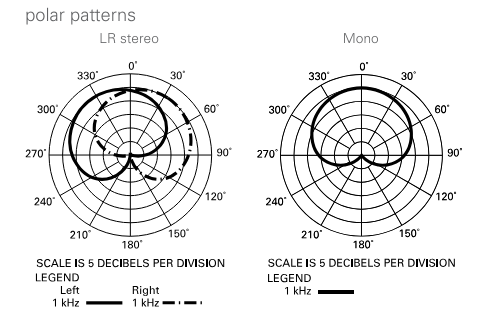
There are a few camera-mount mics around like the AT8024, which combine a mono cardioid mic with a mid-side mic and are switchable between mono and stereo - https://www.audio-technica.com/en-us/at8024 (I've never used it so no idea what the sound quality is like). That will plug directly into the 3.5mm mic jack on the camera if you want to keep things as light/small/simple as possible. As an alternative, if you can take two mics, I'd be tempted to take maybe a stereo Rode Stereo VideoMic Pro for the 'ambient sound' situations, plus a mono Rode VideoMic NTG for when you need a more directional, more focused mic. Both will plug directly into the camera and are lightweight (about 100g each), not huge and not too expensive. Again, I've not used either mic so can't comment on the sound quality. If you're going to be recording outdoors a lot, make sure you have decent furry windshields/windsocks for the mics - you'll definitely need them at some point...

-
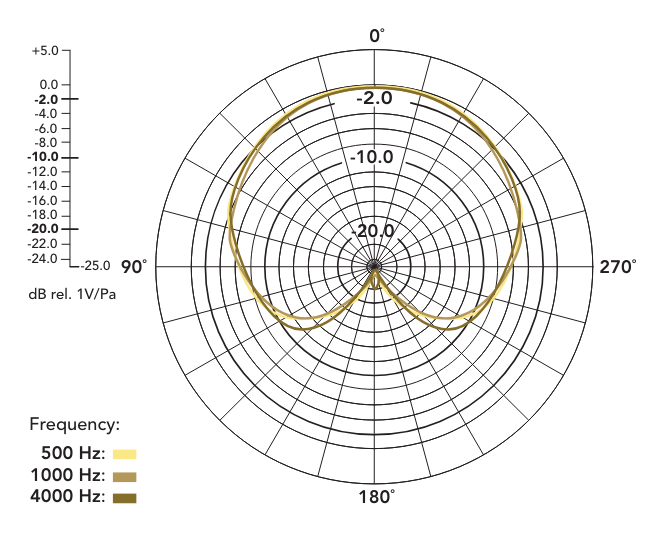
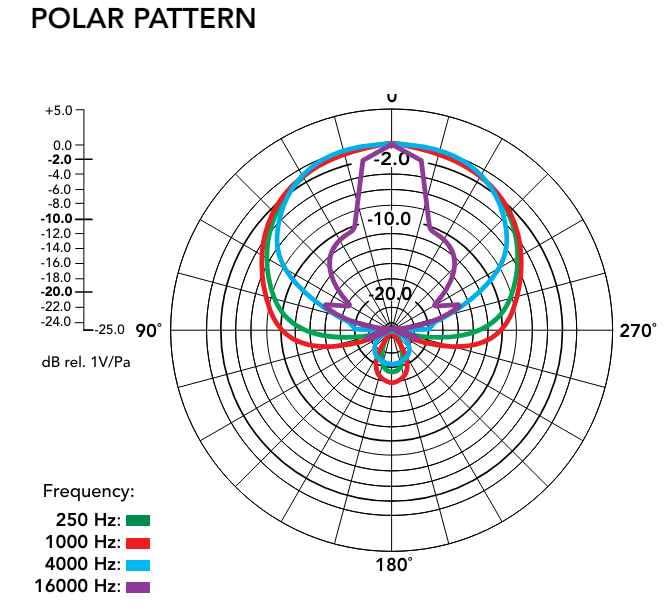
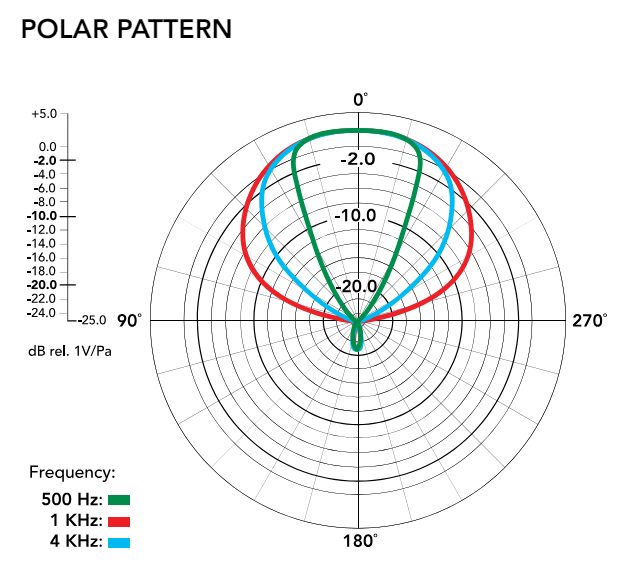
The equivalent of lens 'focal length' for microphones is their 'polar pattern, which their sensitivity to sound versus the angle relative to the direction the mic is pointed. Below is the polar pattern diagram for the stereo Rode VideoMic-X that you mentioned in the first post. The front of the mic is at the 0 degree position, the rear at 180 degrees. It will respond to sound (to some extent) over a range of +/- 120 degrees relative to the forward direction. It is most sensitive to sounds over around a +/- 60 degree range. Because of its polar pattern and because it's a stereo mic, IMHO it and other stereo mics are good choice if you want to record a general ambient stereo sound field. The recording if played back on a normal stereo loudspeaker setup should recreate the original sound field reasonably well, and you'll be able to locate the individual sound sources within the sound field. If you are trying to record (for example) one person speaking and need to exclude as much of the ambient sound from the sides and rear as possible, you would probably choose a mono mic with narrower polar pattern like a super-cardioid/hyper-cardioid/short shotgun mic e.g. the Rode NTG4 below: ...or a more extreme 'long shotgun' mic like the Rode NTG8, with a much narrower polar pattern:
-
...as was the new 20MP sensor, 4k 50p/60p video support and great oversampled FHD (which looked almost as good as 4k). And not forgetting internal 4:2:2 video recording. A well-rounded hybrid camera and reliable video workhorse, for me the GH5 is easily the most significant GH series camera since the GH2. Even 7 years after its launch they still fetch decent prices used - probably because they are good, get-the-job-done tools. The GH6 & GH7 are improved versions of the same basic idea, but it was the GH5 that pretty much defined the video-oriented hybrid with IBIS concept, not just for Panasonic but for the other manufacturers subsequent models targeted at the same market.
-
I own the E-M1 iii and OM-1. C4K (DCI 4k) on the E-M1 iii is the best quality video mode, 8-bit 237Mbs H.264, but it's 24.00p only. The UHD 4k modes are softer and lower bitrate (and are 25p and 29.97p only, no 24.00p). AFAIK the video quality on the E-M1X is the same. Video sensor-shift IBIS on E-M1 iii is excellent and is adjustable in strength ( -1/0/+1). The +1 setting is almost tripod-like if you hold the camera still, but can be panned slowly without noticeable jerkiness at wide to normal focal lengths. Adding digital IS improves stability quite a lot but adds an extra crop and degrades picture quality a little. OM-1 has better video quality all-round - FHD/UHD/C4K 10-bit H.265 4:2:0 in OMLog400 or HLG at 23.98/25/29.97/50/59.94p (plus 24.00p in C4K only). IMHO the video IBIS is pretty much the same/a bit better than on the E-M1 iii. Also has very low rolling shutter (< 10ms) due to fast stacked sensor and a lovely 5.76Mp EVF. Note that you can't adjust the sharpening in the Flat, Log or HLG picture profiles, and on the OM-1 you can't use the standard (photo) profiles in 10-bit mode, only in 8-bit mode. I can't compare the OM-1 to the GH6 or GH7, but compared to my (original) Pana G9 it's swings and roundabouts - G9 supports 10-bit 4:2:2 video, but OM-1 has better EVF, IBIS, ergonomics and battery life (and better audio from built-in mics). For my uses, that makes the OM-1 a better all-round video camera. (The best stabilisation I've ever used is the OM-1 with the 12-100mm F4 pro lens - that combo uses Sync-IS, combining lens OIS with IBIS).
-
Normally, on a 16:9 screen - thin black bars top & bottom, on 16:10 screen - thicker bars top & bottom, on 21:9 screen - bars on left & right sides.
- 1 reply
-
- 2
-

-

-
If you using an 8mm lens on your GH5, it will be the equivalent of about an 11mm lens on the GH7 in DCI 4k RAW mode. Open Gate 5.7k RAW will have the same FOV as there is no extra crop in that mode (so an 8mm lens will still be 8mm).
-
If it's got a 'dynamic range compression' transfer curve like Vlog-L applied, how is it still raw sensor data?
-
DPreview initial review - https://www.dpreview.com/reviews/panasonic-gh7-initial-review
-
You seem to know better than Panasonic how long it takes to develop, produce prototypes, debug/refine/test/certify, then make pre-production units, then an initial production batch and then gear up for full production - so why don't you enlighten us? (I've worked as an electronics design engineer for 40+ years, so I have some idea of development timescales) Maybe - they'll likely do whatever they think will make them the most money overall/minimise any losses - it's a business with shareholders to keep happy and employees to pay... Nothing bad about that - it's what companies do all the time. Car makers are past-masters at 'parts bin' design, it spreads the base 'platform' development costs across more vehicles and means they have different models to target different parts of the market. How many variants of the same generation of iPhone do Apple sell? I suspect persuading Panasonic higher management to fund the considerable development costs of a new, higher performance, 4/3 sensor for m43 cameras like the GH6/G9 ii/GH7 was quite difficult (versus probably just abandoning any serious m43 camera development). We just have to hope it works out in the long run for the future of Panasonics camera division.
-
Would you prefer they spent a lot of time and money on a new body design and designing a new sensor, delaying the camera and having to charge a lot more money for it? Personally I think they've done exactly what they should have done - merge the best parts of the GH6 with the best parts of the G9 ii, to create what's hopefully going to be the best pro-video orientated micro43 hybrid camera ever.
-
Latest 'spec' update on 43rumors.com (apply usual skepticism etc.) - note 'Prores internal Raw recording' is listed:
-
There are some reasonably compact L-mount Sigma wide primes around e.g. 17mm f4, 20mm f2, 24mm f3.5 and 35mm f2. The 17mm f4 and 24mm f3.5 are about 49mm long (and have aperture control rings). The f2 lenses are around 70mm long. But realistically, for most people, the upcoming 18-40mm collapsible zoom is the lens the S9 needs (and should have had available at launch), with the existing (larger) 20-60mm zoom the next best alternative.
-
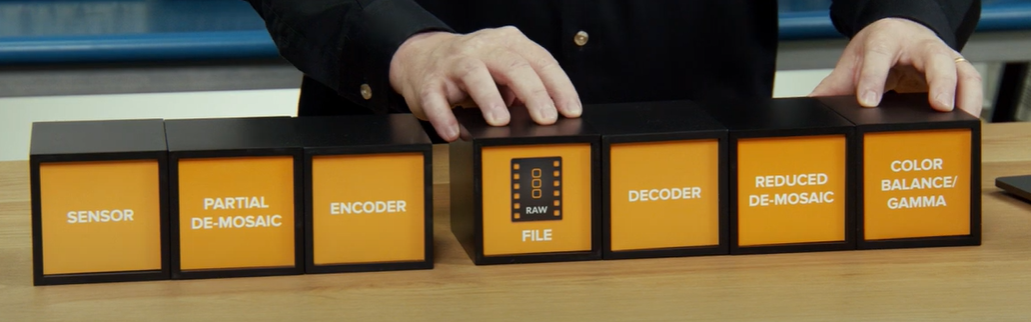
I think the the RED patents cover only compressed RAW in-camera recording, so using an external RAW recorder does not infringe them. Blackmagic RAW is partly de-mosaiced, color space converted and processed before compression, so is a bit 'grey area' as to whether it's really raw anyway in the file. But the point is that it's designed to provide what you might call 'raw equivalent' post-processing flexibility. From a YT video about BM RAW (the three processing blocks on the left are in-camera): A Blackmagic RAW patent - https://patentimages.storage.googleapis.com/71/7a/bb/ae23088049e011/US20180367775A1.pdf - and the abstract from it:
-
I think that too, but I suspect Panasonic decided that it was more important to launch the S9 now (to some extent to ride the X100VI wave and pick up some sales from people who can't wait for one of those). The 26mm pancake feels to me like a 'we gotta have a really small lens, in a hurry, to sell or give away with the S9' rushed product - otherwise why would it be manual focus, given the target market? If it had been maybe F4 with AF, even if that meant it was a bit longer, I suspect the S9 launch YT videos might have been generally much more positive.
-
Good news - something else I'd expect to be rolled out to the S5ii/iix in due course.
-
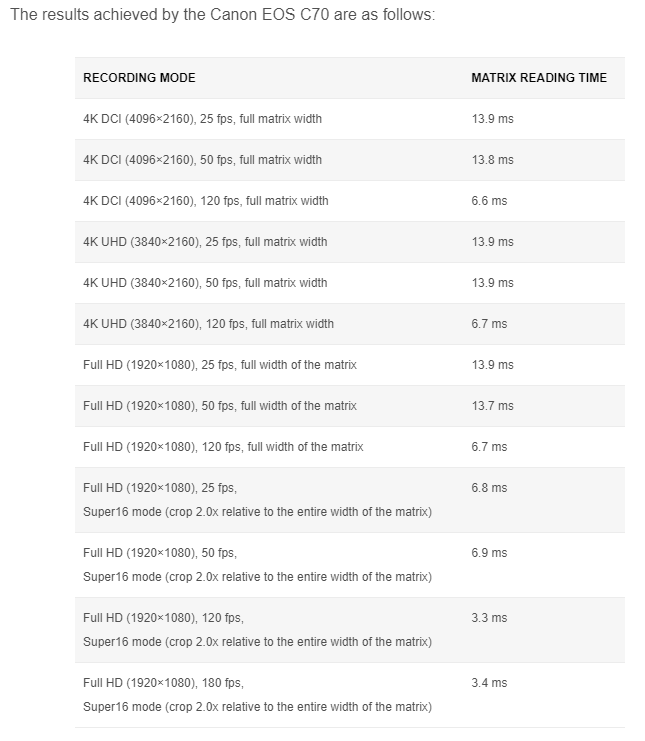
C70 rolling shutter numbers from: https://www.optyczne.pl/48.4-Inne_testy-Canon_EOS_C70_-_test_kamery_Jakość_obrazu.html . 'Matrix' = Sensor (Google translation confusion...) There's also some DR tests towards the bottom of this page - https://www.optyczne.pl/48.3-Inne_testy-Canon_EOS_C70_-_test_kamery_Użytkowanie.html