All Activity
- Past hour
-
https://drive.google.com/drive/folders/1ayD92_55eZom1FTxYGxE6KA_fnjkNwHn
- Today
-
It’s not even close.
-
 Ilkka Nissila reacted to a post in a topic:
Interesting Breakdown Of Arri Colour Science
Ilkka Nissila reacted to a post in a topic:
Interesting Breakdown Of Arri Colour Science
-
Yeah, nice images! What I have learned in all my research is that there are tiny little sweet-spots in every aspect of the image. People lust after OLPF filters with just the right amount of softening, people marvel at skin tones with just the right amount of compression and hue manipulation, or lenses with just the right amount of distortion. Each of these imperfections / distortions / non-linearities has a certain feeling and aesthetic and comes with a range of associations. Combinations of these will have synergies, or won't, or will clash by pulling in different directions. When we moved from cameras that shot in the publishing resolution and recorded colour in the publishing colour space and gamma to cameras that had higher resolutions and log colour spaces etc, we went from looking at the image that professional imaging scientists tuned into a final commercial product to taking an image that was designed to be manipulated and then applying our own (likely far less skilful) texture, colour, contrast, etc. It's taken me a good decade to start reliably getting images I like, and even then, I'm using a film emulation plugin that is doing most of the heavy lifting.
-
Any used camera suggestions for under $400 for YouTube?
fuzzynormal replied to srgkonev's topic in Cameras
All that's true, but, honestly, I just always liked the image coming out of the GX7 better than the GH5. One's 1080 one's 4k, but ... something about that GX7 sensor. It's a damn old camera and this is a tangent from the OP, but did anybody ever figure out what was the secret sauce from that era of M43 LUMIX? I don''t think I imagined it. 😉 I mean, I look at stuff I did over a decade ago and still think, "shoot, that particular 1080 has a certain quality I like better than things I've done recently." For instance, from 2014: -
Not quite. It's announced, but not available yet, last I checked - unless the latest Resolve 21 beta included it. Though if there's really something to inclusion of additional near-infrared wavelengths making the subtle difference for skin tones is true and if BMD's ir cut filter removes that wavelength, there would always be at least some difference. That said, a lot of the way that guy describes things remind me of someone explaining why they think their $4,000 toslink cable is giving richer midtones than someone else's $30 toslink cable. There seems to be a mix of some genuine understanding of things mixed in with pseudo-scientific bullshit. Regardless, even if were all 100% true and based in pure science, a decent colorist is a big equalizer for a bunch of differences in the SOOC image. 😅
-
 gabriels82 joined the community
 -
Looking at the bigger picture the current lead that ARRI has in this field can be eroded over the next few years by other camera manufacturers.As an example Black Magic is already up to Generation 6 color science and each generation is a step better than the last
-
100%. ......and if you switch the question from "is it visible" to "is it important for the content of the video" the answer gets even clearer!
-
kye reacted to a post in a topic:
Any used camera suggestions for under $400 for YouTube?
-
Just thinking more about this, in a studio setup where everything is controlled the 'weaknesses' of older cameras often cease to be important or even relevant. IBIS doesn't matter, DR is irrelevant as you can just adjust lighting, size and weight don't matter, AF doesn't matter (and isn't desirable as the last thing you want is it focusing on your hands and the background whenever you move around), etc etc.
-

Any used camera suggestions for under $400 for YouTube?
newfoundmass replied to srgkonev's topic in Cameras
4K is nice, but I still insist that most of us aren't watching on screens big enough to really get the full benefit of it. I can see very little difference on my 55-inch 4K TV between 1080p and 4K, except on YouTube, but that's because of the significant bitrate bump YouTube's 4K has over its 1080p. That's another reason to upload in 4K instead of 1080p even if you film in 1080p. When watching Blu-rays, though, the difference is almost non-existent unless you literally walk right up to the TV and are a few inches away from it. Now imagine how little difference there is when watching on your phone or a tablet! -
newfoundmass reacted to a post in a topic:
Any used camera suggestions for under $400 for YouTube?
- Yesterday
-
To add to the above, Matti Haapoja (perhaps the king of pixel peeping "cinematic" YT) uploaded a bunch of videos that were edited in 1080p (and upscaled to 4K for export) and he tracked all the comments and not a single person commented that the videos looked different or whatever. In a blind real-world test literally not one of the pixel-peeping techno-fetishist pedants could tell. Of course you'd still want a good 1080p image, some 1080p cameras were better than others. The added bonus of this approach is you only need 25% of the computing power to edit it. Or if you go with h264 instead of h265 then it's even less!
-
How interesting. I guess something like that would be very difficult to determine for cinematographers etc, but if you're a lens manufacturer with all the test equipment then buying all your competitors lenses and then testing them and taking them apart would be pretty standard operating procedure.
-
kye reacted to a post in a topic:
Interesting Breakdown Of Arri Colour Science
-
There's a touch of gate weave in there, but I can definitely increase it. I was surprised about the grain actually. The amount I had dialled in was about 0.16 and I uploaded a test sequence that had 0.1 / 0.2 / 0.3 / 0.4 and the 0.2 was clearly far too much, so the above was just 0.1 as I figured if it's too little then it would be similar to when people upload and YT compresses it a lot and removes most of the grain. I guess there's two approaches.. The first is to make it look like film in the NLE and then upload it and YT will remove lots of grain but it will look like real film uploaded and processed by YT. The second is to do whatever you have to do in the NLE to make the final YT stream look like film. The more I look at my references the more I realise there is incredibly variation between them and that I have tonnes of leeway.
-
kye reacted to a post in a topic:
The GX85 "Super-16" project
-
Cosimo reacted to a post in a topic:
Any used camera suggestions for under $400 for YouTube?
-
Any used camera suggestions for under $400 for YouTube?
fuzzynormal replied to srgkonev's topic in Cameras
I contend that the old GX7 looks better than a GH5. -
It's really good. I'll have to watch a few times again to analyze more but my first impression is that this type amount of grain I associate with the 1970s and the cameras used back then for 16mm had some gate weave. Maybe try a touch of that and see.
-
Any used camera suggestions for under $400 for YouTube?
newfoundmass replied to srgkonev's topic in Cameras
Yeah, honestly anything that has come out in the last 10 or so years is more than good enough for YouTube. Even if it shoots 1080p, if you edit and export in 4K it will look great. My nephew has started a small little vlog with my old GH3. That's a 14 year old camera with really good 1080p and it looks great still. He likes using a "real" camera, so that's why he uses it over his iPhone, but he could definitely get away with using just his phone. -
newfoundmass reacted to a post in a topic:
Any used camera suggestions for under $400 for YouTube?
-
Some of Nikon's portrait F mount lenses do the same. They deliberately let the red light doesn't hit the same plane as blue/green. As like not-much-corrected glasses of the old days. So red is a bit out of focus. Very very tiny amount. Tho that amount changes with focus distance. They usually optimize for portrait distances. They abandoned that approach with Z mount lenses.
-
eatstoomuchjam reacted to a post in a topic:
The GX85 "Super-16" project
-
kye reacted to a post in a topic:
Smartphone Accessories
-
Aussie Ash reacted to a post in a topic:
Any used camera suggestions for under $400 for YouTube?
-
A compact SSD and a good USB-C hub have probably been the most useful smartphone accessories for me lately, especially for video work. Small things, but they make the whole setup feel way more practical.
-
OK, now I get it. There's this one, the PRO, and then the ILS which has interchangeable lenses. I'm waiting to see what that one is like. I love me some lenses!
-
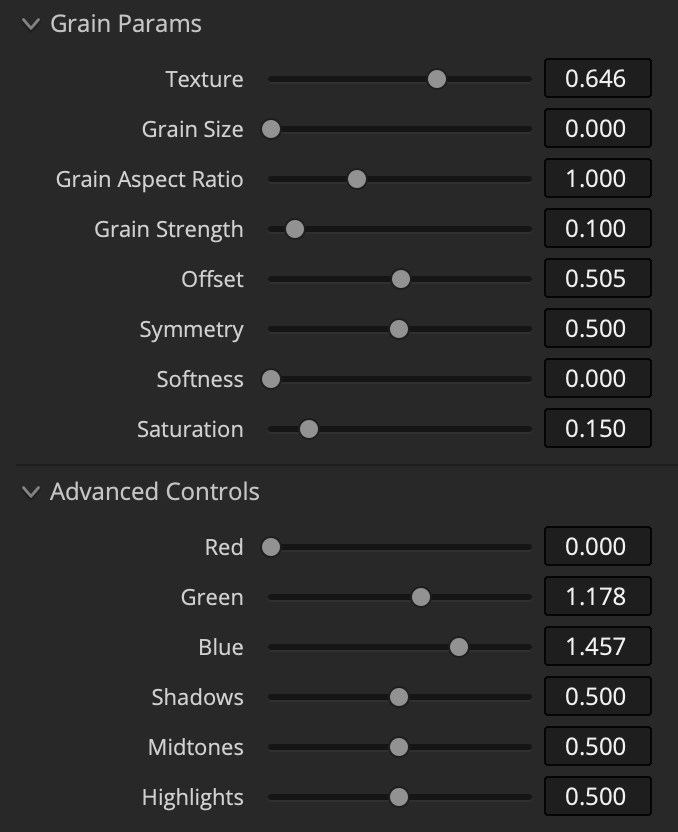
Round 4. Changes: Included lens emulation Stabilised shots Lowered grain I completely rebuilt the grain nodes in a different OFX trying to refine it, then realised it didn't animate. FML. The lens emulation includes adding a vignette, softening the edges, and adding a slight barrel distortion. The grain seems a lot on certain things (like the sky) but doesn't appear at all on other things. I see no pattern for it, but this is how real S16 films also appear on YT so I'll leave it to the judgement of those with a better eye than me. These are my settings for Film Grain OFX - it appears there's quite some adjustments, so let me know if I should play with anything...

- Last week
-
Any used camera suggestions for under $400 for YouTube?
fuzzynormal replied to srgkonev's topic in Cameras
I bought a used Em10iii over 5 years ago for $300 and haven't stopped using it since. Nice 4K video and you can put good vintage lenses on it for next to nuthin'. Yes, concentrate on lighting and getting a good mic (I use a Tascam DR10L) but do know there are a lot of good affordable cameras out there too. I also have 2 old GH4's in the cabinet. They're cheap as well. -
One of our favourites ones among us over here... LOL oh boy : D ...has just spoken:
-
Any used camera suggestions for under $400 for YouTube?
newfoundmass replied to srgkonev's topic in Cameras
These days the camera is the least imporant thing, since we all own phones that shoot very good video with the right lighting. Something like this might be useful, to help you frame yourself so you can use your main cameras instead of the selfie camera on your phone. https://www.smallrig.com/Wireless-Video-Monitor-for-Phone-Vlog-Kit-4851.html?skuId=1902205216988602369&utm_source=google&utm_medium=shopping&utm_campaign={us_roasl}&utm_content&utm_term=1902205216988602369&gad_source=1&gad_campaignid=22986129310&gbraid=0AAAAA9ksdxlR0rKJm8KPUZEfnds4FA25H&gclid=CjwKCAjwidXQBhAZEiwA4egw6IMJP7OXRfSob5wBL8w-tVSe1oUTWPIYilNm1fLnTWsIBMzdbzi5RRoCELoQAvD_BwE -
Very interesting. I've been looking into this for a long time and hadn't heard some of these insights. Very useful. One thing he got wrong, at least for v3 of their colour science is that there isn't anything luma-specific done to the image inside the camera, it's all done in the LUT. The evidence for this is when people do under/over tests, where the camera is deliberately under and over exposed, when you correct the image in post to the correct exposure the colours are all the same. If they were warming the highlights or cooling the shadows in-camera then when you overexposed and brought the exposure down in post then that warmth would be baked-in and your mid-tones would be warm (or they'd be cooler if you underexposed) but that's not what we see. It's also no secret that they compress the skin-tone hue range and also tend to skew yellow, especially compared to Canon which skews magenta/red. The IR-cut filter letting in a bit of far-red so the skin-tones get that scattering is interesting. To a certain extent it might be 'recoverable' in post (ie, perhaps we can guess what might have been there based on what info we do have). Perhaps the key aspect of any such attempts would be to blur this new channel once it's been simulated, as this is the information coming from deeper in the skin and is scattered a bit. It's been hinted at that part of the 'Cooke Look' was that they used materials that slightly blurred light at a range of frequencies within skin tones, so the lenses sort-of worked like a skin-hue-only diffusion filter. Potentially anyone with a full-spectrum camera (OG BMPCC BMMC anyone?) could seek out IR-cut filters that are designed to let in more far-red. Potentially even people with IR-cut filters on their sensors could get strong ND filters to boost the relative proportion of IR coming into the camera. I'm guessing that the right amount of the right ND might do it - have enough ND that the IR is boosted but not so much that the blacks become polluted. It's funny he mentioned that the iPhone has a strong IR-cut filter - I was testing my iPhone 17 Pro the other day with lots of ND (because it doesn't have an iris!) and I got a ton of IR pollution, including getting a non-trivial amount of it when using the same vND I use on my GH7 which I've never seen any IR pollution on. So the iPhone must have less IR filtration than the GH7. It's worth adding that a lot of these things are also accomplished by film emulation.
-
The previous comparing with this one is pure crap. :- )
-
thanks guys! Really appreciate the answers! Yeah, I'll probably will focus on getting mic and lighting setups firsts