



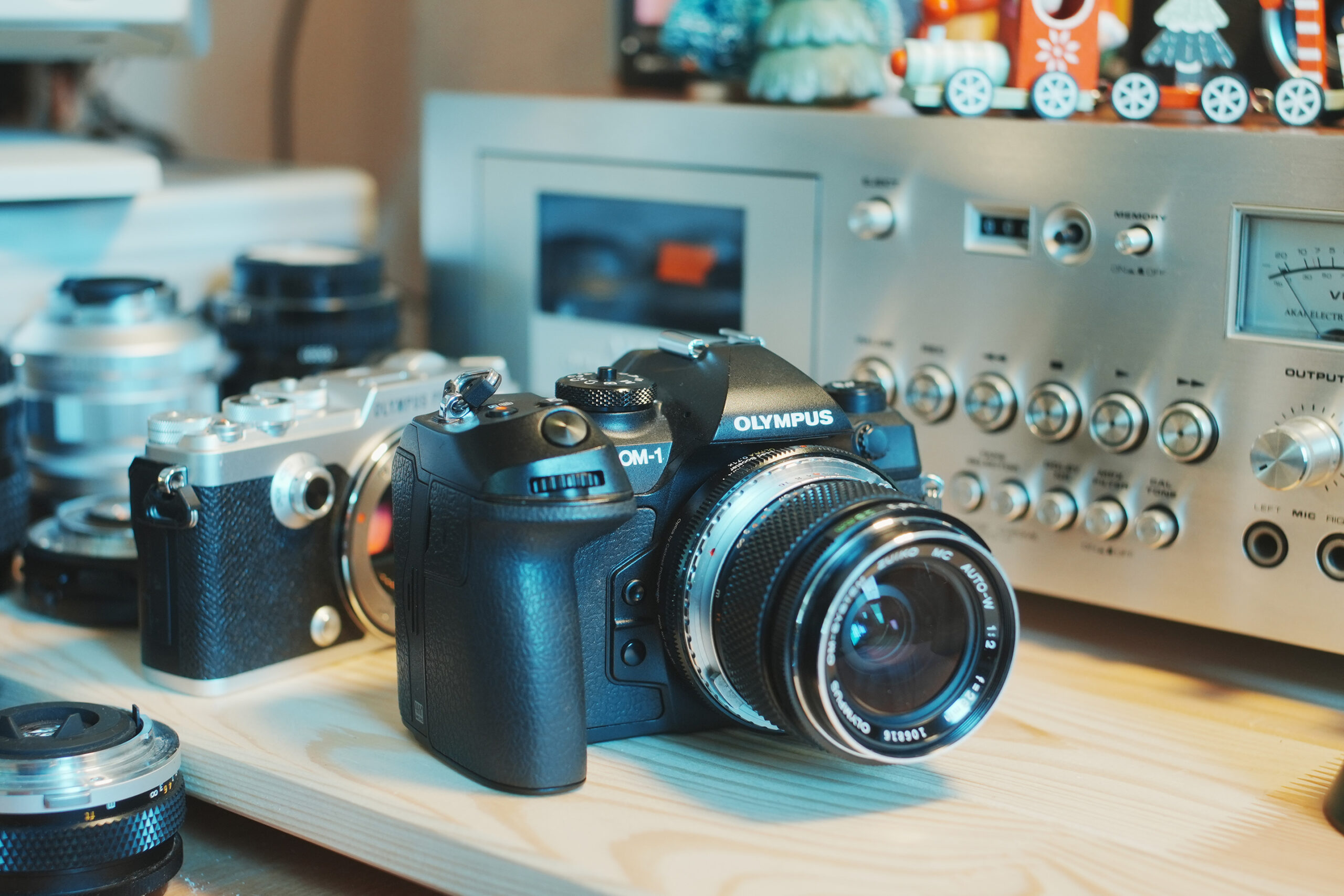
Olympus never gave us a digital full frame camera. It’s one of the biggest regrets of the camera industry. However they did leave us with this… the final Olympus Micro Four Thirds camera.
I have just fitted a Metabones Speed Booster with Olympus OM SLR lenses to my OM-1, be it video or stills, this camera is not just underrated but a powerhouse of good design and good images.
Here is my tribute to the final camera to bear the Olympus badge.
I have two Metabones Speed Boosters with Canon EF mount.
Turns out EF is a good choice. All of Olympus OM SLR lenses, M42, Nikon F and Contax Yashica adapt to EOS although I do miss my Minolta MD and Canon FD lenses on this adapter, the look of the OM lenses on this is fantastic. Caldwell Optics + some of the best vintage Japanese glass ever made.
The Metabones adapters are a tight fit on the OM-1. Be sure to apply protective tape below the EVF on the lens mount side as the thick barrel of the adapter scrapes flush with the camera housing when attaching. Once it’s on though, you get to keep it there – and have your pick of a range of vintage lenses that knock the sterile modern stuff for six.
The OM-1 appears to automatically detect the focal length of adapted manual focus vintage lenses. It doesn’t have the usual entry in the menus to add a focal length for a non-CPU lens like on Panasonic, Sony or Nikon cameras. At least I haven’t found it.
Either way, it works extremely well.
Let me make this clear… the OM-1 still in 2025 has the best IBIS on the market.
It has a much better EVF than the previous Olympus flagship, the E-M1X – although the latter handles like a mini pro DSLR or Canon 1D, which in itself is rather nice. You’ll also notice a design nod to the first Pentax full frame prototype DSLR of 2000, which was never released – just like the Olympus digital full frame camera.
The ergonomics of the OM-1 are truly exceptional. Although it’s an incredibly small camera it doesn’t handle like one somehow.
Do you know that feeling when using a camera, of a workspace? The camera is your office. You sit at the work desk of the Canon EOS R5 for example and it is smooth, slick and professional, it feels optimised and refined, but lacks that extra bit of interest or charm. The workspace of the OM-1 is tactile, smooth, deeply immersive, responsive and actually rather charming too.
This compares better than any other Micro Four Thirds camera ever made. The Olympus PEN-F digital for example although it looks pretty, has a workspace which is stiffer, slower, cheaper and more consumer. The E-M1 II and E-M1X feel more dated, especially the menus. The Panasonic GH6 has a workspace that is direct, utilitarian, but too computer-like and not really quite ‘camera’ enough whereas the OM-1 nails every aspect of what it’s like to shoot with.
The OM lenses are a perfect match for it too.
In the analogue OM days, the Zuiko OM System glass was all very well regarded for small size and superb optics. Maybe not the last word in sharpness but all had character and a nice look wide open, with very good colour and contrast. The mounting system is excellent and the OM to EOS adapters feel better made than, say, Contax Yashica mount to EOS. The locking pins are on the side of the OM lens barrel so the thin adapter doesn’t need to do much. No fiddly latch or locking lever required.
There is however a rather nice little lever on the back of the OM-1 can be configured to switch instantly between stills and video mode.
The 10bit footage in OM-LOG is a bit sharper than the 8bit material, but you can only use the Olympus colour styles in 8bit H.264. For 10bit H.265 the options are only OM-LOG and Hybrid LOG Gamma. DCI 4K up to 60fps with no crop from a stacked sensor rounds out a very capable filmmaking spec.
For stills the Olympus colour is superb and really satisfying to shoot with, it nails white balance every time as well.
So to the 0.71x Speed Booster, and my OM 28mm F2.0 becomes a 20mm F1.4, and the sensor is a 2x crop – so you end up with a 40mm field of view 35mm equivalent. This is pretty versatile and you have less distortion and sharper corners than with this same lens on full frame. My OM 24mm F2.0 becomes a 35mm equivalent wide angle (math is 24*0.71 = 17mm * 2 = 34 mm).
You can also get an 0.64x Speed Booster from Metabones but I don’t recommend using it with the OM-1. It fits my Panasonic GH5S but the optics go very far into the lens mount, the risk of hitting the shutter casing is pretty much 100% with the OM-1, so the 0.71x adapter is the sweet spot.
Speaking of the GH5S…
This has a larger than Micro Four Thirds sensor, it’s wider. The crop factor is 1.86x. So combined with the even wider 0.64x Speed Booster XL adapter, you’re getting very close to full frame on this, and the low light performance is just incredible with it.
24mm * 0.64 = 15.36 mm
Multiply that by the 1.86x crop factor and you get a 28mm equivalent. Therefore the GH5S can be made to perform like an APS-H 1.3x crop sensor camera!
The gain in aperture is significant too, an F1.2 lens turns into an F0.76.
If this doesn’t give you a sign that there’s still a future for the Micro Four Thirds format, I don’t know what will. There are times when I do find myself shooting more creatively with a camera like the OM-1 or GH5S than something like the usual Sony a7 series, or Canon EOS R mount camera.
And there is definitely a size and weight difference, with Micro Four Thirds telephoto lenses that difference is even more.
So hats off to Olympus. It’s a beautiful camera. Your engineers didn’t deserve the P45 you so cruelly handed out to cut a few 0.1% costs off your annual expenses.
This is what happens when an accountant turns gatekeeper of the arts and of engineering.
Sad isn’t it?
