



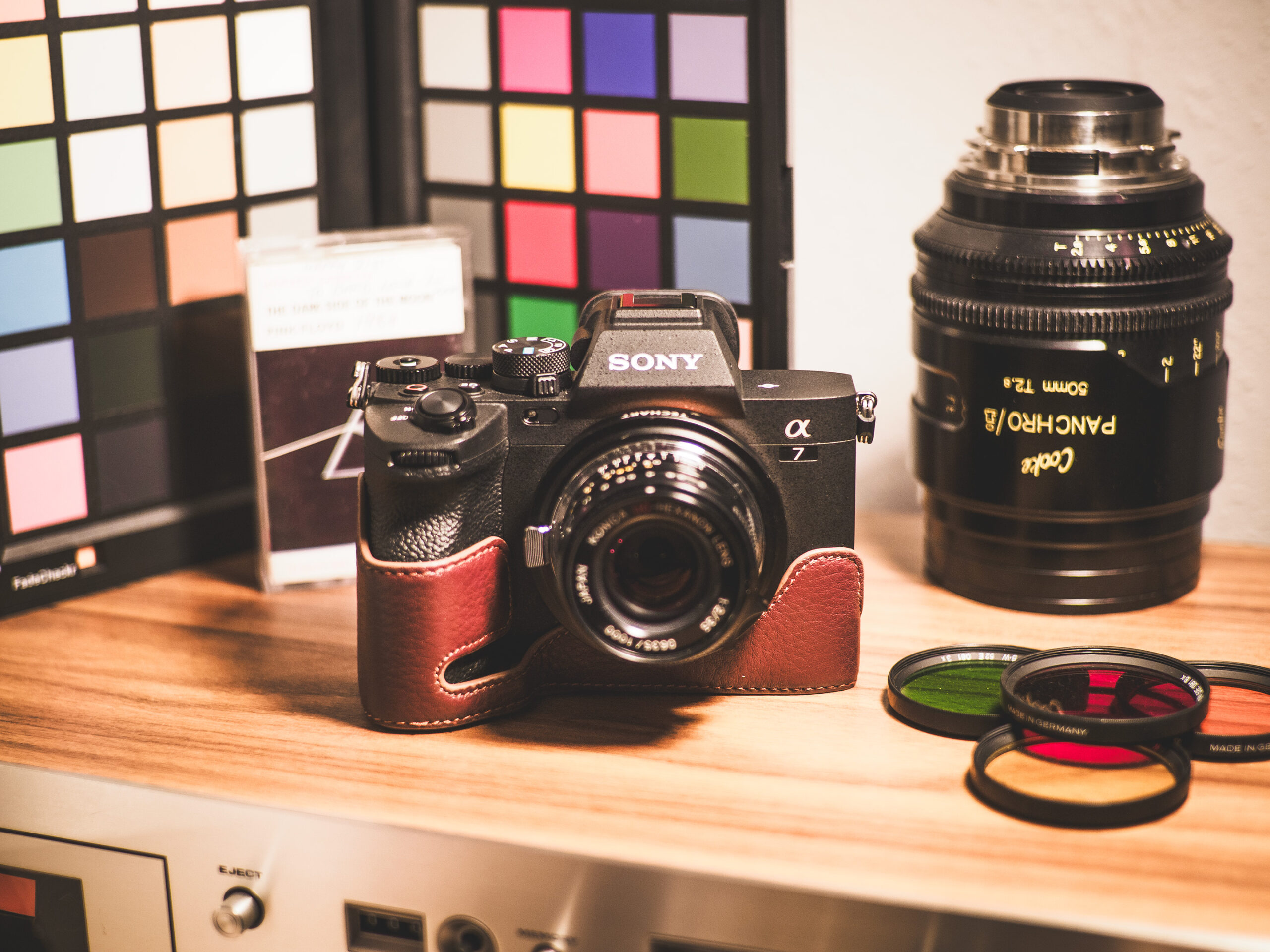
With the Sony a7s IV nowhere to be seen, and a Sony FX2 with disappointing specs and an old sensor, Sony’s failure to go fully-in on video features have left users in the lurch. Now, with rival cameras like the Nikon Zr and Canon EOS R6 III offering so much more than an a7 V, for less money, Sony is building the perception that hybrid users and video shooters shouldn’t choose a Sony mirrorless camera.
From my personal point of view the Sony a7v is a very capable camera, but it in recent days the new model has become somewhat infamous and the target for a lot of disappointment from video users.
The competition has not just overtaken, it’s undercut on price.
Sony will hate this, the hybrid video/stills market is very important and Sony pioneered it, overtaking the previous leaders Canon (in the DSLR era) and Panasonic. Now the others (especially Nikon) are fighting back.
Now I’m not suggesting Sony is afraid of Panasonic grabbing all their video users, but they should be worried about what Canon and Nikon are doing.
Canon lost the crown back in the DSLR days and then decided to get those users back, starting with the EOS R5 which blew other cameras away for video specs only to prove itself to be completely defective in the field. Canon decided to un-cripple it with subsequent firmware updates for longer operation times. Ever since then Canon have been full-on chasing hybrid shooters, at all price ranges starting with the cheap EOS R50V, all the way to the Cinema EOS C50. Inbetween there is the R6 Mark III which shoots 7K Canon RAW internally with an Open Gate mode, for $2799. An aggressive move, that Sony didn’t seem to see coming.
Then there’s the Nikon Z6 Mark III for $2096 and the Nikon Zr, just $2196. These are the current best-bang-for-buck cameras, taking the limelight away from Panasonic. Sony is trying to get $2899 for something which is comprehensively worse for video than these cameras. The a7v counts on people being photography-first, and locked into the mount. Both of Nikon’s cameras shoot 6K RAW, and the Zr benefits from the purchase of RED being the first mirrorless camera to shoot REDcode raw.
And it is not just the headline resolution and raw capabilities lacking at Sony, the other missing video features are really starting to add up.
- The Canon EOS R6 III for example doesn’t need to crop in 4K/120p.
- The Nikon Zr has a larger than 3.2″ display, at 4 inches, and it makes a significant difference.
- Taking a leaf out of Panasonic’s book with the GH7, the Nikon Zf has 32bit float audio support.
- Both the R6 III and Zr have open gate modes.
- The Panasonic S1R II and S1 II have anamorphic de-squeeze and multiple recording aspect ratios like 3:2 and 4:3.
- The Panasonic cameras also have the best LUT support, and Realtime LUTs allow custom 10bit colour science to be baked into both video recordings and photos.
- Cine EI is available on the Nikon Zr in REDcode raw.
- 60fps is available without a crop in 6K and in 7K on the Nikon and Canon cameras, whereas most of the Sony cameras even the flagship a1 are only able to max out at 4K in 60fps and on many models this is less detailed pixel-binning mode rather than a full pixel readout.
- There’s more shooting aids on the Canon, Nikon and Panasonic side too, like waveform monitoring.
So Sony find themselves in a bit of an odd place and that’s before I mention the Sony FX2 sales disaster.
This is a camera that has already put back some of the missing features from the list above. It has the extra shooting aids, the best LUT support of the Sony cameras, many of the features found in the FX3, including anamorphic de-squeeze, Cine EI, and a form factor closer to the Nikon Zr.
The Sony FX2 however has not sold very well, to say the least and that’s because Sony put the old sensor from the a7 IV in it. It can’t even do full frame 4K/60p without a crop and yet is marketed as a modern hybrid camera. It has no anamorphic aspect ratio mode like 3:2 or 4:3, despite having a 2x anamorphic de-squeeze mode for monitoring! It has no Open Gate mode and the maximum resolution is 4K. It has the same middle-of-the-road rolling shutter performance as the 3 year old a7 IV and there is still no internal RAW codec, not even on the Sony a9 III with the global shutter sensor, or the $7000 Sony a1 II – only uncompressed raw via HDMI. To top it off the FX2 has no 120fps in 4K at all, not even a crop – only 1080p (what year is it, 2018?)
The FX2 then, is one of those rare failures from Sony in terms of sales despite the fact I personally actually really like it for my own needs. It’s laudable for being the only mirrorless camera with a cine body that features both a mechanical shutter and articulated EVF (does it think it’s a Panasonic GX9?) whereas the Zr has neither.
So there’s trouble brewing for Sony.
Their direct Nikon Zr competitor the FX2 is in many ways already outdated, more expensive and basically dead on arrival. The lack of sales back that up.
Their Cinema EOS C50 competitor the FX3 has a 6 year old 12 megapixel sensor, no raw codec, no open gate, no 6K, no 7K, no 8K and owes most of its popularity to a feature film.
Their high resolution a7r V is a stills camera with a video mode that has so many asterisk points not even Richard Butler can remember what crop goes where and the rolling shutter in 8K causes even cat videos to wobble.
The eyewateringly expensive a9 III and a1 II have two of the best sensors in the world but neither can be bothered with anything more than 4K, let alone open gate!
And the a7v has disappointed all of Sony’s loyal userbase who wanted better video specs, many of whom will be tempted to get a Nikon Zr or Canon EOS R6 Mark III instead.
There is still no a7s III successor. Much like the Panasonic S1H line, it seems to have vanished off the planet.
Meanwhile they have allowed Nikon to get their hands on the RED raw recording patents, which might explain why there is STILL no Sony internal raw codec to call their own. Sony face paying hefty royalties or doing something like BRAW which is partially debayered in-camera… that is, if they don’t also end up falling foul of Blackmagic’s patent on that!
Then there is Fuji who is making inroads into cinema with the medium format GFX 100 II (my dream camera) and the Eterna cinema camera. With their much less expensive APS-C X-mount bodies, video specs have been a priority for a long time – they have ticked nearly all the boxes including 6K, open gate and currently have the best LOG editing codec – with all flavours of ProRes in the X-H2 and X-H2s even LT for smaller file sizes. Indeed the X-H2 is the best value for money 8K mirrorless camera currently on the market.
So if I were Sony now I’d be a bit worried, despite the fact the a7v still appeals to me, for a few reasons. I set them out here but the summary is that I think Sony E-mount has the best range of third party lenses and adapters, the Leica M autofocus adapter by Techart fulfils my wildest dreams when it comes to vintage lenses, although it’s available for Nikon Z mount as well. I also think that aside from 6K, 7K or 8K, some of the extended video features Sony are missing do appeal to only a niche audience. Does everyone need open gate, more than 4K, internal RAW codecs and a vectorscope? For shooting social media content? Really?
And yet at the same time the perception won’t go away…
That for the first time in many years, Sony are now BEHIND on video.
