All Activity
- Past hour
-
 No, @kye, I do not think they are lying. Where exactly did I write such a thing? ; ) The reference to Andrew’s forum rules was precisely what I called it: a slightly amusing irony. Nothing more than that : ) BTW, one small correction: the result is 16 stops at SNR=2 and 17.2 at SNR=1, not the other way around. The Luna’s supposed 13-stop result is not really a valid 13-stop measurement either. CineD explicitly says that the aggressive NR prevented IMATEST from distinguishing the different patches correctly, thereby invalidating the result. They will not even include those figures in their database. So yes, their test demonstrates very clearly that the current I-Log implementation is seriously problematic. No disagreement there. But charts and real-world footage are two very different things. A chart isolates one particular variable under one very particular set of conditions. It does not shoot a street, a face, movement, changing available light, colour, texture, skin, foliage, fine detail or an actual scene. This is precisely why the comparative footage posted above matters. Objective measurements are useful, of course. But only for as long as they help us evaluate an image rather than begin evaluating it on our behalf. There are limits to everything, including measurable advantages and human perception. Someone worth $1.6 billion is sixteen times richer than someone worth $100 million. A huge objective difference, no doubt. Yet if both go out to buy a pizza, chances are they will end up buying exactly the same pizza ; ) The extra wealth only begins to matter when what they want to do actually requires it. Likewise, an 8K image contains sixteen times as many pixels as a 2K image. Another enormous and objectively measurable difference. Yet once both are projected onto a cinema screen and viewed from a normal seating distance, many people may struggle to tell them apart at all. The additional resolution only becomes meaningful when the screen size, viewing distance and image content actually allow us to see it. And this is especially worth remembering in your case @kye considering how often you have quite rightly defended 1080p as being more than sufficient in the real world... : D More is more. It is not automatically more relevant forever. Four additional stops can obviously be extremely valuable when a particular scene actually requires them. I have never denied that. But a four-stop advantage on a latitude chart does not mean that the resulting image will look four stops better, or even necessarily better at all, in every real-world shot. And this particular latitude comparison was not even entirely like-for-like. The Luna was tested in 8K25 I-Log at around 120 Mbps, while the Pocket’s headline result came from 4K25 D-Log2. CineD did see the same aggressive NR in the Luna’s 4K wide modes, correct, but they did not repeat the complete latitude test in 4K. Nor did they test the standard profiles, which they themselves suggest may currently be the better choice. It is also worth remembering that D-Log2 is only available on the Pocket’s 20mm wide camera. The 60mm module falls back to regular D-Log, where CineD measured 11.6 stops at SNR=2 and 8 stops of exposure latitude. Very good figures, certainly, but substantially more conventional than the headline 20mm result. The digitally extended 120mm view naturally derives from that same 60mm camera too. So even within the Pocket itself, those spectacular D-Log2 figures cannot be extrapolated across the complete 20mm to 120mm shooting range. So the honest conclusion is still that DJI’s 20mm D-Log2 implementation completely and utterly defeats Luna’s current I-Log implementation in this particular laboratory test. That is not the same as saying that one complete camera system completely and utterly defeats the other. Sometimes all the technical blah blah blah is extremely useful. Other times it is worth close to zero and can even contaminate the evaluation, especially once people have already been told which image is supposed to win before they look at the actual footage. At that point, the chart is no longer informing the eye. It is replacing it ; ) Take another look at the real-world comparisons above. The difference is certainly not “complete and utter” there, and in some of those shots the result may even go the other way, depending on what each of us values in an image. So I think we are not very far apart on the measurements themselves. We simply disagree about the amount of territory those measurements allow “completely and utterly” to occupy ; ) E. :- )
 - Today
-
 lipiberkne1973 joined the community
 -
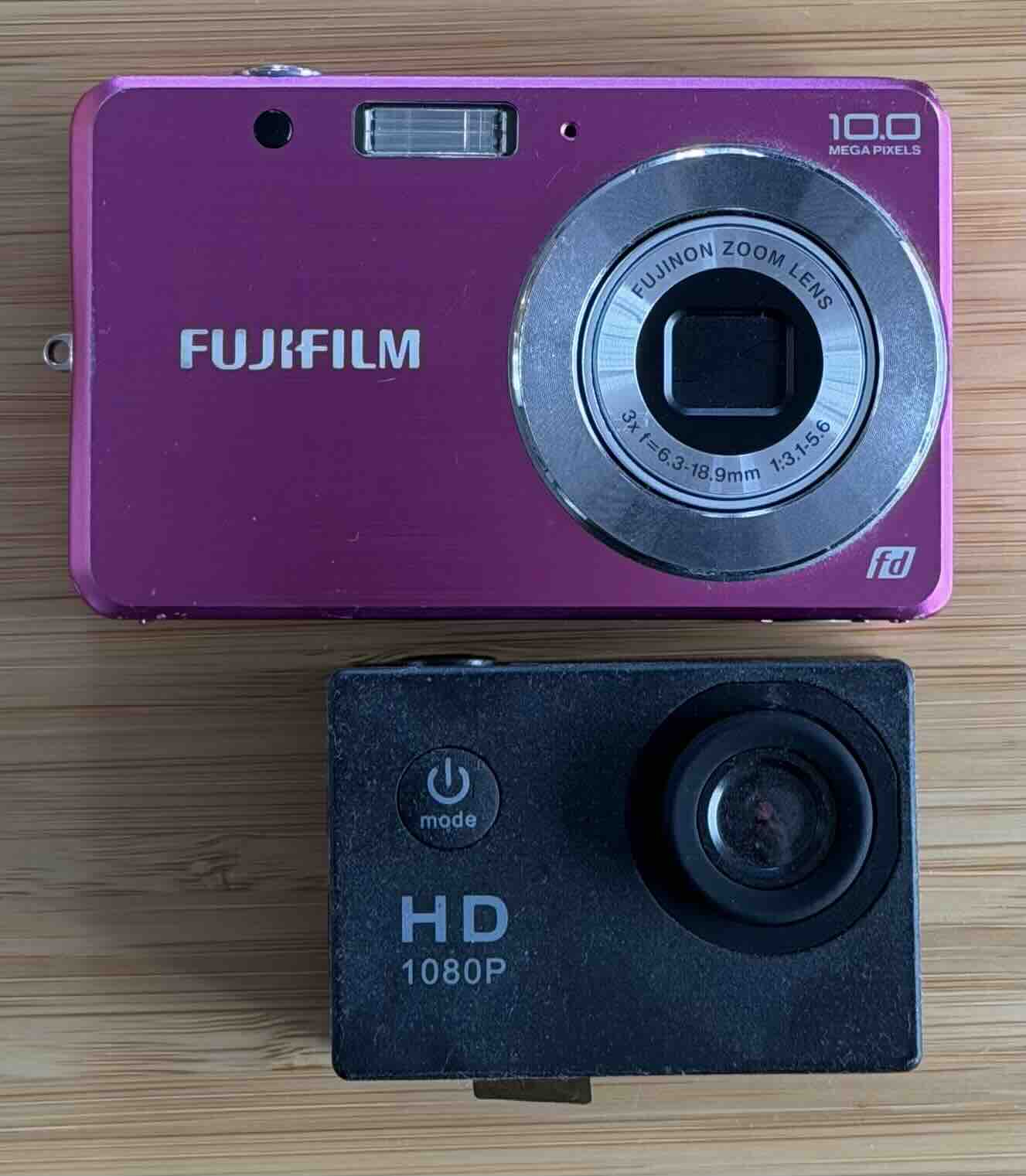
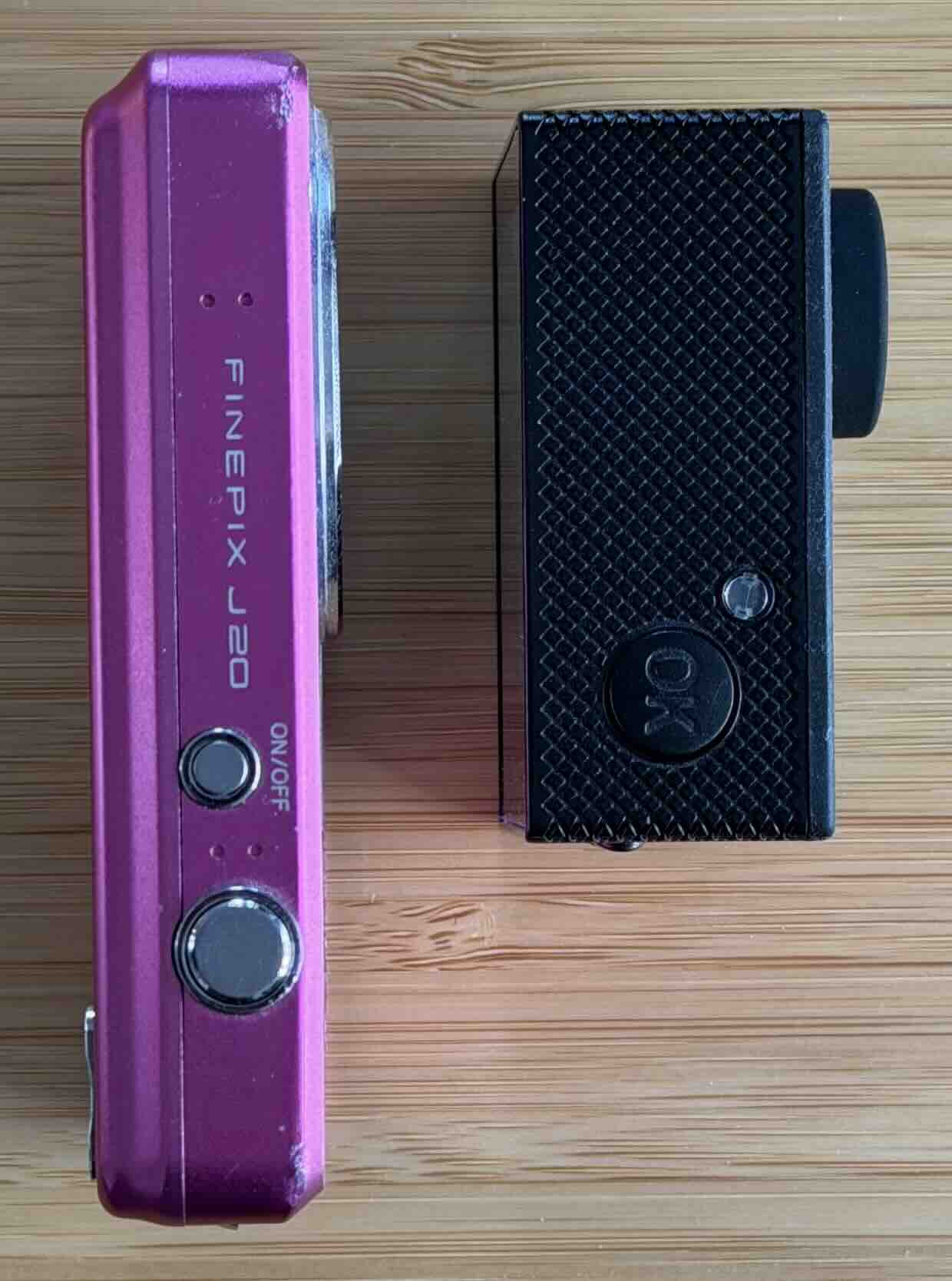
If the camera shoots 4K then you'd be silly not to, and I was really looking for the smallest 1080p camera, not the smallest 4K camera, but I did include a couple for reference so that's my fault for not being clear. I guess really this thread was a bit of a fantasy that I could trade spec for size, but we all know that's not how it works. Even 10 years ago the tech was there to make a camera with a GoPro sized body and a P&S lens on the front. I have one of my daughters old cameras - a Fujifilm J20 from 2009, which is an SD P&S but it's just under 20mm / 0.79 inches thick and has a 3x optical zoom lens. This is the J20 pictured with a fake SJ4000 action camera, which is basically the size of a GoPro. Combine these and they could have make a 1080p camera with 3x optical zoom in a body thinner than a GoPro and by making it slightly wider they could have made room for the battery and given a little grip to hold it with. Given that it might have been a big seller back then, I was hoping they'd be a forgotten classic and around for a couple of hundred, but really it's just a fantasy. The idea is the "smallest 720p or 1080p P&S camera" not the "highest resolution P&S camera". Sensible people don't want the best specifications available in the camera so large they can only just operate it, they want the nicest possible shooting experience with a camera that has the spec they need for their given situation.

-
 aledacca1976 joined the community
 - Yesterday
-
 tourwellwhetsrazz1980 joined the community
 -
It Was Just An Accident (2025) by Jafar Panahi is an amazing film with sequences shot in secret in Tehran...
-
John Cassavetes, enough said:) There used to be some BTS footage and docs on youtube. I think they should be still up there. @QuickHitRecord
-
 PannySVHS reacted to a post in a topic:
Narrative films shot in uncontrolled cities
PannySVHS reacted to a post in a topic:
Narrative films shot in uncontrolled cities
-
PannySVHS reacted to a post in a topic:
Narrative films shot in uncontrolled cities
-
PannySVHS reacted to a post in a topic:
Narrative films shot in uncontrolled cities
-
PannySVHS reacted to a post in a topic:
Narrative films shot in uncontrolled cities
-
PannySVHS reacted to a post in a topic:
Narrative films shot in uncontrolled cities
-
How are battery life, overheating and startup time? @MrSMW Built? Thanks for sharing!
-
PannySVHS reacted to a post in a topic:
LUMIX L10 - announced
-
 PannySVHS reacted to a post in a topic:
LUMIX L10 - announced
PannySVHS reacted to a post in a topic:
LUMIX L10 - announced
-
 lyndellstingy joined the community
 -
2x digital zoom was without artefacts right? 4x has to be aliasing extravaganza though!:) I could test it myself. But then, why not ask a GX afficiando like you!:) I still love mine. Got a second one so I carry two sometimes when doing a phototour. Up for a 2026 8bit challenge btw?:) Would be nice with more than two challengers though of course.:) @kye
-
PannySVHS reacted to a post in a topic:
The GX85 "Super-16" project
-
Afaik the RX100 MK3 has downsampled HD and a 50Mbit codec. From my own experience HD on the LX15 feels too brittle for my taste, compared to a G6 or G7. Same goes for the GX85. @Andrew - EOSHD 4K on the LX15 is looking nice when graded. So my recommendation as well. @kye Beautiful 8bit 709 image, which makes me think we should do another 8bit challenge. It's been 7 years since the last one.:) @fuzzynormal How is focussing on the 25mm Pentax 110 lens? Looks like it would be very fiddely. Built like plastic and not so fantastic?
-
 azglutitis1983 joined the community
 -
 taesaisanre1979 joined the community
 -
 isronteno1985 joined the community
 -
 wayziesichi1981 joined the community
 -
 samangroup02 joined the community
 -
I was very impressed with the results I saw from various people testing it. The GH7 sensor is good, the lens in the L10 is also good, and V-LOG and the codecs available are more than enough, so it should be a great combo. In terms of the lack of IBIS, that's definitely a thing, but if you're able to steady it with almost anything (tripod, gimbal, monopod, even just a large handle of some kind) then it should be pretty stable.
-
kye reacted to a post in a topic:
LUMIX L10 - announced
-
 One has 16 stops of DR (or 17.2 with SNR=2) with little if any NR, and the other has so much NR that the DR is measured as 13 stops for both SNR=1 and SNR=2, which is a completely ridiculous result. One has 10+ stops of latitude and the other has something like 4-5 stops of latitude. Considering that the primary purpose of these cameras is to shoot wide scenes in uncontrolled situations, DR is always a major challenge. NR is normally the issue with cameras like this too, and one has results that are remarkably good for cameras of any price, and the other is remarkable for how heavy the NR is. When the one that scores better in all of the above is the cheaper one, that's also saying something. I don't think that "completely and utterly" is overselling it at all. Hey, if someone else wants to publish lab tests on these things then I'll link to them instead. Unless you think they're lying about the lab test results, then the discussion is normally better when it involves actual objective measurements than if it doesn't involve any at all. I'm not saying that measurements are the only thing that matters, but if you're comparing two cameras that have a difference in performance of 4 stops then that's an incredible amount and when shooting outside in available light on wide angle lenses then that is something that really matters in real-world situations.
 -
The CineD lab tests disagree with you about there being NR. Below I have linked to where they talk about NR test results and they say "very little if any noise reduction" (linked to timestamp): I believe your impressions about how the final images look, but Nr can happen anywhere in the pipeline, so maybe it was something done elsewhere in the process? YouTube compression is absolutely brutal on grain, acting as a pretty serious form of NR that is applied to every upload, so maybe that's part of what you're seeing too?
-
Unfortunately, not everyone cares. - EAG :- )
- Last week
-
No, I have only viewed DJI's and various youtubers' material of the Pocket 4P. I assume everyone will use settings that will make the footage look its best as they would for their normal work, what would be the point of using settings that produce subideal results? Some of the youtubers did mention tweaking the settings to their preferences. A lot of cameras don't have any settings that would reduce noise reduction of their video files to zero, I would not be surprised if this is the case here as well.
-
Have you actually shot with it? Sharpening, noise reduction and the other image-processing settings can obviously be set to the minimum ;- )
-
I noticed when watching various videos made with the Pocket 4P using my TV that the images had a processed appearance, especially faces seemed overly plasticky in appearance, like they were not of real people. This could be due to image processing (noise reduction & sharpening) and partly due to the characteristics of the lens. However, the dynamic range did seem spectacular and it is only this processed appearance of the main subject that bothered me. Is the processing something the manufacturer applies due to smaller area of the photodiode vs. conventional BSI sensor, the small overall sensor area or due to the expected requirements of the user base (which may be social media mainly viewed using small mobile device screens, and used to processed outputs from mobile device cameras)? The Pocket 4P image appearance wasn't that bad compared to typical mobile phone output, I would say it was very good in that category, but the overly smooth and dolled-up appearance of faces did bother me and it would make me question whether I would be willing to work with such a compromise, especially if there is no option to turn the NR down or off. I believe DJI has used dual gain paths before and combined the two ISOs in their cameras before (e.g. my Mini 5 Pro when in Auto ISO mode) and while my initial reaction was that this looks processed, I don't notice that so much any more, it seemed to help things when I set the camera into Pro mode rather than the default (Auto). I'm talking about still images in the case of the drone though. Is this kind of combination of dual gain signals prone to artifacts (I can see why it might be, but it depends on how well they can get the technology to work). I've happily used two different 32-bit float audio recorder products and not noticed any artifacts in the results despite at least one of the two using dual ADCs and combining the outputs into one signal. Canon use DGO in the C70 and C300III Super 35 mm cinema cameras but not in their recent full-frame C80 and C400 models, is this because they can't make it work or produce economically in 35 mm full frame size, or are there problems with the technology which lead them to use a different design in their newer products? Although this hand-held gimbal camera might not be my cup of tea (due to the processed appearance of the image, and lack of support for bluetooth timecode and requiring an adapter to take a 3.5mm audio signal), I am interested in seeing if DJI will be bringing out drones with this new 1" sensor, such as in Air 4 or Mini 6 Pro, and if the technology is applicable to still photography. I find that in my Mini 5 Pro, the image quality on flat days is quite good, but in high-contrast environments such as streets between tall buildings, I find the images quite noisy, and not sure what could be done about it while staying within C0 or C1 classes that can be flown over or near people. I have noticed the drone camera in Auto ISO mode (still photography) seems to select excessively high shutter speeds in order to be able to use both base ISOs (100 and 400, if I recall correctly) for a combined image with larger dynamic range. I might not quite make the same choices myself, as I usually am more concerned with the signal-to-noise ratio in the main subject areas of the image. Anyway, more transparent and manually controllable logic in these devices would be useful. I am not keen on purchasing a Mavic 4 Pro (with the larger sensor camera, presumably with less noise) because it cannot be flown over people even accidentally (lawfully), and in the type of environment where I would be mostly interested using the drone, there are usually uninvolved people. I would be keen to try out a new C0 or C1 class drone with this LOFIC sensor, to see what kind of images it would produce in my applications. I think the 20 mm equivalent focal length of the main camera makes sense in the Pocket 4P as it is probably intended to be used frequently to record video of the operator using it at arm's length and to see at least some environment, the wide angle is needed. Also, one can take the 4K video and crop a bit to get a more normal angle of view (40 mm equiv) while still preserving 1080p quality. The sensor area used for this crop would be quite small though, and the image quality can be a concern. Even in full sensor size (no crop) the images don't show that much real detail based on the videos I saw. I think for social media and news usage this is probably fine for special situations such as videos of action (racing cars or bikes, with the camera mounted on a moving platform, or when the operator walks around the subject to capture it from different sides, while the device automatically keeps the subject in the frame). For quick clips of such subjects I am sure it is a great device, and very tempting. But if the purpose is to make video that looks really beautiful, and where the automatic subject tracking is not a priority, I would still assume larger cameras are preferred. The Pocket 4P doesn't have an adjustable diaphragm, and the ND filters have to be clipped onto the lenses, and the Auto ISO doesn't work in the high DR log2 mode (if I got this correctly), which means the operator may often be relying on the dynamic range to get acceptable results rather than controlling exposure. A lot of users will probably let the shutter speed vary, leading to not so smooth motion, but this might not be obvious or completely objectionable when viewed on tiny screens at reading distance away. I am surprised that the integrated gimbal cameras have the options of these tiny devices (230 g) and then the next step up is the Ronin 4D at 4.67 kg. The other options in between include using a generic gimbal and mirrorless camera which can lead to quite heavy setups as well. I would assume there would be space in the market for some intermediate options, such as micro four thirds sensor size with dual lens(cameras) but no interchangeable lenses, that could weight around 500 g or so. Is there something in the market with those parameters?
-
Big portion of that 16 stops is unrecoverable due to heavy baked in raw processing and NR. LOFIC low light performance is intrinsically poor, so they have to use two or even three readouts with conventional approach and combine them all (which is not very linear) then add some sharpness tricks to reconstruct the degraded quality. At this sensor size and consumer level, nobody cares and the only thing matters is that it makes truly HDR image. To implement this tech in bigger sensor for pro bodies, that process should be way more refined.
-
I think “completely and utterly” may be doing a little too much work there @kye : P There is also a slightly amusing irony in relying on CineD here, given that Andrew’s forum rules have historically discouraged linking to the site whenever possible, although, of course, he also made clear that such links would not be censored. That aside, the DJI result is undeniably impressive. The 20mm LOFIC camera in D-Log2 seems to be in a different league when it comes to measured dynamic range and exposure latitude. I’m just not sure that this particular test supports such a definitive verdict on the two complete camera systems. Those spectacular figures apply specifically to the 20mm camera in D-Log2. The 60mm camera does not offer D-Log2 and produces considerably more conventional results. On the Luna side, the CineD test seems mainly to reveal that its current I-Log processing is seriously problematic, particularly because of the aggressive internal noise reduction. They did not test the standard profiles, which they themselves suggest may currently be the better option. So, to me, the fair conclusion is that DJI’s best sensor and profile comprehensively outperform Luna’s present I-Log implementation in these specific laboratory tests. That is still a major win for DJI. Just not necessarily a complete and utter defeat of the Luna in every respect. In these comparative tests [A | B] though ; ) the result is rather less one-sided : ) Now compare the Luna’s 8K with the Pocket’s 4K [1 | 2] and judge for yourself ; ) Lab tests are extremely useful because they isolate specific variables and give us repeatable measurements, but they are not the same thing as real-world shooting. They cannot fully account for colour, detail rendering, motion, sharpening, texture, highlight roll-off, subject separation or simply which image looks more convincing in an actual scene. As these comparisons and the footage itself demonstrate, a camera that appears decisively superior on a chart does not necessarily produce the preferable image once we step outside the lab bubble and look at the actual footage. LU I | LU II | LU III | 4P I | 4P II | 4P III Part of it has already been posted, among others, for instance right there. Both are irresistible to me. Whichever one comes out ahead in any particular test, I think both cameras are genuinely worthy of the OOAK label. The Pocket 4P is unique in what it achieves with its 20mm LOFIC sensor and D-Log2 in such a small body, while the Luna Ultra is equally singular in its modular design, detachable remote screen, internal 32-bit float stereo audio and overall shooting concept, particularly with its innovative POV Head Tracker. They are not merely two versions of the same product competing on a laboratory chart; each offers something that currently exists nowhere else.
-
 Yeah, “Unconsciously Stumbling Upon The Appropriate Lens Choice Since 1978” is definitely something I’d like to have as an epitaph.
 -
L10 update… Shot 5x wedding ceremonies plus their day prior & post events exclusively on the L10. Stills only so far… The experience and results have been great. Not S1Rii great or even S9 great (but in isolation more than good enough as a back up camera stepping up to do a job) the latter of which is supposed to be my back up camera but was in the shop being supposedly fixed…but as it turned out the fix was going to cost more than buying another mint used one, I bought another. Also one week long family adventure as my sole camera. Also perfect for that. However, now that I am back with 1.5x S9 camera bodies, I have decided to repurpose the L10 as; personal plus back up plus dedicated gimbal unit. Bought my 4th gimbal but this time determined to actually use and keep it…my previous issues being a combo of; reliability, weight, too much kit, user ineptitude…but as it’s an RS4 Mini with the tracking unit and L10, it should be a pretty sophisticated and lightweight unit. Only 3x more jobs that have video this year but at least it will be a good test ahead of 2027 where every job is hybrid. Should be GH7 level results, albeit with a fixed lens and the lack of IBIS the L10 has removed and improved…
-
Real 1080p on compacts is a unicorn. None of them do it, they are all pixel binning the 1080p and 720p. There's a wide variance in binned image quality though - some pixel binning techniques get close to native res 1080p. Pixel binning works well on the RX100 M1/M2, these use a good sampling method. Cleanest 1080p for the price, with the fast aperture zoom and the size is as small as it gets. The RX100 M4 or newer got the fast stacked sensor, so they CAN do a full pixel readout for 4K, no crop, but the 1080p is still binned. LX15 I can recommend as an all-round stills compact with 4K, but it still cannot sample the full width for a full pixel readout, the 4K is a crop and the 1080p is binned. I never used it for 1080p so can't vouch for the binning quality. I always 4K'ed it.
-
I’m getting a Pocket 4p in hand in the coming days. Looking forward to seeing how it matches up with the S1ii and Pyxis 12K. The videos I’ve seen truly are remarkable.
-
AFAIK Panasonic don't use Sony for all of their sensors - they've implied the GH6/GH7/G9ii sensor is not from Sony (I think the words were 'it's not made by who you think it is' in response to a question at a launch event). OmniVision are also in the LOFIC game - the OV50X50 is a 50MP 1" sensor with both dual-gain and LOFIC - https://www.ovt.com/products/ov50x50/ 'TheiaCel® technology' is their version of HDR capture including LOFIC - https://www.ovt.com/technologies/theiacel-technology/
-
The reality is although I would desire 1x SL3-P over 1x S1Rii… …2x S1Rii + 4x primes kills to death, any (existing) single camera lens combo from any manufacturer. The closest today might be the Nikon Z8 or the Sony A7Rvi with f2 28-70, but even then, 28mm is nowhere near 18mm and 70mm is not 85mm. And that is the ‘one & done’ camera/lens scenario, ie, it does not exist without a substantial compromise. Real world, I shall soldier on with my pair of S1Rii’s with my 4 primes because they just work. I’ve been trying to find even a single criticism of the S1Rii and other than overheating shooting even ‘just’ 4k on longer takes on hot days (no longer an issue now I have my audio-less S9 and second S9 in the house), I can’t find one. Loved my S1H and my S1R’s, but this developed hybrid of the two is better real world tool and one of the best hybrid cameras in existence to date.
-
Good discussion and I think this cuts to the heart of how different the thought process really is. If I'm shooting in public with a single prime then this is how I am thinking about it: - I have a fixed FOV, but I can move around and closer/further and when I do that I change all of the following at once: - the size of the subject in the frame - the perspective I have on the subject - the size and position of the subject compared to the items in the foreground and background - my distance to the subject - my influence on what I am shooting - So I visualise the situation in 3D and estimate where I need to move to create the composition I want - I move there and refine the camera position and take the shot If I'm shooting in public with a zoom then this is how I am thinking about it: - I have a flexible FOV and I can move closer/further so when I do that I can: - zoom, which changes the size of the subject and foreground and background in the frame without changing their relationships, or my distance, or without changing my influence on the subjects - move, which changes the perspective I have on the subject and therefore the relationships of the objects in the scene to each other, and it changes the subject distance and my influence on what I am shooting - So I visualise the situation in 3D and estimate a line/cone of positions I can be in to create broadly the composition I want through varying combinations of focal length and my position - I weigh up my priorities, trading subject distance, my influence on the subject/scene, and composition against each other to work out what I think is the best balance - Depending on the layout, I also consider how fast I can get there compared to what is happening in the scene - I move there and refine the camera position and zoom simultaneously, and take the shot One is starting with a single FOV and working from there, the other is starting with an infinite number of FOVs. The thinking is completely different. When I'm using a prime the idea of zooming is completely alien and when I am using a zoom the idea of there being set focal lengths is completely alien. It's like I have two programs in my head, one for primes and one for zooms, and I just run the appropriate one for what lens I am using at the time. The idea of taking a zoom and limiting it to preset lengths might seem like a miracle compared to having a prime, but it's a disaster compared to having a zoom lens. I spoke more about this in my dedicated thread about it, and once you start thinking beyond composition and into aesthetics and tone the idea that a 35mm vs 50mm FOV are 'similar' is about as ridiculous as a photo editor only allowing you to crop the image by 0% or 30% (this is the difference in FOV between a 50mm and a 35mm). I'm sure you're aware of these fundamental differences from your own shooting and you'll have been doing all this consciously or unconsciously. If you start from a technical perspective then a zoom is just like a set of primes, but from a creative perspective it's nothing like a set of primes whatsoever.
-
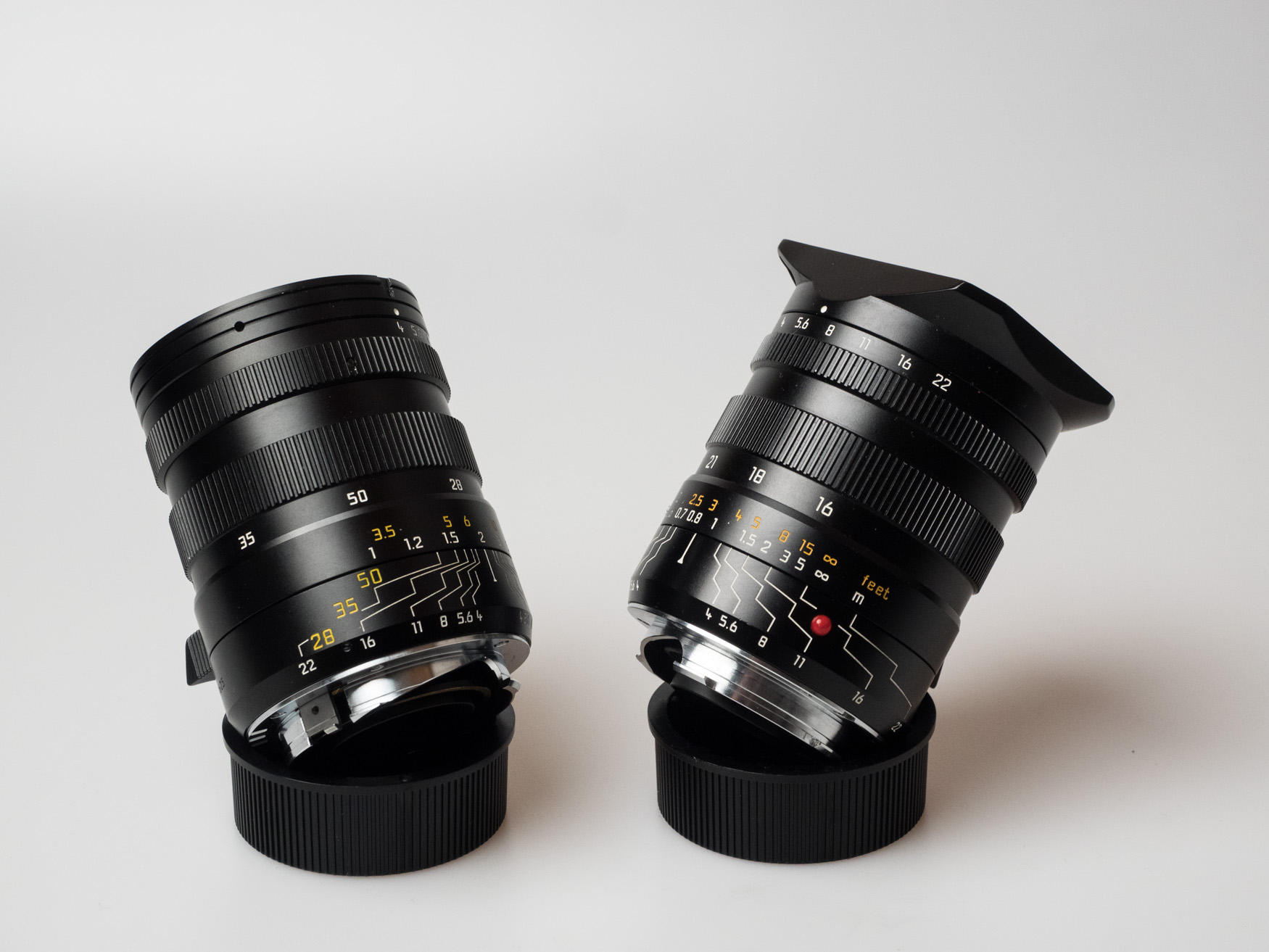
It depends on the range really. A 24-70mm is definitely 3-4 primes for me but something like the Canon 35-350mm is a different animal. Leica used to do these two lenses They are referred to as MATE (Medium Angle Tri-Elmar) and WATE (Wide Angle Tri-Elmar) and are “zoom” lenses with fixed focal length stops. The MATE is stepped at 28-35-50mm and the WATE at 16-18-21mm which on their intended use (Rangefinders) were used with a specific ad on viewfinder that was so clunky it is known as the Frankenfinder. They are not fast but are compact and have focal length stops that make sense so are very much a bag of primes (and very much more useful adapted on to an EVF body). Some Panasonic fixed lens cameras (LX10 and LX100 spring to mind) emulate this by allowing you to use the zoom ring to increment to fixed focal lengths and it is a good feature especially on those with return to position on power on functionality. I *think* some of the Sony RX100 do this as well.
-
Apparently Sony is working on a smaller LOFIC sensor now, so swapping to LOFIC may well mean sticking with Sony, especially if you already have a deal of some kind worked out.