
Ty Harper
-
Posts
506 -
Joined
-
Last visited
Content Type
Profiles
Forums
Articles
Everything posted by Ty Harper
-
Maaan, if they would just add that remapping feature I would be so content with my 1DC. I mean, I'll probably never sell it, but the knowledge that the hot pixel issue is just a matter of when, not if it happens to this camera, is just enough to make me feel uneasy anytime I reach for it to do a shoot. I'm not an expert on the history of DSLR f*ck ups at all, but the omission of that feature (a feature that seems to be standard or at least common place enough to be expected in their high-end product line) seems more egregious than their practice of crippling their cameras.
-
Been using the Nexto DI 2901 with a 1TB SSD for the last few years to transfer RAW ML files from my 5D MKIII, and although they've discontinued it, it's served me well. https://www.bhphotovideo.com/c/product/1194890-REG/nexto_di_nese_nd2901500s_nd2901_500gb_ssd_portable.html Definitely open to newer options tho. Wish the CF option was built in although I get that CF cards are on their way out, but I'll be rockin' Canon stuff for the foreseeable future so that kind of sucks. Also hoping these new options will allow us to switch out the drives like the Nexto DI.
-
So you're saying the rs shows up, even when you're doing static closeups?
-
The rolling shutter on the 5D MK4 seems unacceptable, and prefer the dslr form factor to the C100/300 line. I'd pick the 70D over the 80D bcuz of the Magic Lantern hack.
-
Geez! Didn't know it was that bad. Seems like my only option for something compact and under $3K with DPAF from the Canon line is the 70D (?)
-
Can someone explain what happened in this scenario?
-
Agreed! But I honestly can't see myself ever shelling out that type of money for a camera that doesn't have DPAF (unless I'm mistaken the C500 doesn't have it right?). I also can't see myself ever going back to that more traditional form factor (I used a C300 as a producer daily a couple years back and I'm assuming the C500 has a similar feel and heft). I'm in the minority but so far I prefer the ability to build up a dslr around a cage system and strip it down when needed.
-
Yeah figure so but actual confirmation is always good :-) I've got a 1DC and a 5D MKIII and although I know many have written the MK IV off I''m really leaning towards just picking one up once the price gets in sub $2K/used range. I know the cropped 4K sucks and all that but it's really the DPAF that I want.
-
Anyone know how well the MK IV and 1DC cut together?
-
Mmm I think playback is still the choppy Black and White... at least on mine it is but I also haven't upgraded in a while.
-
And then use the LUT that is closest in color temp to the color temp of the footage?
-
I've got the X-rite color checker and was going to do those same steps but I guess my main question was whether a LUT created under say daylight color would be something I can just apply to footage shot in say non daylight situations?
-
Any color matching experts with advice on the best way to do this? I'm assuming it would make sense to match the 5D Raw to the 1DC and LUTS would be the way to go, but I'm foggy around how it all works. I know I'd have to set up some basic tests with color cards and stuff, but would I have to create separate LUTS for different lighting scenarios (Daylight, Tungsten etc)? Or are the color differences between the two cameras a mathematical value that can be figured out and applied with just one LUT? All that said, if someone has already created LUTS for this particular camera matching scenario I'd definitely be open to paying for a copy.
-
Just thought I'd update this thread for historical accuracy. Got my 1DC back a few weeks ago and all seems to be working fine, but if any other issues come up with this thing it will automatically become a paper weight.
-
I've used the Glidecam HD400 with an arm brace for most of my time shooting stuff. How do these ones compare weight-wise? And are there arm braces or accessories to help with the weight?
-
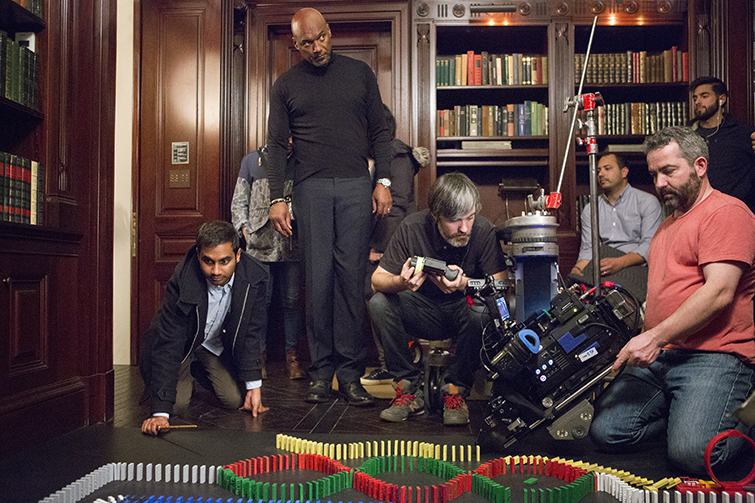
Cool article.. The Cameras Behind Netflix’s Original Films and Series BY MICHAEL MAHER NOVEMBER 17, 2017 Curious about the cameras behind Netflix Originals? Here are the cameras Netflix has officially approved — and the series using them. Top image via Netflix. As a company that produces and streams content on a massive variety of devices, Netflix requires their original content to be at least 4K for optimal presentation. These recommendations come directly from Netflix, and they are primarily for their own content. So you can still shoot on other gear and hope for distribution, but to meet their standards or work on one of their sets, you’ll need to use the following cameras or specs. Netflix’s Basic Camera Requirements There are two main classifications for Netflix cameras: primary and secondary. Primary is your main camera, which must have a true 4K sensor. Secondary cameras capture any type of B-roll or additional footage, like crash cams, aerials, POV, and underwater cameras. Image: Master of None via Netflix / Panasonic. Primary Netflix Cameras True 4K sensor (equal to or greater than 4096) Minimum 16-bit Linear or 10-bit Log processing RAW Log (Including, but not limited to…) S-Log3 V-Log CanonLog3 REDLogFilm BMDLog LogC Must send original camera files without looks, LUTs, or color correction Maintain metadata Tape name Timecode Frame rate ISO WB In addition, Netflix requires approval for aspect ratios greater than 2.00:1 — filmmakers must also shoot framing charts before principal photography begins. That way, the framing charts can get processed through the pipeline of editorial, post, and VFX. Full article: https://www.premiumbeat.com/blog/cameras-behind-netflix-originals/?utm_source=facebook&utm_medium=post&utm_content=The-Cameras-Behind-Netflix's-Original-Films-and-Series&utm_campaign=11-2017-facebook-posts --

-
For sure, and I'm not a super experienced camera person, but it does seem like pixel remapping is one of those features most might expect to come standard in a camera from Canon's C-line.
-
I'm pretty sure Canon has stated that you can't remap the 1DC, it's discussed in the infamous Dead Pixels thread over at dvuser: http://www.dvxuser.com/V6/archive/index.php/t-333479.html Point is you'd have to constantly be sending it back to them every year or so, and of course they wont be doing it for free. I honestly wish I'd known all this before I bought it but hey, lesson learned.
-
Strangely, you can't do it with the 1DC.
-
Yeah I hope to run my 1DC into the ground but if there's another issue I'll be extremely pissed. By the way, have you had an dead pixel issues with yours (yet)?
-
Good to know! And thats $1500 Canadian, which is still really steep imho. I could buy another 5D MKIII for that price! Actually all-in I could've bought a 1DX MKII at this point!!!
-
They said it was PCB Ass'y, MAIN, PCB Ass'y, FP and would cost about $1500 Canadian to fix. Anyone got an idea of exactly what the PCB is and whether replacing it is just a catchall solution? (i.e. I probably will never know what the exact cause was?) Also anything I should be doing to make sure it doesn't ever happen again?
-
Thanks for the info. How did you become aware there was an issue?
-
I'm not sure exactly what the issue is/was, but I had the camera recording in Canon LOG mode and the ISO was in the high #s (just running some tests for a shoot) and suddenly the picture froze. I shut it down, and took the battery out. The battery had been blinking red, so at first I thought it was just a power issue. I replaced it with my Canon 1DC AC power adapter so I wouldn't have to rely on batteries moving forward, but the camera didn't turn on. I turned the camera off again, pulled the power adapter out, and put in a newly charged battery, and it still wouldn't turn on, and hasn't turned on since. I should also mention that I had a Ninja Blade monitor connected to the camera via hdmi as well although I doubt that factored into this issue at all. I only became aware of the 1DC's history of issues (recurring dead pixels even after being serviced, PCB circuit board failures) AFTER I purchased mine, and I honestly was hoping these issues were only affecting some of the cameras. But it's not that much of a stretch to believe the entire line is/was essentially defective and would probably qualify for recall status, except for the fact that Canon discontinued the line, but most importantly, only sold a comparative few # of these cameras. I'm definitely going to send it in to Canon for an assessment but I'm in Toronto, Canada, so I was hoping anyone that's had 1DC issues could pass on any info about Canon service, specifically ph#s and any specific people you were in touch with so I (and any others out there) could either contact them directly, or relay that info to the Canon Canada reps in Toronto. From what I gather from other owners' experiences (via the infamous and especially helpful DVX thread), WHO handles your service file, and who services your camera really matters, so any info or advice on all this would be greatly appreciated. This is my first major issue with a camera and first time having to deal with Canon service, so here's to hoping my Canon/1DC servicing experience is better than the horror stories I've read about here: http://www.dvxuser.com/V6/showthread.php?333479-Dead-Pixels-random-errors-terrible-support-anyone-else I don't work for a production company, and I'm not a CPS member, so like many indie/amateurs on this board I'll be personally swallowing the costs on this one way or another, so again, any advice on how to handle this would really be greatly appreciated. If you'd like to keep this private and PM me instead, I understand and will respect that as well. Sincerely, Ty
-
Anyone know what Canon even charges (ball park) to fix the pixel issue?