All Activity
- Past hour
-

Narrative films shot in uncontrolled cities
Bioskop.Inc replied to QuickHitRecord's topic in Cameras
Chungking Express by Wong Kar-Wai Absolute masterclass in film making. Think it was shot in S16mm film, but the most impressive thing about the film was that he shot it in 2 weeks whilst waiting to edit Ashes of Time. The script/story changed whilst they were filming and they shot on location in Hong Kong. I think if you're going to write to make a film, keep it simple - if you look at Wong Kar-Wai's early films like Chungking Express, Fallen Angels, In the Mood for Love etc. - the premise is always simple/basic and they shine a focus on very few characters which really draws you in and with quite limited dialogue. He creates a mood and you should use the environment where you are filming to make it another character in the film, which complements the atmosphere you are trying to create in the story you are telling. Having filmed a lot for TV in cities etc. it really makes you focus on what you are trying to do and ultimately achieve - you've got to do things quickly and ignore what is actually going on around you, get the shot and be ready to be adaptable. -
 That's such a bummer, re: the overheating. I've been eyeing the original S1R for stills. Was hoping he used price would go down more, but it hasn't moved much in the last year.
 -
 newfoundmass reacted to a post in a topic:
What are your feelings about Panasonic S1R II being in the S5 body design?
newfoundmass reacted to a post in a topic:
What are your feelings about Panasonic S1R II being in the S5 body design?
- Today
-
.thumb.webp.02ab75c0380a61053ed0e27de8828909.webp) FormalDressShops joined the community
FormalDressShops joined the community -
 Voigtländer made a 90 mm f/3.5 Apo Lanthar for DSLRs. Nikon made a series E 100 mm f/2.8 that is very compact. I think most people today prefer to use zooms for landscape photography. Short tele lenses of smaller maximum apertures typically have some close-up capability or even may be optimized primarily for close-ups. I believe for the most part, manufacturers follow sales and make their product lineups based on sales data combined with estimated future demand. Often users just have to adapt to what is available if they want to use new lenses. Even popular lenses can be neglected or discontinued if the manufacturer wants to promote something new. One issue with non-macro primes of smaller apertures is that manufacturers find it easier to market product lineups where there is a clear line of progression from one level of product upwards to the mid-level and top-of-the-line, and every parameter of performance should improve along the way. This means that although it would be easier to make smaller-aperture lenses better optically than large-aperture lenses of corresponding focal lengths, the manufacturers will make every effort to make the reverse true and the larger-aperture lenses better in image quality, focus speed, etc. and sometimes this means the smaller aperture lenses don't get all the quality they could have. This is unfortunate as I believe there is significant demand for compact, very high quality lenses.
 -
I remember Jim Kasson once said in his blog he wished there was a small but sharp corner to corner 85mm f/4 lens for landscape (he would prefer a f/5.6 one, but it would look silly marketing wise). 99% of photographers these days can't see whats the point of that, they all learned that 85 is for portrait and it should be fast to create a blurry background. So lens makers don't even think about that. We have gazillions of 85mm f/1.4 on the market right now, but none truly optimized for landscape. The irony is camera makers are trying to make full frame body as small as possible, so a compact 85mm would be ideal for a landscape combo, but everybody assumes compact=slim body+28mm pancake.
-
Aussie Ash reacted to a post in a topic:
People don't seem to understand lenses (moving beyond 'zooms vs primes' thinking)
-
What are your feelings about Panasonic S1R II being in the S5 body design?
MrSMW replied to Andrew - EOSHD's topic in Cameras
Well one thing is for sure and that is the S5II absolutely annihilates the S1RII, even with the ‘heat management’ firmware update. Shooting a pair of S1RII’s and a single S5II, same or at least similar lenses, tripods, same settings (4k) at approx 40 degrees Celsius in the shade…and the S1RII’s within 20 minutes shut down each, 3x. Quick battery changes helped string out a couple more minutes before the next inevitable shutdown. Meanwhile, the S5II mumbled something about holding its beer. That’s it, one unit is being traded for an S1II, which was something I was considering anyway. S1RII principle photo and occasional video S1II principle all day video unit S5II workhorse tripod unit S9 backup and roaming ceremony unit L10 candid & details unit But otherwise zero criticisms of how this kit is performing. Ticks basically every box for my needs. -
 motobuys joined the community
 -
 Emanuel reacted to a post in a topic:
People don't seem to understand lenses (moving beyond 'zooms vs primes' thinking)
Emanuel reacted to a post in a topic:
People don't seem to understand lenses (moving beyond 'zooms vs primes' thinking)
-
 I've been thinking about lenses a lot over the last few years, and just to be cheeky I've put some observations into a framework. Level 1 is where we start - with zooms The normal start to using lenses is with zoom lenses, probably the kit lens. We know the thinking at this stage: its convenient, you stand in one place and zoom, hooray! Level 2 is what most YT lens videos are about - primes are better than zooms We all know the arguments. Primes make you "zoom with your feet", they make you learn about perspective, they're sharper, better in low-light, BOKEH!!!!1, you can learn the FOV and develop an instinct for it, vintage ones are cheap, "real photographers / cinematographers use primes!" There are approximately 1000 billion videos and tutorials explaining this, but this seems to be where the thinking stops. I've not seen that much stuff that goes beyond this, but this is really just the start. Level 3 is where understanding begins - zooms and primes have their uses Almost none of the discussion up until this point acknowledges that lenses create images, and images have aesthetics, and aesthetics are what is actually being discussed. Moving to talk about motion pictures now, and cinema especially, there is a bunch of nuance that Level 2 doesn't really discuss. People have decided that FF sensors are the most 'cinematic' and typically are used with FF vintage lenses. This means that the FOVs are 24mm / 28 / 35 / 50 / 85 / 100 etc, with maybe a 40mm in there if you're getting fancy. These weren't the FOVs of cinema though, because cinema was S35. So the FOVs of cinema using the 50/40/35/27/18 were really like 75mm/60mm/52.5mm/40.5mm/27mm. It gets stranger when you add anamorphic into the mix. If I go to B&H anamorphic cinema lens category and sort by best sellers, we get: - DZOFilm Arcana Anamorphic Prime 3-Lens Kit, which are FF and 32/45/75mm and 1.5x, so on FF they are: 21mm 30mm and 50mm - BLAZAR LENS Talon 50mm T2.1 1.5x, which is FF and equivalent to a 33mm - Sirui Saturn 35mm T2.9 1.6x which is FF and equivalent to 22mm If you're using the standard FF lenses on a FF camera, you are using the FOVs that stills photographers used, rather than those that cinematographers used. Shooting on S35 sensor size (or crop mode) with FF lenses can create some of these in-between FOVs too. People at Level 2 thinking probably won't be swayed by the above. I would imagine the thinking is take a step forward or back, what's the difference? Level 4 is where understanding begins to mature - enter the feedback loop The feedback loop is where you realise that the focal length changes how you shoot. A ridiculous example to illustrate it. You decide to shoot on only a 28mm on a FF camera, but when you frame up a close-up shot, the distortion makes the talent look awful, so you take a step back and now the footage feels more distant because we're not seeing the talents face so much because there are no close-ups. We all know about perspective from level 2 thinking, but the level 3 thinking was that taking a step forward or back was no big deal, so which is it? This stuff is subtle, but (like all feedback loops) it pushes us to act differently and this can create a cascade of changes over time. Level 4 thinking realises that this dynamic is powerful and pervasive. I shoot in public, so I don't control the environment. I discovered that if I shoot with a 35mm FOV then I can get environmental portraits of my friends and family from close enough that people won't walk in-between me and them, but moving beyond a 45mm I'd either get shots of them that were tight and didn't really show their environment that well, or I'd step back and be struggling with people walking in-between me and the subject, which is a completely different situation. How would I respond to this? I might shoot from eye-level instead of chest height. Now I've changed the shot angle because of a FOV change. If I shot from eye-level for a while I might notice that I get more attention and now I find that the people interacting with my subject are more aware they're being filmed and keep looking at the camera. Now my subjects are acting differently because of a FOV change. If I asked someone the difference between shooting with a 35mm and 45mm would they think it would change the shot angle and subject behaviour? Not with the Level 2 thinking of "primes are sharper! duh!!", or the Level 3 thinking of "just take a step back! duh!!". What about controlled sets? Sure, on a controlled set there aren't random people walking in-front of the camera, but now we're talking about actors and all the dynamics that goes on there. Can great actors deliver amazing performances while the matte-box is only inches from their face? Sure. Do YOU have actors that are that good? I don't think so. Can great production designers change a set to accommodate a camera being further away, while keeping the frame looking the same? We know that as we move the camera back the subject gets smaller in frame, and that as we do that the background gets smaller but not nearly as fast as the subject does. This is great if you are only filming the subject and don't really pay attention to the composition of the entire frame. But you're a talented cinematographer, so you want to move back a bit and keep the same composition, which means that production design needs to 'cheat the camera' and basically rearrange every item in frame that isn't in the very background. I remember shooting a student film in a cafe and every setup required moving the vase of flowers on the table the subject was sitting at. That vase probably used two-thirds of the area of the table! I watched a video recently where a street photographer tested a 40mm prime for the first time. They didn't know what to make of it, having only a week to shoot with it before they had to release their video review. What struck me wasn't that they didn't know what shooting with a 40mm was like, it was that they didn't seem to understand that there's a period of learning that goes on, they didn't understand that the feedback loop exists. I realised they had 'learned' each focal length by memorising its attributes (which Level 2 photographers will crap on at great length about), rather than having learned them for himself by following a process where you explore the feedback loop and see how it makes you feel and how it makes you act and how the world responds to that, and how you respond in turn, and how the loop feels and matures over time, and how to make the loop go faster etc. I recently spent some time in a small town in rural Japan and shot the same location with FOVs equivalent to 71mm, 82mm, and 100mm. I went out for a walk each night with one of those lenses, going out for perhaps an hour or two. Shots that were possible with one were not with the next, shots that were great with one were lifeless with another. As I walked down the same road from my accommodation seeing the same shots night-after-night and making different framing decisions with each lens (and deciding to take the shot or not to bother as it didn't work) I noticed that I made different decisions to walk one way or another as certain subjects required different FOVs and distances to make them. I've also spend a lot of time, over several trips, shooting night scenes with 68mm and 71mm FOVs. In some locations I can make some shots and not others, while in other locations I can take different shots. If I'm shooting across a road then the width of that road (combined with my FOV) determines the type of shots I can take. After taking a number of those types of shots I start to adapt to how I'm shooting these locations. The more I shoot the more everything feels different. Level 3 thinking says "just take a step back, what's the difference?" and when shooting in those situations the difference between a 35mm and a 50mm feels like it's a span where there are several complete aesthetics in-between the 35mm end and the 50mm end. Thinking about shooting a 50mm FOV vs an 85mm FOV feels like travelling to a different country where things look similar but feel very different in practice. I know I'm barely scratching the surface of Level 4, and perhaps there are levels beyond this that I'm unaware of, but it's just amazing to me that almost no-one seems to talk about anything beyond Level 2. It's probably controversial to say, but I deliberately avoid almost all stills-only people because the thinking seems so rudimentary in comparison to people who shoot moving images. You can feel the limited thinking and the "well, actually!!!!" responses where they miss the entire point entirely because one lens is sharper or something ridiculous. Anyway, hopefully this helps. I've not really heard anyone talk about this stuff, which seems a shame as the rabbit hole is very deep and to only talk about ankle-deep water seems silly.
 -
No. Remember: the First Amendment ; ) Secondly, we now have AI, and AI can be made to justify almost anything ;- ) The Soviet Union came to an end on Christmas Day, 1991.
-
WOW What a thread! :- )
-
Emanuel reacted to a post in a topic:
Narrative films shot in uncontrolled cities
-
Emanuel reacted to a post in a topic:
Narrative films shot in uncontrolled cities
-
Emanuel reacted to a post in a topic:
Narrative films shot in uncontrolled cities
-
Emanuel reacted to a post in a topic:
Narrative films shot in uncontrolled cities
-
Emanuel reacted to a post in a topic:
Narrative films shot in uncontrolled cities
-
Emanuel reacted to a post in a topic:
Narrative films shot in uncontrolled cities
-
 Exactly, that is the interesting part for me too. I don’t think the best use of this will necessarily be obvious “POV footage” in the usual action-camera sense. The more interesting uses may be the almost invisible ones: situations where the camera is there, alive, following attention, but not constantly being operated in a way that announces itself to everyone in the room. Your point about parallax and offset is completely fair. If the camera is too far from the head, then the head direction and the actual camera perspective will never match perfectly. But I am not sure that perfect matching is always the goal. In many documentary or making-of situations, what matters is not to reproduce the exact optical perspective of the eye, but to reduce the burden of manual operation and preserve a more natural relation with the subject. That is why I find it interesting for BTS, documentary and observational work. Not as a perfect substitute for a shoulder camera, not as a Steadicam either, even though, as a gimbal camera, it belongs to a lineage that goes much further back, including the invention that so impressed Kubrick that Garrett Brown ended up operating his own system on THE SHINING. I see it more as a small autonomous B-camera, or a reactive camera system, able to follow intention without forcing the operator to constantly lift, aim, correct and therefore disturb the situation. In a film set, for instance, the value may be precisely in allowing the device to become boring after a while. If people stop reacting to it, or react to it less than to a conventional camera operator moving around with a visible setup, then it starts doing something useful. So yes, I think the strongest uses for it may be almost invisible. Not spectacular POV shots, but the kind of footage that exists because the tool reduced the amount of intervention needed to capture it.
 -
Yes, but I don’t think it is exactly the same thing. A Go clipped to a hat gives you a small head-mounted action camera. Useful, of course, and probably better for some pure POV situations. And I say this as someone who actually owns two Insta360 GO 2 units and the GO Ultra. In fact, the GO Ultra was also used in the making-of situation I mentioned above, so I am not dismissing that kind of camera at all. But the interesting part of the Luna accessory, at least to me, is not simply “put a camera where the head is”. It is the possibility of using the head as a control input while the camera itself can remain somewhere else. And that is a whole different thing. With a hat-mounted camera, the camera position, lens, sensor, stabilisation, codec, monitoring and point of view are all physically tied to the head. With something like Luna Ultra, you are potentially dealing with a much larger sensor, better latitude/dynamic range, 10-bit colour, log recording, stronger codec options, proper monitoring, several focal lengths, a real gimbal system and a camera body that can be placed where the shot actually makes sense. So it is not just “POV versus POV”. It is the difference between a tiny self-contained action camera recording from the head, and a more complete image acquisition system where the head becomes one possible way of controlling the frame. The gaze and the camera body become partially decoupled. The head can guide the framing, but the camera can still benefit from a better sensor, 10-bit recording, log capture, stronger codec, better lens choice, better stabilisation, better monitoring, better audio possibilities and a more deliberate production setup. So I agree that an Insta360 Go on a hat is a valid alternative for some situations. But I see this as potentially more than that: not just a POV camera, but a different way of operating a small gimbal camera with less visible intervention from the operator, while still keeping the image quality, 10-bit colour depth, focal-length flexibility and production control of a more serious camera system. And the outcome is already starting to speak for itself. Even if the example comes from the competing Osmo Pocket 4P/Pro side, the IQ benchmark is becoming very clear. D-Log 2 10-bit colour: https://www.facebook.com/reel/937883892382597 Small pocket gimbal cameras are no longer just convenience tools or “good enough” secondary cameras. They are beginning to produce images that can stand on their own, with a cinematic quality that would have been unthinkable in this form factor only a few years ago. Back to the subject and to my eyes, this is not just a clever accessory. It is part of a real revolution already in motion.
-
Interesting points and I definitely see the challenge and how this potentially provides new potential solutions to some aspects. @eatstoomuchjam mentions having something mounted on the brim of a hat, and this does in some way create an alternative option. Perhaps the added feature of the head tracker is that you can track the direction of the head without having the camera on the head, which makes me question where would you have it? The further from the head you put it the more parallax error, and unless it could have some sort of offset (which is probably possible) then the framing might be off. Maybe it's better as a more walk-around camera rather than if you're stationary and what you're filming is mostly stationary. I do see "those shots" in docos from time to time where the footage you're seeing wasn't shot well but is pivotal to the story and therefore included in the edit. For example when crossing a border into a war zone the audio is of the border guards talking with the producer and the visual is the camera seeing the back of a car seat, or everyone is running while chaos ensues, etc. I can definitely see that it's an alternative to a chest-mounted action camera where the ultra-wide is capturing far too wide a FOV, and where the head-mount would capture the action with a much tighter FOV. I can also see someone doing BTS rigging one up with an NPF battery and mini desktop tripod and body clamp and just wandering around with it constantly turned on but not always recording, and the fact that it's always on and always moving would mean it would become invisible after a while, making the footage it captures much less influenced by its presence. Interesting stuff. I guess it's probably a thing where the right uses for it are almost invisible. Like how shoulder-mounted ENG / doco cameras can be used to create footage that doesn't call attention to itself, but in certain drastic situations such cameras do really call attention to themselves, this would be able to capture footage that doesn't call attention to itself in situations where no other camera setup could. Great discussion!
-
I was reminded of this one too.
-
 But all of that was previously already possible by using something like the Insta360 Go mounted on the brim of a hat. And as I previously mentioned, that has the advantage of actually being the perspective of the person using it, vs the perspective of their chest.
 -
I think the POV Head Tracker should not be seen merely as a vlogging gimmick or as another accessory for people who want to film themselves walking down the street. There are many different ways of filming, framing and capturing reality. The most “professional” approach is often understood as the most controlled one: you plan the shoot, you discuss the framing, you block the scene, you decide where the camera goes, you decide what the subject is supposed to give you, and then you execute. That is obviously valid, and it is the basis of a lot of good cinema. But it is not the only way to make images. There is also another tradition: a more intuitive, observational, physical and spontaneous way of filming, where the camera is less a machine imposing a pre-decided frame on the world and more an extension of the filmmaker’s presence inside that world. That is where I think something like the Insta360 POV Head Tracker becomes interesting. The question is not only “what can it do technically?” The question is: what kind of relationship with reality does it allow? When you are operating a camera in the conventional way, you are always doing several things at once. You are looking, framing, correcting, adjusting, deciding, reacting, and at the same time you are also visibly present as “the person filming”. That presence changes the situation. It changes the people in front of you. It changes the rhythm of what happens. It can intimidate, formalise, freeze or theatricalise reality. In documentary, this is especially important. The more you plan, the more you risk fixing the subject before you have really encountered it. You may think you are observing reality, but you are already working on a construction of reality. You are no longer only receiving what is in front of you. You are fabricating a gaze, and the subject starts to exist inside that fabrication. Of course, complete objectivity does not exist. Every image is already a point of view. But there is still a big difference between a camera that constantly announces itself as an intervention and a camera system that allows the filmmaker to remain more physically and psychologically inside the situation. This is why the POV Head Tracker interests me. It may allow the filmmaker to film without constantly “operating” in the traditional sense. The camera can follow the natural direction of the filmmaker’s attention. The image can become closer to a lived point of view rather than a pre-composed shot. Not perfect objectivity, obviously, but perhaps a more immediate form of subjectivity. That distinction matters. A head-tracked gimbal camera could be useful not because it replaces deliberate cinematography, but because it opens another mode of acquisition: a more instinctive, embodied, less intimidating mode. It lets you be present with the subject while still filming. It can reduce the gap between seeing and recording. In that sense, I see a possible historical parallel with what happened when smaller 16mm cameras became available. Those cameras did not simply make cinema smaller. They changed the grammar of cinema. They allowed filmmakers to move differently, to follow people differently, to enter rooms differently, to film streets, faces, accidents, gestures, private moments and unstable situations in ways that would have been much harder with heavier, more industrial tools. You can connect that to cinéma vérité, direct cinema, the Nouvelle Vague, the New American Cinema, Jonas Mekas in New York, underground and independent filmmaking, and later the influence of that freer, more mobile language on figures like Cassavetes, Scorsese, and the whole post-studio generation. Even mainstream cinema eventually absorbed some of that looseness, that handheld energy, that search for immediacy. Jonas Mekas is not just an abstract reference for me. I had the privilege of knowing him personally in the mid-1990s, at the Figueira da Foz International Film Festival, which he used to attend. In that same context, I was also fortunate enough to receive an award as best daily press film critic. More importantly, a project I am still developing today was born precisely from that contact with Mekas. So when I refer to him here, I am not only invoking a name from film history. I am also referring to a very concrete personal encounter with a way of understanding cinema as diary, presence, immediacy, memory and life. The technology did not create those artistic revolutions by itself. But it made certain gestures possible. And when a tool makes a new gesture possible, it can also make a new kind of cinema possible. That is how I would look at the POV Head Tracker. Not as “AI tracking for creators”, but as a small step toward a different relation between body, gaze and camera. From the end of last month and carrying into this June, I worked on the making-of for A NOITE, Leonel Vieira’s film adaptation of José Saramago’s homonymous play. During the shoot, we used the Osmo Pocket 3 alongside other cameras, including a Sony A7S III, an FX30, a Panasonic GX80/GX85 and other small-format tools, Insta360 included. The film itself was being shot on two ARRI cameras, so this kind of low-profile equipment was obviously not what people on a cinema set are most used to seeing. Even Leonel Vieira, the director, looked at the Osmo Pocket 3 and jokingly said it looked like a toy camera. But that was precisely part of the point. I took the initiative to use it without hesitation, accepting the risks of bringing that kind of device into a professional film set, and combining it with different optical tools, including black mist filters to create atmosphere, Sirui anamorphic lenses and other accessories. In that context, I became very aware of how valuable it would be to have a device that lets me film without constantly managing the camera as an object. Not to mention that 10-bit Log recording is now available on the Luna Ultra as well. In a making-of situation, the best moments often happen before people know they are “performing” for the camera. They happen between takes, in hesitations, glances, silences, rehearsals, small gestures, private exchanges, and moments when the machinery of cinema briefly becomes human again. But the moment you raise the camera, adjust the frame, move closer, correct the angle, ask for space or visibly operate, you can lose the very thing you were trying to capture. The reality in front of the lens changes because of you. And that is fundamental in a making-of context: to be as minimally intrusive as possible, so as not to disturb the set of the main film being shot. The reactions of the professionals involved are, in many ways, the real subject of a making-of, and those reactions should not be manipulated by the visible presence of the image-capturing device itself. In our case, we were working with a very small crew: two to three people at most. In fact, it was necessary to convince Leonel Vieira to accept a maximum of three people, because ideally he preferred two, and sometimes only one person could be present. In those situations, when only one person was shooting and I still needed two possible angles, a camera A and a camera B, the only viable option was to have a B camera as autonomous and unobtrusive as possible, which is exactly how the Osmo Pocket 3 was used. With a device such as the Luna Ultra and its POV Head Tracker, that kind of work would become much easier, not only during the shoot itself but also later, when reaching the post-production suite and needing more options in the edit. So a device that lets the camera follow your attention, while your hands and your body remain less occupied by the act of filming, could be extremely useful. It could allow the operator to be less intrusive, less theatrical, less visibly extractive. It could make the camera feel less like a weapon pointed at reality and more like a witness moving through it. That does not mean this is for every situation. It is not a substitute for composed cinematography, lighting, blocking, lenses, or intentional mise-en-scène. But it could be very valuable for documentary, making-of work, rehearsal footage, street filming, travel, observational cinema, and any situation where spontaneity matters more than perfect formal control. The professional instinct is often to control everything. But sometimes cinema gains power when we control less. Sometimes the most authentic image is not the one we planned best, but the one we were able to receive before reality became aware of our plan. That, to me, is where the POV Head Tracker could become genuinely interesting.
-

Sigma Fp review and interview / Cinema DNG RAW
Ty Harper replied to Andrew - EOSHD's topic in Cameras
@mercerI started my cam journey in earnest on the 5D MKII/IIII with the ML hack - so I have a soft spot for that RAW workflow! And I still have two 5D MKIII that I will prob never sell. I currently have a R5OV as travel/casual/C cam but I am not feeling the APSC look. So when I recently rediscovered the FP I became a bit obsessed with the idea of having something that small and powerful become my casual/travel cam. Meanwhile I'd just keep the R50V as a C-cam to my R5Cs. But as you say, the FP seems so finnicky that it has required an unprecedented level of research/due diligence on my end. So I've been wavering back and forth for about a month now. As it stands, if I can get a used FP in good condition for $600 USD (just missed one with the modded back dial for that price!) then I'll go for it (knowing I'd still be buying the DPL screen mod, the DPL base cage+SSD holder+SSD bottom mount and side accessory, a Meike or Vizelex Smart adapter/VND, and the pdmovie 3). If not, there's the Lumix S9 and maaaaybe the Nikon ZR but that then I'm getting to R6V territory as far as size and price. - Yesterday
-
Narrative films shot in uncontrolled cities
QuickHitRecord replied to QuickHitRecord's topic in Cameras
I'm not too worried about a short that will be sent out to a dozen or so festivals and then make its way onto YouTube. If I was hoping for distribution, that would be another story! I remember seeing this trailer! I think it’s a great one to add. -
You may have read me post before that I came to the FP, due to my love of 1080p (actually 1920x818) ML Raw on the 5D Mark iii. I seriously love the image and it still reigns as the best image and favorite camera I have ever owned, but being 1080p and an EF mount camera, it could be "soft" with certain lenses and I couldn't use some lenses I have collected over the years. That said, in some ways, the FP is the spiritual successor to the 5Diii ML Raw because both are "uncompressed" raw and both have, or lack, a manufacturer designed post production workflow. Coming from ML Raw, this never bothered me. With the FP, I set the picture profile to OFF and used the camera meter to judge exposure... as long as you hover +/- 0, you will be able to finesse the image in post however you want to. So I never worried about seeing an accurate representation of anything with it. I made sure I didn't clip the highlights, used False Color to check skin and hit record. As far as EF mount lenses go, I have 4... the Canon 28mm 1.8, Samyang 50mm 1.4, and two modified lenses... a Minolta 58mm 1.4 and the Canon FD 50mm 1.2 L. I have so many other vintage lenses that I didn't even get an EF adapter. However I was planning to bring out my 5Diii more often, so I looked at purchasing (repurchasing) a couple lenses... the 24-70mm f/4 and 35mm f/2 IS, so I did glance at a few of the electronic adapters for L Mount thinking they could pull double duty. At the time I was more worried about IS translating over to the FP than I was ND, so the Sigma adapter seemed like the safest bet. The FP was intended to be an inexpensive and tiny raw camera that I could walk around with and grab shots for short films, so I wanted the footprint to be as minimal as possible, which unfortunately is near impossible with the FP and eventually frustrated me. I later bought an inexpensive GH6 and the Arri LogC3 upgrade key, with similar intentions but the crop annoys me. Now I think I'm going to sell both and get a Nikon ZR, and be done with it. I have my 5D3 and a Canon V1 for one film I started working on and the Nikon will be for the other film. All that said, the FP is a fine camera and the image is pretty damn good, it's just too quirky for my run and gun incognito sensibilities, but if you don't mind rigging it up a little, I can't imagine the S9 could come close to the FP in pure image quality. In fact, I was thinking of waiting to do a major camera upgrade and getting the original S5 as a stop gap for my second film and then reevaluating my cameras this time next year, and I may still do that for the IBIS, but in reality, the image is more important to me, and the flexibility of a raw workflow, so I'd probably just keep the FP for that scenario... even though the GH6's IBIS may have spoiled me a little.
-
Sigma Fp review and interview / Cinema DNG RAW
Ty Harper replied to Andrew - EOSHD's topic in Cameras
Got it! I think for me, the biggest things I've been trying to wrap my head around (because I've only been able to learn about this cam via bits and pieces of anecdotal info from Youtubers and owners posting in FB/Reddit groups) are: (i) The monitoring situation: So as I currently understand it - the Ninja V is the only monitor that - when used with the Ole Berek LUT - shows you a fairly close representation of what the RAW image actually looks like in the field compared to what you get on the FP's own screen (as far as exposure, etc) (ii) What is the best EF-L mount adapter with VND? I'm seeing that the issues with the Meike version might have been addressed and I'm unsure whether the Meike and Fotodiox/Vizelex Smart adapter/VNF versions will fit when using the Dark Power Laboratory Base cage and.or Ultimate cage. Any help/thoughts on this would be appreciated. All that said, I'm still interested in it but if I can't get a good deal on one here in Toronto, I will prob just end up getting an S9! -
Left handed girl form 2025 comes to mind. They shot on an iphone.
-
What will you use this kind of thing for? You seem very excited, but I don't really know what I'd use this for.
- Last week
-
All music at soundimage.org is now free for commercial use
Eric Matyas replied to Eric Matyas's topic in Cameras
Greetings Fellow Creatives! My quest continues to make every looping track on my site available in higher-quality Ogg format, so this week we have: "THE ITALIAN HEIST" You can listen to it here: https://soundimage.org/wp-content/uploads/2026/06/The-Italian-Heist.ogg And freely download it here: https://soundimage.org/world/ "CHUGGIN' THROUGH COLOMBIA" You can listen to it here: https://soundimage.org/wp-content/uploads/2026/06/Chuggin-Through-Columbia.ogg And freely download it here: https://soundimage.org/world/ As always, all of my music and sounds are 100% free to use in your projects with attribution. PLEASE CONSIDER SUPPORTING MY EFFORTS Here are some cool ways you can help: https://soundimage.org/ogg-game-music-mega-pack/ https://soundimage.org/ogg-music-packs-2/ https://soundimage.org/donate/ See you in July! 🙂 -
What happens after you release the "film" for public consumption ? Could a city come after you legally ? Since we are talking guerilla style, you know your being a little bit naughty 😳 I personally dont see an issue with two friends talking on the side of a street with another filming unless of course you start closing down streets. Then i can understand the need for permits and counsel approval. Half or three quarters of youtube must be filming outside. I watched a youtuber shoot a timelapse in Italy a week ago. Set up a tripod right in front of some famous place, plonked a dlsr on top and away he went . Mind you he did set up close to a large rock to stop people tripping over it. He also moved around did some behind the scenes stuff. So he was there for awhile, it was very touristy, nobody bothered him. No idea how car parking works in your area. If you could access a minivan, throw a couple of magnetic signs on it, saying such and such tours. When a bunch of loud tourists jump out of it and proceed to wander round willy nilly taking photos, if three of those people are of to the side, it wont alarm any one. You could also do make up and have cold drinks and snacks in the van. Heck have some people tossing a football or baseball around, nothing can be more American than that. I live in an agricultural area, we rely on backpackers to help pick the seasons fruit. I'm always seeing backpackers hanging out in the main street using the free wifi from the banks i think. Seeing phones and tablets is pretty much accepted.
-
I'm once again reminded of Noam Kroll, who has gone a long way into this rabbit hole. My recollection of his method was a balanced approach, where you make a plan and then improvise and adapt within a limited range. My impression was that he would storyboard things as a way of mentally rehearsing the shoot, and would end up with a clear idea of the logistics of the shoot, the equipment required, etc. Location scouting and anticipating the light etc as you normally would. I believe he also gained a clear idea of which shots were required, and which had some flexibility. Then when he was shooting he could make sure that he got enough for a functional edit, but was also clear enough in his thinking that he could adapt the plan to compensate for any challenges that arose and also to take advantage of any serendipity or inspiration that occurred. I suspect that this is a very deep skill, to plan and then improvise a shoot with an understanding of how the choices being made will go together in the edit. I know enough about editing to know that it's a jigsaw puzzle where you can have two small sequences that work well but don't cut together directly, so unless you can find a way to get from one sequence to the other then you have to change one of them so they're compatible. To do this for a whole scene, or whole film, in your head while you're still shooting it is beyond what I could even imagine, but I'm sure that the talented cinematographers are easily up to the challenge. Noam actually went further, describing a process where he worked with two actors and where he 'designed' what would be shot ahead of time, with the major plot points and story beats, but didn't fully script it. On each day of shooting the three would have breakfast and discuss the motives of the characters and how the scenes should go. Then they'd shoot while improvise the scenes, filming as they went and exploring ideas. It was freedom within a planned structure. I believe he was shooting one or two days a week, and so after shooting he'd review the footage and do rough edits, seeing what worked and what didn't. Then he'd 'design' the next shoot day accordingly, sometimes keeping on with his overall plan for the story but other times seeing something in the footage that made him adapt the narrative. I suspect that the skill is in knowing how much you can stray from the plan and knowing in which ways to adapt to make the end result better than if you just shot it as planned without any adapting to the situation. Certainly if you make a plan and then prioritise which shots are the most to least important then you'll have a good chance of coming back with a functional edit. My impression of great travel content is that most shots are good-but-not-great, and the art is in the edit and how they're combined. EOS-M and primes and a Fujinon-TV 14-70 f/2 will do a lot of the heavy lifting in making it look like cinema instead of video. In my mind you'll need to pay attention to how to keep the camera stable and then look at your references and study their coverage so you can design yours. By shooting on less than pristine equipment, you'll have to get things right in-camera as you won't be able to mess with it in post as much. Specifically, being able to zoom in a little in post can be useful if a random passer-by is staring. If you were shooting this with a modern mirrorless and sharp/neutral lens then I'd suggest using the highest resolution possible just so you have that flexibility. Your concern for getting stared at is legitimate, but the focus is to not get people staring while they're in the frame. As such I'd suggest getting more coverage using tighter framing and shallower DOFs, and for shots that are wider, simply getting more footage so you can edit around people staring. AI can potentially help if there are random people staring in shots you really want to use, but if you can edit around these moments (or prevent them from being in shot in the first place) then all the better. It's also worth considering that there are a number of things you can do that will lessen the changes of people noticing you and the camera, or lessen the people who are currently in frame noticing it. Another strategy is to investigate how much b-roll can be used in the edit without it taking away from the story. You may be able to get away with putting b-roll on top of a good audio edit, essentially having an L-cut followed by a J-cut where the audio goes from one character to the another but the visuals go via a b-roll shot from the location. I'm sure there's a deep art to doing this, but it's worth grabbing as much b-roll as you can while on location (especially if shooting has to wait for any reason but you're able to shoot). You can even return at a later time to get more footage, or better yet, take your kit and go shoot the location ahead of time so you can do a dry-run with the actual rig and also get a sense of what the location is like to shoot by actually shooting in it.
-
Narrative films shot in uncontrolled cities
QuickHitRecord replied to QuickHitRecord's topic in Cameras
So far, we have: The French Connection The Day Of The Jackal Escape From Tomorrowland Chubby Rain Woody Allen (Annie Hall, Hannah and Her Sisters, Deconstructing Harry) Lost in Translation I think this is a great list! I know that Sean Baker’s Tangerine was shot this way, but I’d rather not sit through another of his films. I've written a drama short. Two characters, 11 pages, lots of walking around town. I live in Portland and I’ve shot all over town before without ever once being hassled (except by some in a crisis of mental health). But I’m really more interested in seeing what kind of aesthetic choices might even be available to me when balancing that with coverage needs, moving quickly, and not attracting too much attention. I'm always so envious of New Yorkers for this very reason. You can fill the frame with sidewalk commuters and often no one will even bother to give you a second glance. I can’t think of any other US cities where this is true. Lovely screen grabs, Kye. If any of these were publicity stills for a film, I’d want to check it out. Especially the 68mm shots. Great mood and sense of place. I think that this quote sums up some of the decision-making that I am facing. I could totally go in there and “wing it”, just figuring out my shot as I went. But I want to rely on natural light, which means timing certain shots for certain times of day, and then that raises the question of how much planning I want to put into each scene, and ultimately how the visuals will compliment the story. I’d rather not lean too far into the documentary aesthetic. After shooting my last five shorts with my C70s, I’m actually thinking about shooting this film on a hacked EOS-M with c-mount lenses. I’ve been collecting them for a while and have three sets of primes, plus some great zooms. I’d personally put the aesthetic available with this (windowed) sensor and these lenses up against anything, I like it that much. I think the reason that no one really wants to do this is because it’s one of the most difficult digital cameras to work with, AND on top of that, the most difficult lenses to work with. But I’ve been tackling the challenges presented by these one by one, and I think I have them pretty well sorted. We shall see! Current plan is to hide a Deity PR-2 recorder with a lav on each actor and attach a timecode box to the audio input of the camera. Stabilize with a steadybag. Transmit the image wirelessly to a producer and make up artist in a car, along with refreshments for the actors. If I end up working with long zooms, I might give direction over a phone and provide a discrete earbud to each actor so that I could also monitor. -
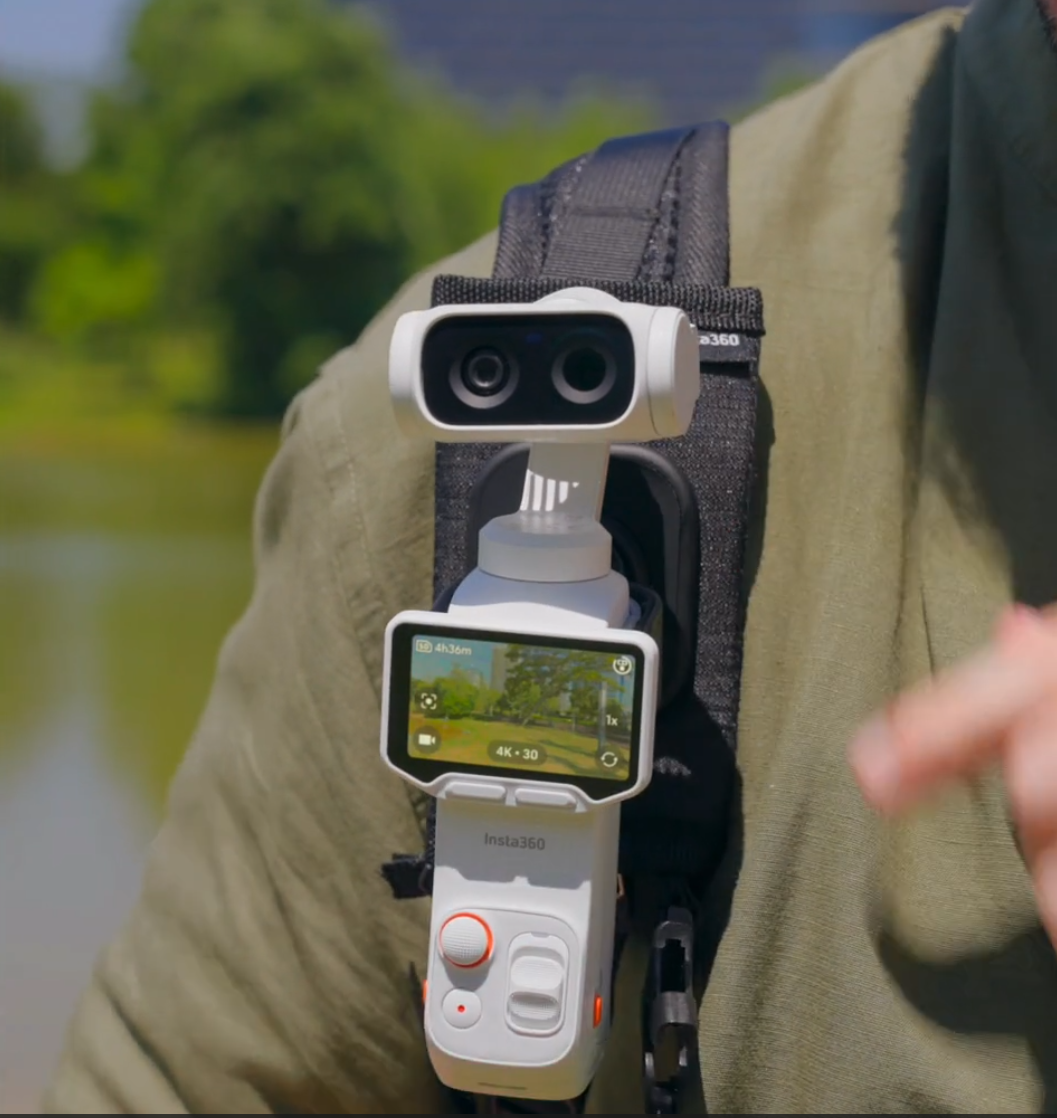
No idea about you guys, but I am in love with this tool accessory... pretty useful in those much different configurations: Head tracker, finger tracker/tracking, etc.* ; ) *shoulder mode: More comparisons here and there or yet this one too from same Chinese tester BTW. And here, more for the new Osmo Pocket 4P/Pro with the sample(s) of the new add-ons introduced (whereas Luna Ultra reaches 4K120fps across 20-60mm, DJI's Osmo Pocket 4P/Pro goes up to 4K200fps at the telephoto end). Haven't you bought a gimbal-pocket-cam yet? This is for those who will buy one then : D ;- )