
sanveer
-
Posts
2,542 -
Joined
-
Last visited
Content Type
Profiles
Forums
Articles
Everything posted by sanveer
-
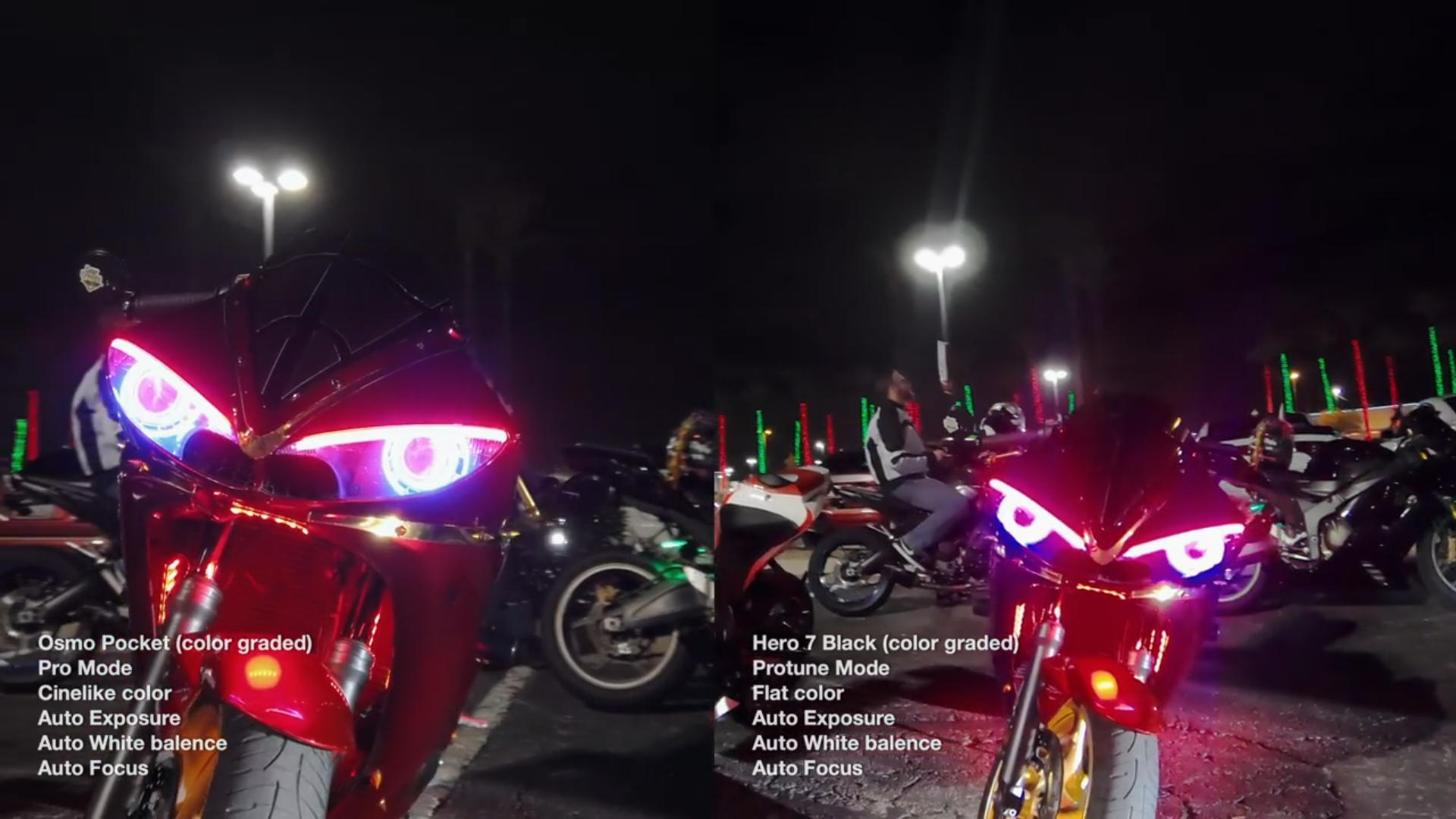
Cinelike is IMPORTANT. The footage lacks a little dynamic range in tough lighting situations (meaning the majority of them). Also, the 100mbps should be in 4k 30p and 24p instead of 60p. That's the lowest bitrate required for Suprefine Pro Mode. It's great that DJI reached out to you and is listening to reviewers and prospective buyers. If it solelely improves dynamic range and increases the 4k 30p and 24p to 100mbps, it will sell way more. That's one of the few complaints that people have, both of which seem well addressable by firmware. Plus price should determine this, or that this is for hobbyists is just some other BS. Cause it's like a drone head without the drone, meaning it's probably like 1/4th the price or less to make. Plus if it can be fixed with a firmware, why not fix it. This footage looks great. The DJI Pocket had just a hair more dynamic range in low light and less blowout of light sources. Plus more details, as can be seen from the headlights, where the Go Pro blows out details and the light and dark contrast.

-
Is there any proof that a Global Shutter Camera will or has better motion cadence that ci rma camera and prosumer CMOS sensors with faster readout? In the cinematic or filmmaking cinema sensor space, many cameras (especially the Alexas), seem to be more than good enough. Are there global sensor cameras that apparently have a more cinematic motion cadence and less noticeable rolling shutter? Also having an extremely fast readout speed, I suspect, may not let the image have the necessary softness required for a cinematic image. I am suddenly wondering whether film stock had issues with rolling shutter. Not to mentions the 2-3 stops of light loss and lower dynamic range of global CCD sensors. Also many CMOS sensors have global shutter circuitry, so things are not exactly black and white.
-
An excellent review at NewsShooter.com: https://www.newsshooter.com/2018/12/03/dji-osmo-pocket-hands-on-review/ It appears that most of the issues with the Osmo Pocket can be addressed with firmware updates. IMHO they are thus: 1. Slightly Higher Bitrates would be great. The 100mbps is solely limited to 4k 60p. (HD Superfine 25p – 30.71 MBit/s HD Fine 25p – 24.85 MBit/s HD Fine 60p- 67.16 MBit/s UHD Superfine 25p – 87.75 MBit/s UHD Fine 25p – 79.88 MBit/s UHD Fine 60p – 100.23 MBit/s) 2. The highlights and shadows are not being handled as well as they should be. Meaning either that it doesn't have HDR in video or that it's not preserving those well enough because of the codec in general. DJI does have some great experience with Codec so they should listen to custoner feesback and actually improve the dynamic range. 3. The low light also seems to be something that needs to be tweaked slightly. And I am guessing it can be with firmware. 4. The 120fps mode will be brought back with a firmware update apparently. I hope they increase the bitrate and improve the Video quality slightly. 5. There are some modes like times lapse and others they're available solely in HD. I wish they were available in 4k too. At worst it may be software limitation.
-
Yes. And with the waterproof case it can do upto 60 metres which is pretty amazing. If it's the IMX377, 477 or 577 sensor, it should have some serious potential. @androidlad will probably be able to answer the sensor question better. ?
-
Maybe if users petition them, DJI add a few more features. With the bright features, I can see this selling in the truckloads. Most of the limitations (except perhaps the water resistance) seem fixable with firmware.
-
It's actually created a new line of cameras: Tiny Travel Vlog Camera. And it seems to have so many features. I hope I find one or 2 around the $349 advertised price around here. I hope the CameraSize comparison site has this. Would love to compare it with more cameras. I am sure this is like 1/2 or even 1/3rd the size of many Vlogging Cameras. P.S.: I noticed this from the DJI site: "Notes: 1. Tested without a connection to a phone or accessories. 2. Panoramas must be viewed on the DJI Mimo App. 3. Story mode and D-Cinelike video will be available soon in a future app update." I guess the quality of the video including the Dynamic Range should go up with the D-Cineline update. I saw minor focus jumps in a few of the videos. I hope they fix the minor glitches with focus too with firmware.
-
The stabilisation, colours and the frame in general looked better on the Osmo (no strange fisheye and vignetting). Though it needs to fix the 4k 24p with a firmware update and also the sound on the mics needs to improve on the Osmo. I am also guessing that the waterproof features on the Osmo could be fixed with a few accessories. Hopefully they don't price the accessories too high. It seems to be a great camera. It has the Mavic 2's camera with all the bells and whistles at a fraction of the cost (it doesn't have the 2x zoom, but it costs a lot less). I forgot to mention. WAY BETTER battery life on the Osmo.
-
@DBounce maybe DJI actually makes the World's BEST Vlogging Camera that's terribly inconspicuous, has superb stabilisation, good sound, good dynamic range, reasonably long battery life; and does equality good video and photos.
-
 After looking at various smartphone HDR photos I am convinced that cameras and photos too have a lot more dynamic range than we know and can imagine. Photos start galling apart in post more due go the bit and colour depth than due to anything else. If this characteristic of the photo can be handled better, we don't have to worry about assuming that there isn't too much information to begin with. Computational Photography and AI in post should actually, in theory, be able to improve dynamic range of photos even after they've been taken. It's almost like turning B&W photos to colour. The limitations right now, IMHO, are more to to with a lack of imagination by programmers and experts in the field, than anything else. I am not sure you're right about interpolation and it's limitations. Those are more of the accepted limitations of the present times based more on unexplored methodologies more than anything else. In theory HDR should be possible from a photo, whether physical or digital, and also up-ressed and increased in bit depth. I actually think that downsampling a 4k photo to HD will improve the noise and increase the colour information. It can then be upressed back go 4k and it might be way better than the original photo. It would obviously require a lot of processing power and great algorithms. Also it may not yield the same results and would vary from photo to photo (depending upon the quality of the original photos to begin with). There is that Sensor fusion process where information from 2 sensors is read and a composite image is created with MP count from one and noise foem the other helping out. The same thing can be done with a single image by undergoing a few steps to help improve it vastly.
 -
There is a (debatable) school of thought that says that downscaling perfectly from 4k 3840 x 2160 to HD 1920 x 1080 ensures that there is more colour information and less noise, and in thus in theory, the equivalent of more bit depth. There have been lots of articles to push this theory forward. I agree with some of the viewpoints, but I have neither tried it nor an I am sure of how much the inage quality improves. (Translated this page cause it's in German). https://www.slashcam.de/artikel/Grundlagen/4K---Von-RAW-bis-4-2-0.html And https://***URL not allowed***/best-way-downsample-4k-smartphone-footage/
-
Or they gate-crash the FF Party and spoil many a great dream for 2019 ???
-
The problem with using Natural light for lighting, especially video, is that it is extremely unpredictable and unreliable. Anything from small cloud movements to many other factors can completely ruin a shot and video. Also while reflectors can be great for manipulation of light, they are much better and more reliable for phone and not so much for video. That's also perhaps why lighting is as important during the day, as it is during the night. Also, it is much easier creating the 3-point lighting setup during the day, than it is during the night.
-
Panasonic announcing a full frame camera on Sept. 25???
sanveer replied to Trek of Joy's topic in Cameras
Early 2019 they release more substantive information about the camera. Maybe by mid 2019 or late 2019 they release the camera finally. I heard a few theories (one by the Northrops too), saying that the 2 cameras have the sensors that are already on a few cameras now and that the corners or ends of cameras can ensure a few Megapixels to be added or subtracted to the final count. Also like @androidlad pointed out in an other thread, the A7iii sensor does have some superb potential, especially for photo. Even @Andrew Reid posted the new story on expected sensors on the new Sony A line cameras and some of those sensors could easily be doing 8k on professional video cameras as well. -
Interesting. I am suddenly wondering how much is the maximum a camera photo/ image can be pushed in post.
-
"The source also told me the sensors will have this: 1: Weighted pixel binning: improve the image quality when shooting videos with pixel binning. Already featured in a lot of Sony sensors. 2: A new dual-gain ADC mode: improve the dynamic range by almost 2 stops. The sensor loses 50% speed when using it. Details not known yet. Already in XT3’s sensor. 3: Digital Overlap HDR (DOL-HDR): It’s like bracketing, but you can shoot 2 frames almost at the same time! (The minimum time interval is only 1/6000 seconds). All the new sensors with 3.76um pixel size have this function." And the multiple ISO settings on Sony sensors for their own cameras. So these sensors (mentioned above) have 3 settings for improving dynamic range range alone. AND, both of these sensors can easily push nearly 15 stops (and I wouldn't be surprised if they breach the 15 stop of dynamic range mark), and have 4-5 stops of highlight and shadow recovery in post with their 16-bit sensors. No wonder nobody cares about organic sensors and quantum dot and graphene and other technologies in sensor material.
-
Ok interesting. Did they also mentions anything regarding the other specs on the camera. Maybe we could make an intelligent guess about who the manufacturer may be.
-
I didn't say it will have a 1inch sensor, someone else did. I would have assumed that it would, instead, use the Sony APS-C Global shutter sensor, since it may have a lot more going for it (better dynamic range and low light). @KnightsFan mentioned 1inch sensor. Most cinema cameras have CMOS sensors (some with a few global sensor circuitry modifications), and yet produce great motion cadence. I am guessing as long as they aren't large sensors with slow frame rates, motion cadence (and rolling shutter) shouldn't be an issue. I am guessing it also has Something to do with bitrates and codecs, since action cameras and cameras that have proportionately lower bitrates in comparison with high movement have issued with bad looking images (motion cadence). Issues with micro blocking. I didn't notice you replied. Is the 1inch sensor Size mentioned in their Facebook page. Where was it mentioned.
-
Holy F@ck !!! Sony sensors are a camera designers wet dream. I wish I was working with a start-up that was in the imaging space. The sheer number of camera sensor choices is Insane. At every size and imaginable spec.
-
There are some interesting Sony Global Shutter sensors out there, but I couldn't find one in a 1inch sensor Size. I found this instead. 2 sensors that are about 1inch each with larger pixels, though I doubt the dynamic range and low light (like @androidlad mentioned above) will be good. These sensors were announced this year itself. https://m.onsemi.com/news/article?id=4043
-
The ProRes and RAW started out too slowly and the codec (especially log and other features) was also slow. That along with the pricing slowed down stuff. They should have just thrown in a cheap 5inch monitor along with the thing. Once ProRes and RAW come along (along with a small price correction), interest should go up in the Z2. GS cameras always have much lower dynamic range. Plus the Sony Sensor in this anyways doesn't have much rolling shutter anyway, so global shuttwr won't really bring much of an advantage. Unless it's a new sensor with much larger pixels and higher dynamic range (which I frankly doubt). We should know soon enough.
-
Unlikely. Panasonic and Samsung aren't even in the game. They never really were. I am also curious as to who actually made the sensor for the NX1. Would love to see the datasheet on that one. It could be AltaSense or OneSemi (not not absolutely likely). The Panasonic's promised organic sensor is a very recent development (If at all), and way too high end to every make it to a camera under 50k. I must say it again. RED had practically infinite resources at hand, to begin with. And while RED seems like a great success story, it's like Spielberg making a Zero Budget Feature. For THE most influential filmmaker of our time, who also happens to be a billionaire it really is a Joke. RED was big enough to buy a few camera makers to start it's cinema camera journey. Kinefinity is not on the same footage. I read a Superb article a few days/ weeks ago about how the original RED cameras had some terrible issues with quality control, extreme delays with delivery, very poor availability of parts and very low dynamic range (well under 10 stops and barely above the 7 stops of the REC709 standard). The C200 has the same sensor as the C700. Which means it had superb low light and dual autofocus. And good RAW. And about $7.5k with great ergonomics and a body that appears way more ready to shoot (it does need lenses, batteries, Monitor, EVF, CFast Cards etc). Do you see what I am getting at. The MAVO is unable to justify the price. The ProRes and RAW are still in development and it's a $2k camera. Which puts greater pressure on MAVO and other new entrants with much higher prices (maybe not compared the absolute high end of cameras). Blackmagic does it well by offering a usable camera out of the box (you actually only need a lens and Memory Card), which costs $1295, but with $300 worth of the Software Suite. And it already shoots ProRes and RAW out if the bix (unlike the ECam Z2) and will shoot even better RAW (BRAW) soon.
-
Could you share the datasheet of the IMX551 sensor.
-
Wow. You're an encyclopedia of camera sensors. I now know who to contact if I ever make my own smartphone or ILC ???
-
Offering RAW and ProRes? The Mavo LF price is just the brain of the camera. There are many other components (like on all major modular cinema cameras). People who can usually afford the $15000-20000 can afford another few thousand dollars for upgrading to a subjectively better camera. Actually it does. While the Ursa Mini 4.6k may be more on the price range war, things like options for better low light, various flavours of RAW, high speed options and limitless recording put it as a competitor in some ways. The lack of more audio options, SDI and other connections, along with EVF and other accessories do obvious matter. GH5/ GH5s have other advantages of extremely long batter life, weather proof bodied, extremely affordable recording media options, huge lens line-up and practically limitless lens options with adaptors, IBIS/ OIS, etc. The cinema cameras probably don't even have OIS (except perhaps Canon EF lenses), but except for shoulder mounting (especially without stabilizers), they dong need them. All I an saying is that between the high end rentals of tge 30-65k camera range and the 4k options of DSLRs and cameras that record ProRes and RAW below the 10k mark, the middle market is more of less pushing filmmakers towards the high end, unless they are penny punching. And I am not sure why they would trust Kinefinity in the 10k (and under) and 10k+ price bracket of cameras.