


Jedi Master
-
Posts
170 -
Joined
-
Last visited
Content Type
Profiles
Forums
Articles
Posts posted by Jedi Master
-
-
11 hours ago, Emanuel said:
Will they be able to match it?
I have my sincere doubts this will ever be possible.
And I have no doubt that it will eventually be possible. The human brain is just a very sophisticated, massively parallel chemical computer, but there's nothing about it that couldn't be implemented given sufficiently advanced technology. We're not there yet, but progress is being made.
-
Try this. Save it to a file with .dctl extension and copy it to the place where Resolve looks for DCTL files.
DEFINE_ACES_PARAM(IS_PARAMETRIC_ACES_TRANSFORM: 0)
__DEVICE__ inline float log_to_linear(float in)
{float out;
if (in < 0.100537775223865f)
{
out = (in - 0.092864000000000f) / 8.735631000000000f;
}
else
{
out = _powf(10.0f, (in - 0.790453000000000f) / 0.344676000000000f) / 0.555556000000000f - 0.009468000000000f / 0.555556000000000f;
}return out;
}__DEVICE__ float3 transform(int p_Width, int p_Height, int p_X, int p_Y, float p_R, float p_G, float p_B)
{float r1 = log_to_linear(p_R);
float g1 = log_to_linear(p_G);
float b1 = log_to_linear(p_B);float r2 = r1 * 0.69545200f + g1 * 0.14067900f + b1 * 0.1638690f;
float g2 = r1 * 0.04479460f + g1 * 0.85967100f + b1 * 0.0955343f;
float b2 = r1 * -0.00552588f + g1 * 0.00402521f + b1 * 1.0015000f;return make_float3(r2, g2, b2);
}
-
20 hours ago, kye said:
The CPU of a computer has about as much sophistication as a pocket calculator. I'm not kidding, they can literally only do binary logic operations. Modern computers are billions of tiny little pocket calculators built to go screamingly fast.
This couldn't be further from the truth. As someone who designs CPUs for a living, probably know a little more about this than most. Yes, all computers perform binary logical and arithmetic operations, but they are far more sophisticated that a pocket calculator, and it's not just speed.
It doesn't take much to implement a pocket calculator. One of the first, the HP-35, used a 1-bit CPU with a serial ALU. More recent calculators tend to use more general-purpose CPUs, but the sophistication needed is not that great. By contrast, modern desktop and laptop CPUs have 64-bit data paths, can address gigabytes of memory, run at multi-gigahertz speeds, are superscalar (can execute more than one instruction per clock cycle), implement sophisticated branch prediction and speculative execution of instructions. They implement virtual memory, hyperthreading, virtualization, support for multiple SMID instruction set extensions, floating-point coprocessors, support for PCI Express, DDR4 and DDR5 memory interfaces, and have megabytes of on-chip cache. Some even have hardware support for encoding and decoding H.264/H.265, ProRes, and VP9. Yes, modern desktop and laptop CPUs have multiple cores, but not billions of them (four to 24 cores is typical). What they have billions of is transistors.
Comparing a modern CPU with a pocket calculator is like comparing a Ford Model T with a Lamborghini.
Supercomputers used to be very fast single core machines (like the Cray-1), but modern ones use thousands of the same CPUs and GPUs used in desktop PCs. These computers are increasing in power and sophistication every year, and combined with the advancements in AI, will soon be able to do the things no one dreamed of ten years ago.
The human brain, by contrast, isn't as fast as a modern computer, but is massively parallel in a way that's as yet unmatched by even the most powerful supercomputers. We can still do things computers can't, but the gap is closing.
-
5 hours ago, kye said:
your goal is diametrically opposed to the goal of the entire industry that creates cinema and TV.
The goal of the entire industry that creates cinema and TV is to make money. That may sound cynical, but it’s true.
-
1 hour ago, kye said:
There is a huge way to go. In a discussion about cinema, pointing to an image generator is like having a discussion about poetry and pointing to a video where a monkey can write basic words with a crayon.
No disrespect intended here, but it really seems to me that cinema is an art-form that you don't seem to really understand, and don't really seem to be interested in understanding. All the discussions that I've seen you participate in seem to be where your approach is just at-odds with the entire concept. There is a huge body of discussion and debate about cinema and even what is an isn't cinema, but I haven't seen a perspective so remote from the others.
Yes, there is a huge way to go, but I have no doubt that we'll get there, and a lot sooner than people think.
Yes, my view of what cinema is is probably different from that of most people on this forum. Is that a problem? Is this a zero-sum game, where my views on cinema somehow diminish or denigrate yours? If so, I'll just go away. Otherwise, my personal views on cinema are just as valid as anyone else's. Is this is discussion forum or an echo chamber?
I do admit that as someone in a highly technical career field, and who is involved in lots of things on a hobby level that mostly involve tech, I'm probably much less artfully inclined than most people here. Where some see art, I see the tech behind the art, and that is what interests and fascinates me. I'd much rather read the ACES specification or the history behind why it's 23.976 FPS rather than 24 FPS than read someone's opinion on why Citizen Kane is a good or a great movie. Where some look at a Vermeer painting and wax lyrically about its artistic merit, I wonder how the heck he nailed the perspective in his paintings so accurately and whether he used mechanical or optical aides. That's just my nature.
-
15 minutes ago, kye said:
Sure, but how does this relate to what I posted about?
It’s an example of what can be done and how realistic AI can make human forms look.
I didn’t imply that I think movies can be generated using AI by telling an AI system “create a movie about a team of commandos infiltrating a mountain redoubt to rescue a scientist who develop a warp drive engine.”I expect that human writers will still need to write the scripts and production designers will need to design the visual elements and then let the AI generate the images.
-
2 hours ago, Andrew Reid said:
What’s this got to do with anything.
Thread will be locked soon due to troll-like behaviour and the lack of appreciation towards our community and the advice given.
You’re right, it doesn’t have much to do with anything. It was a flippant response to another’s flippant response.
It was never my intention to troll anyone and I did express my appreciation towards the participants in the thread several times. I have Asperger’s so I often don’t pick up on subtle clues that other people would and as a result frequently end up sticking my foot in my mouth.
Close the thread if you wish. I did get a lot of benefit from the discussion and appreciate everyone’s responses even if some don’t feel that I do.
-
1 hour ago, kye said:
Of course, 24p doesn't make the magic of cinema!
But, the counterpoint is pretty strong - for many/most (as evidenced by this thread) the absence of 24p sure destroys it.
I think that perhaps one of the most overriding (and infuriating) principles at work here is that to make something truly cinematic requires that everything be at a high standard - there's very little room to move on the knife edge.
Of course, how much you can deviate from perfect and not ruin the whole thing is different for each element - the quality of acting or production design or sound design or writing might be more or less important than other elements, and are also going to depend on the viewer as well - one person is tolerant of mediocre acting and the next person will walk out of the cinema because of it.
For whatever reason, these forums tend to focus the discussion on the image. At our best we talk about it with a certain emphasis over other aspects, and in our worst moments we talk about it like no other aspect of film-making exists. For better or worse this often attracts people to drop into the forums who have no concept that the other aspects even exist, then the resulting discussions are just separated from the reality that almost everyone else lives in.
I think AI will replace the farcical comic-book blockbusters that the Hollywood sausage-factory is currently configured to create, but to confuse the seemingly infinite stream of Insect-man and the Saviours of the Metaverse sequels for the entirety of "movies" is a mistake.
Cinematic "realism" is a much more nuanced concept than you might think, because I want movies to be intellectually "realistic" and/or emotionally "realistic".
People don't react well to serious movies with shallow and contrived plot lines, nor do they react well to bad acting, these are both forms of the movie not being realistic in other ways that do matter.
I've been contemplating this concept of "realism" and to be perfectly honest, the more I think about it the more I realise the entire concept is completely non-sensical. If we take "realism" to its logical conclusion then:
-
Gone With The Wind, a movie that takes place over the course of the US Civil War and its aftermath, would have been over 5 years long - jumping forwards in time to just look at the "important" bits isn't even remotely realistic.
During screenings the audience will be made to partly starve due to the war-torn conditions.
-
John Wick would be awful. Making it realistic would result in something like this:
You get told to go kill John, you are nervous on your way there, you see him and run at him yelling, he almost immediately shoots you in the head, the movie is over in 17m42s. The theatre has specially designed seats that break your legs at the 17m12s mark.
or,
You are John Wick, to be realistic from the perspective of almost every audience member worldwide, the 78 people in the first scene who are sent to kill you succeed. You die in 3m27s. The seats stab you from 5 different directions to simulate being shot.
etc.
If you think these are completely preposterous, which they absolutely are, then you need to accept that some aspects of film-making are not best when made more "realistic". From there it is possible to start to have a sensible discussion.
Human beings are exceptionally finely tuned animals when it comes to certain things like facial expressions and how things move in 3d environments etc, so I suspect that the uncanny valley will take a while to cross, probably a lot longer than most would imagine.
However, I think it will be crossed eventually because people are also great at personification and interpretation, as things like the Kuleshov effect show, especially if we are invested in the subject matter.
With enough data, AI will get there.
I find that people mis-interpret AI. Here's how I suggest that you think about it.
The CPU of a computer has about as much sophistication as a pocket calculator. I'm not kidding, they can literally only do binary logic operations. Modern computers are billions of tiny little pocket calculators built to go screamingly fast.
AI is us programming them to analyse a bunch of input data and then make output data that fits the pattern. ChatGPT is literally trillions of screamingly fast tiny calculators playing a game of "what comes next?" with a gargantuan database.
If the tiny calculators can learn to write a doctoral thesis, in English, or learn to make a photorealistic image of a monkey climbing a tree, then there is no logic in saying that it can analyse and mimic those things but not a nice edit.
In my mind it's like saying that someone has walked 10,000 miles and has made it to the outskirts of the city, but that there's no way it could ever make it to the central train station.
Try this site:
https://thispersondoesnotexist.com/
Every time you refresh it it creates a photo of a person who doesn’t exist using AI. Looks pretty realistic to me.
The big tech companies are pouring billions into AI research right now and progress is rapid. Imagine where it’ll be in a decade.
-
Gone With The Wind, a movie that takes place over the course of the US Civil War and its aftermath, would have been over 5 years long - jumping forwards in time to just look at the "important" bits isn't even remotely realistic.
-
20 minutes ago, eatstoomuchjam said:
If you give GFX 100 II's for Christmas presents to your spouse, I think a number of members of this forum are going to try to woo you away from your wife!
One year I gave her a new Lexus.
-
5 minutes ago, mercer said:
Even escapism is art. Hollywood is run by unions, and the unions will not let that happen for a long time. Eventually, actors will sell off their likeness', or their heirs will, but until that day, you will not have the star power to put asses in the seat of an AI generated movie.
It would be interesting to see Hollywood "resurrect" actors like Bogart and Brando in the form of CGI.
-
32 minutes ago, mercer said:
@Jedi Master Sure let's take humanity out of art.
Sadly you're probably correct, but it will take another 20-30 years before it happens entirely. I'm still waiting for the flying cars and hovercrafts we were promised in the 80s.
Btw, 24p looks better. No room for debate. If other frame rates looked better, they'd be used. It's been tried and were utter failures.
But every couple years there are a few new forum members that try to argue against it... but their argument has no footing because every example they have that it looks good, has been shot down by the audiences.
Btw, what is that you shoot that makes you prefer 60p or even 120p?
Depends on what you define as art. When I go to the movies, I'm looking for escapist entertainment, not art. If I want art, I'll go to an art gallery.
I predict AI-generated CGI movies will be here a lot sooner than 20-30 years, given the cost incentive this change will bring.
24p may look better to you, but saying there's no room for debate discounts the opinion of those of us who feel higher frame rates look better.
-
4 hours ago, kye said:
From this perspective, such a video is an example of a great many techniques that are employed by film-makers to make the finished product more appealing, but do so specifically by making the end result less realistic.
I predict that in a few years, movies will be entirely CGI created by AI systems, including the actors. Since "realism" doesn't seem to be necessary in movie making, I don't see this as a problem, and it'll save the studios zillions of dollars and lots of time.
-
On 12/4/2023 at 8:06 PM, kye said:
Since we started using SSDs the RAM limitations were much less impactful, but WOW does OSX fall apart if you run out of SSD space! It becomes a struggle to even use the computer to delete some files and recover, things just unravel..
Do Macs still have that mode (I forget what it was called: target disk mode, or something like that) where you can boot them so they appear as a USB storage device? If so, you connect the machine with the full SSD to another Mac via USB where it will appear a mounted drive, and delete files.
-
15 hours ago, kye said:
Hardly anyone even says 'thank you' either.
This is why experts burn-out from posting on forums - the trail of people who ask for help and then fight every inch of the process to try and provide the help they asked for.
I think I’ve said thank you several times in this thread as I do greatly appreciate the information and lively discussion. Sometimes the experts you refer to don’t take kindly to the person asking for help questioning their advice. I’ve seen this many times on other forums. Human nature, I guess.
After ordering the GFX100 II, I had lingering mixed feelings. I really wanted a cinema camera and the GFX100 was a compromise advocated mainly by my wife, who herself prefers stills over video. So I did something that was very logical (for me anyway): I ordered a Canon C300 MkIII + PL mount. I’ll give the GFX to my wife for Christmas and use the Canon myself. -
19 hours ago, JulioD said:
And as I’m sure you know,
Projecting material at 48fps that was acquired at 24FPS doesn’t realllllly make it HFR either even if this is the case.
I was under the assumption that the hobbit movies were shot in-camera at 48 FPS. Is that not correct?
-
-
6 hours ago, Attila Bakos said:
May I ask how you installed the IDT? I didn't follow Resolve development lately but I was under the impression that they only support DCTL format. What Fuji provides is in CTL format, for me it doesn't even shop up in the IDT list, even though I copied it to Resolve's IDT directory.
You need to change the file extension from .ctl to .dctl and add one line to the top of the file. I’m at lunch right now, so I don’t have access to my computer. I’ll post the line you need to add when I get home. After that, you just need to restart Resolve and the new IDT will show up in the list.
-
7 hours ago, BTM_Pix said:
You asked about two specific cinema cameras - neither of which has stills capability - so what worthwhile opinion was there to influence when you weren't revealing 70% of the requirement ?
Wow! I certainly wasn’t expecting that… One’s desires can and do change. At the time I originally posted this thread I fully planned to get a cinema camera and a stills camera. The fact that I found a hybrid that can do both well is a good thing (for me at least), and it was a last minute decision (I had the Canon C300 in my B&H cart right up to a few minutes before I pushed the “place order” button). I posted a similar query on another site (one devoted to stills photography) requesting advice on stills cameras and they were the ones who pointed me at the GFX100 II (I didn’t know it had been released), and since I was planning to get both a stills camera and a cinema camera, I didn’t think it necessary mention that here (just like I didn’t mention on the other forum that I was planning to also get a cinema camera).
I’m sorry that you feel I wasted yours, or anyone else’s time here.
-
I've made my decision and placed an order with B&H.
After a lot of thought, I decided to take a 180 degree turn and get a Fujifilm GFX100 II.
Why? One thing I didn't mention in my original post in this thread was the fact that when my wife and I go out, video is only part of what we do. Stills photography makes up perhaps 70% of our outings with video about 30%. I didn't want to mention this at the start of the thread to avoid influencing anyone's opinions.
The GFX100 II does 8K video in ProRes 422HQ, which is probably more than good enough for my tastes. I've looked at a lot of sample video from this camera and it looks really good on both my computer and on my 4K projector. It also is a 102MP stills camera, which is a big improvement on the 20MP camera we currently use. That should help with the large prints I like to make and hang on the walls.
In the end, I just couldn't justify spending the amount of money I did on a pure cinema camera that doesn't also do stills. I also realized that even if a camera had features like SDI outputs and timecode, I'd probably never use them. It only has a 3.5mm audio input, but I'm used to that and if I eventually want XLR inputs Tascam sells an adapter. The GFX is new, so it uses the latest cards and is likely to continue getting firmware updates for the foreseeable future.
Thanks again for everyone who participated in this thread and offered advice. It certainly helped me make a decision.
-
4 minutes ago, D Verco said:
I've never used aces, but I can tell you that the correct cst inputs are ARRI LogC3 and rec2020.
Thanks. Yes, that looks much better.
-
12 hours ago, Fatalfury said:
though many theatres screened it only in 24fps and that's the reason why Jedi Master and his mates didn't see any difference.
No. The theater we saw it in showed it in 48 FPS, not 24 FPS.
I have never played a video game on a computer, so perhaps that influences what I like with respect to movie frame rates.
-
12 hours ago, androidlad said:
Fuijifilm provided IDT for ACES:
Thanks.
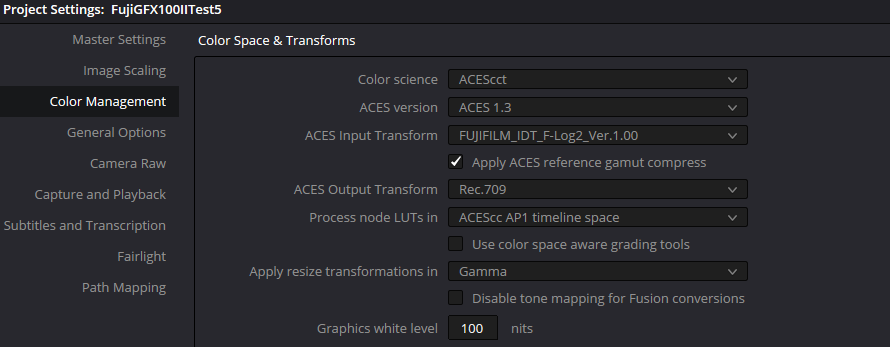
I downloaded the IDTs and installed them in Resolve Studio. I get inconsistent results with them. If I use my standard way of setting up ACES, like this:

I get a washed out image.
If I instead select ARRI LogC3 as the input transform, I get a nice looking image.
Any idea what's going on here? What am I doing wrong?
-
8 hours ago, kye said:
One example that I was thinking of when I was writing a previous reply was the ability in unix to create a symbolic link from anywhere on the file system to anywhere else, which is incredibly useful for moving things to external drives to free up space on the local SSD for example, and doing it in such a way that the OS doesn't know and doesn't throw a fit.
Windows supports symbolic links. To create them, use the mklink command.
-
7 hours ago, kye said:
People definitely use external SSDs to augment their internal storage, but there are limitations to that kind of thing.
At the time you needed about a dozen third-party utilities to be able to do all the things that you wanted. When I moved to the Mac I did a bunch of googling about "how do I do X in OSX" and read a bunch of tutorials on how to switch, and at the end of it I realised instead of needing a dozen third-party utilities I only needed 1 or 2. That was an interesting observation. I realise things likely changed in the meantime as Windows gradually added things.
Maybe it was just a point-in-time thing. Maybe it was just because I already knew how to use unix, so using things like piping and regular expressions etc was all stuff I knew how to do.
Every time there was a new version of Windows it took a bunch of hours to deal with the fallout of things not working the same etc, and that time requirement just stopped when I made the switch. It was something I really noticed at the time.
I'm not trying to say that either one is better or worse, and if I had to switch platforms then I'm sure I'd be fine and would see some new things I like as well as some annoyances too.
I realise today things are much more ubiquitous. Probably every software package I use would be available on both platforms, and the hardware might be better on the Windows side now too. I've had a constant stream of Windows laptops since then for my day job and they seem to work ok.
Yes, Unix does have a lot of put-together-the-parts utilities that run in pipelines to do useful stuff. Windows never really had that kind of ecosystem, but there have been utilities added over the years that do most of the things Unix utilities do.
Recent Windows versions have WSL (Windows Subsystem for Linux) which supports running a Linux distro in Windows, and then you have access to all of the Unix tools like grep, sed, awk, diff, etc.
I mostly don’t use them much these days anyway because development tools like Visual Studio provide such a rich environment for developing code that they’re not necessary. The other tool I use heavily, Vivado, not so much ☹️




24p is outdated
In: Cameras
Posted
Never say never. People who do usually end up eating their words eventually.
What is a “soul” anyway?
Yes, consciousness will be a tough nut to crack, especially since we don’t even know yet what causes it in animals.
Look how far we’ve come in just a few decades. In the mid-1970s a CPU had a few thousand transistors. Today they have tens of billions. In the 1960s we had ELIZA. Today we have ChatGPT.