
eatstoomuchjam
-
Posts
1,351 -
Joined
-
Last visited
Content Type
Profiles
Forums
Articles
Everything posted by eatstoomuchjam
-
Almost no card ever reaches the quoted "up to" numbers that they give, especially not in a sustained transfer. A2 and V30 are generally the best specs that you'll find on a MicroSD. If the Mission 1 Pro writes faster, you might want to check on some forums to see which cards people have found work well with its highest-bitrate modes. Though that said, if you're talking 100-200mb/s (megabits/second), a V30 card should do that without breaking a sweat since the V30 refers to 30 megabytes/second which is 240 megabits/second.
-
Looks like I came close-ish while overall being too optimistic (my guesses didn't feel all that optimistic?) and they exceeded in at least one way ((cropped) 4kp120). Otherwise, yes, faster UHS-2 SD card (I think that's the second row of pins that I meant). No CF Express, but memory stick is indeed gone. No extra megapixels. I didn't watch anything yet to see if 4k recording is now full sensor width vs slightly cropped or whether they support open gate - guessing no on open gate, at least, since it seems to be either the same sensor or a minor update to the same sensor. I also mistyped the camera model on the USB port bit.
-
I have no direct experience with the rawlite filters, but people seem to like them. You might want to specify the camera since there may be variance in the quality/utility of the filter. As a cheaper option, have you considered using a pro mist/glimmer glass/etc filter? I think those can help with moire too.
-
Let's hope they updated it more than they updated the ZV-1 Mark II over the ZV-1 (or for that matter, the RX 100 V). From what I remember, that "upgrade" was really just giving the new model a wider-angle zoom lens closer to the focal lengths on an iPhone and reducing some other specs (like getting read of the burst video modes). My guess? At most a small incremental update over existing RX10 bodies. Any substantial upgrade would see Sony risking letting their point and shoot camera have superior specs, if even on paper, to their prosumer gear. 6K? 240fps 4K? Higher dynamic range from a newer sensor? My guess without looking at rumor sites? It'll have a somewhat updated 1" sensor and add USB-C to replace the micro usb port on the existing RX 100 IV (unless they already released an updated version with better USB?). Maximum 4K recording will go from 30 to 60fps. Full HD from 120 to 240fps. Memory stick + SD card will be replaced with CF Express A + SD Card. SD might get faster with the second row of pins that's on newer SD cards. Still images will go from about 20 megapixels to 24-26 megapixels. Video crop will go from 1.09x to 1x and open gate in either 4:3 or 3:2, whatever the sensor dimensions are, will be an option.
-
Thoughts on the tiny camera market (and Kodak Charmera specifically)
eatstoomuchjam replied to kye's topic in Cameras
True - though an argument could be made that an ultrawide lens and higher resolution frees you from too much need of a screen. Just sort of point it in the general direction of the photo you want and shoot. Then lock down the frame in post. Instead of Weegee's "f/8 and be there," we could be in "16mm FOV and be there." 😉 -
Usually a clean plate is useful for things like subtracting objects from the scene or similar things. Once you erase the thing, you need the stuff that should have been behind it. If your goal is just to key out the smoke from one scene and add it to another, I can't think of why you'd need it. Though I'm no VFX expert so I'm fully prepared to be wrong!
-
Thoughts on the tiny camera market (and Kodak Charmera specifically)
eatstoomuchjam replied to kye's topic in Cameras
He used to wear weirdly large cargo shorts and it became a running joke on this forum. He doesn't seem to do that as much anymore, but the meme lives on! -
As Kye said, you could also shoot it against a back background and key on luminance instead of color. What would the purpose be of a clean plate in this case?
-
Thoughts on the tiny camera market (and Kodak Charmera specifically)
eatstoomuchjam replied to kye's topic in Cameras
Another thread where I'll mention the Insta360 Go 2/3/ultra or similar as an option. The price is definitely higher than a Charmera, but in terms of size, it's maybe even a little smaller? And with much better image quality. From what I remember, the carrying/protective case in the Go 2 is about the size of an Airpods case and I've definitely kept those in my pocket before. Matt Granger has entered the chat -
Yikes! I'm so sorry about your dad. 😔 I hope things improve!
-
Sigma Fp review and interview / Cinema DNG RAW
eatstoomuchjam replied to Andrew - EOSHD's topic in Cameras
It's been a while, but I think it was either that or a slightly bigger cage that wrapped the whole camera. I had the option for the bottom-mounted SSD or a side-mounted smaller one. I primarily used the side-mounted one since it was overall smaller. I didn't - I don't have a lot of interest in shooting 1080p these days. If I did, I'd be more inclined to re-buy the original BMPCC (sometimes I consider this and always turn back when I see the current prices). The EF 35/2 IS is great. I don't think I have (or have used) the EF 24/2.8 IS, but it's decent. You might also consider the 24-70/4L IS. It's definitely a little bigger than the other two lenses, but not bigger than both of them together. Not as fast, but the fp is alright in low light. I personally didn't like the PDMovie at all. The one that I had used some weird little batteries and there was no way to tell it to focus on anything but the closest thing. YMMV. If it were me nowadays, I'd give a hard look at the ZR. A used ZR costs more than a used FP, but the difference gets to be less when you end up buying a DPL cage and PDMovie to make up for the FP's shortcomings - and closer yet with the flip screen mod. With the ZR, you'll get a much nicer screen, decent autofocus, and built-in raw. -
For me, it's not even an argument. Or if it is an argument, it's a silly one and I want to stay as far away from it as possible. There was a time when zooms were noticeably worse optically than primes - potentially made worse with the release of lenses like the Nikkor 43-86 (that said, I have and kind of love the 43-86, though I have yet to convince anybody to let me use it on set). But since sometime in the 80's, high quality zooms have existed. The 24-70/2.8's and 70-200/2.8's from Canon/Nikon have been fixtures in the bags of nearly every professional photographer since then. They're sharp, fast enough, and extremely convenient. I've used them on set dozens of times. When shooting by available light or when going for more extreme subject isolation, I might move to a faster prime... but when I do, I'm rarely like "wow, this is so much better." I'd even go so far as to challenge most of those people to tell the difference between the 24-70/2.8L II at 50mm stopped down to f/4 or f/5.6 and the EF or even RF 50/1.2L stopped down to f/4 or f/5.6. There might be a different character in the bokeh from the RF, but that's more of an ultra-modern design vs still-pretty-modern design concern vs a zooms vs primes one. I'm pretty sure that's what I just said. 😉 This goes with another of my parlor tricks when on someone else's set - pointing out things to them that will be a problem in their scene simply by looking at the lens on the camera and where it's pointed - I usually have a good idea of what their frame is without having to look at the screen. "You sure you don't have the sound engineer's pack in the frame on the right edge? With that 35mm lens, I'd think you'd see it." (pause) "Oh, yeah. Could you take a step back?" It can be useful for making a guess at the price/quality ratio of the lens (also based on the widest aperture). Finding a good quality f/2.8-f/4 lens that's a 2x or 3x is usually relatively affordable. 4x less so. At 5x, you're either going to be forking over a lot of money, getting a slower lens, or mounting a coke bottle to the camera. That said, I still check prices on the EF 35-350 sometimes in a fever dream since I'd like to see if it can be "good enough" in many cases - and the same with the more useful EF 28-300, but its used price is staying stubbornly high. Once it hits $700, I might buy one in a late-night drunken rampage or something (I barely drink these days so there are fewer opportunities than there once were). Kubrick was fully correct! As he often was!
-
iPhone Lidar apps & cables as focus helpers or AF
eatstoomuchjam replied to radneuerfinder's topic in Cameras
I really wanted to like the PDMovie. I had the previous version (Air 3 Smart? Something like that) for a bit and ended up selling it after trying to use it just a few times. The weird batteries were a little annoying, but I could have lived with them if not for the complete lack of ability to choose what it focuses on. As far as I could tell, the focus would always be on "whatever is closest" With DJI focus, the hand grip has a little screen where you can at least tell it where you want the focus to be - and it'll successfully focus on that thing about... well, 85% of the time. For me, the systems that fake out PDAF are more exciting. I hope that someone comes out with one for RF mount sometime - or even better, for EF mount. Otherwise, the ones with a little motor are kind of neat - though moving the lens back and forth is not quite the same as adjusting the focus (though usually it's a relatively petty distinction). -
Sigma Fp review and interview / Cinema DNG RAW
eatstoomuchjam replied to Andrew - EOSHD's topic in Cameras
This is exactly why I ended up selling my fp and fp-l. I tried just about everything to keep the kit small for raw recording. And kept coming back to how big they got, even with the smallest possible external SSD (one of the DPL SSD cases in their mount). By the time I added that, I had a camera the same size as my Canon R5, but also less capable than the R5. If Sigma would release the exact same camera, but able to record compressed 12-bit raw to SD card (Canon did it on the C70 and they do it in raw lt on the C80!) - or with a CFE slot that can record the existing uncompressed raw, I'd be strongly considering it again. The default size for the fp is just so good. Similarly, once the price of the bf gets to "not silly" level, I'd be apt to get one. Anyway, the ZR seems to be almost everything that I wanted the fp to be - it's another one that I'm likely to get someday after prices drop more (or there's a crazy good sale). -
"Cinema" over the last 130 years would strongly beg to differ in terms of the size of the imaging sensor used. 😉 This one is a best seller, presumably, because it was just recently announced and it's still in preorder state (with a free PL adapter!). I'm tracking it, though, as it's in the "less squeeze, but with oval aperture" that I find somewhat interesting, as shooting true 2x anamorphic feels generally unwieldy. I'll point out that even in a distortion-free 28mm lens, shooting a close-up tends to be unflattering due to perspective. The reason longer focal lengths tend to be seen as more flattering is because the relative distance from the nearest part of the face (probably the nose) and the rest of the face (especially the eyes) is much larger. If I am standing 12" from a subject with a nose 1" long, the nose will seem much larger in comparison than if I am standing 48-72" from the same subject. This can be observed simply by holding the hand about 11" from the face and moving it back 1". The difference in size is noticeable - and it is for the nose in a portrait as well. There's an additional part of this which will get you chased out of a number of forums for heresy - if you are shooting at sufficiently high resolution, you can take a couple of steps back with your 28mm lens and then just digitally reframe/zoom in on the subject and get functionally the same result as putting on a slightly longer lens at the same aperture value (give or take variances in lens character, etc). If you're shooting at 8K to deliver in 4K, it can be a pretty big couple of steps. This is basically turning a prime lens into a zoom lens. This sort of thing is specifically why I love having a 180mm macro lens - it lets me do extrame c-u of an actor's eye or eyes without getting the entire camera package right up in their grill. No matte box, though. I ain't professional enough to use a matte box. Controlled sets can also be places where using a Zoom lens becomes more attractive, as swapping lenses can take 3-5 minutes. - Detach FF gears - Remove support - Unmount first lens - Mount second lens - Attach support - Attach FF gears - If using electronic FF, run calibration - Potentially, if on a fancier set than I'm usually on, inform whoever is doing script notes of the change If shooting under any sort of time constraints, everybody will start to hate you after a little while if doing this frequently. This sort of thing is why I've begun using a Canon C80 with autofocus stills lenses for timed film competitions. I did one with the RF 24-105/2.8 on loan from CPS (worked great, beautiful lens, maybe someday when the price is more reasonable, I'll buy one) and another with my own 24-70/2.8L II and 24-70/4L IS and swapped in the 85/1.4L IS for some close-ups and the 180/3.5L for some extreme close-ups. It's been working really, really well. On the last set, when someone got annoyed that I was swapping lenses again for some reason, they timed me - total time for a lens swap was about 1 minute 15 seconds (no lens supports, no FF gears).
-
For me, I'm still not seeing that as especially useful or revolutionary. It's been possible for a long time, probably 10+ years, to do gyro control of larger gimbals (usually through the phone app, but I think I had or saw at least one with an external gyroscope controller in the past). It never took off much and I never saw anybody strap a phone to their head to remotely control their gimbal. I'm not sure if gyro controls are in DJI MIMO, but if they are, it's already basically possible with the Pocket 3. I've found gyro control to be somewhat useful with the Ronin 4D (including with the flex unit). On one shoot, I was getting too tired to carry the camera anymore so the grips started carrying it around while I controlled the frame from the gyro on the high bright remote monitor. It worked... OK. It'd be better if we'd practiced it beforehand, probably. For me, it's more "parlor trick" than "genuinely useful tool" in most cases.
-
But all of that was previously already possible by using something like the Insta360 Go mounted on the brim of a hat. And as I previously mentioned, that has the advantage of actually being the perspective of the person using it, vs the perspective of their chest.
-
For me, the head tracker suffers from a few problems. - No 4th axis stabilization means the footage will be partially smoothed, but with footstep movement (not different from carrying it, but not ideal) - Is not actually at eye level, assuming that the wearer and people they interact with are all of average height, the viewer will be staring at the chests of everybody - or at their double chins and nostrils. - Many people are going to find it creepy and will not react naturally when someone comes up to them with ET in the papoose For this sort of use case, something like the Insta360 Go line is a lot more suitable and it can be clipped to a hat. People might still find a little square camera on a hat to be a bit intrusive and odd, but at least it's closer to eye height and will be looking directly at people's faces. And electronic stabilization is generally pretty good these days - haven't used a Go myself, but I'm sure it does a perfectly adequate job of making things not overly spastic. And aside from the hat use case, helmet mounts for action cameras have existed just about forever and for any use case where the user would naturally wear a helmet, they work well and most action cameras are more robust if there's a crash - and they cost less if they do get broken. Of course, there are also SmartGlasses that sit exactly at eye height an point to exactly whatever the user is looking at...
-
There are so many variables when it comes to how you're viewing the film images. Negative film has wide dynamic range and soft highlight rolloff. Positive film has much more limited dynamic range and pretty hard highlight rolloff. Faster film tends to be grainier. Filmmakers with a big budget would be choosing their film stock for aesthetic/style reasons. Imagine shooting Taxi Driver on the same technicolor low-grain film stocks that were used for The Sound of Music. Bright saturated colors would have been terrible for Taxi Driver. Scorcese chose less gritty films than some others might, but Travis Bickle lives in a relatively desaturated/dark world and that's for the best. Filmmakers with low budgets were likely to choose the cheapest film stock they could and some even used the leftovers that weren't exposed from the productions of others. Or in the case of John Waters, whatever film he could steal. Next, as you said, for these classic films, you aren't necessarily looking at scans from the master negatives. You might be looking at scans of the release prints. They didn't always save the masters. It could even be a second or third-generation print. Then to add to that, the way the film gets transferred matters. Did they scan the original negatives or a print? How was it scanned? Was the film being scanned perfectly flat? What compression was used on the scanned image? Was it scanned or telecine? If telecine, which projector lens was used during the telecine process? As far as the lenses, razor sharp lenses have been available for a long time, including in the 50's, and including wide angles. Lots of vintage wide angles are a little softer in the corners, but they can be very crisp in the center... but fashion applied in many eras of film, just as it applies now. For some of the softer images, especially close-ups, they might have been using a net filter, made more complicated by the net filter potentially being mounted behind the lens instead of in front. https://www.provideocoalition.com/the-secret-life-of-behind-the-lens-nets/ I'm sure I'm forgetting more things too. Like almost anything going through an analog to digital process, there are about a bazillion variables to consider along the way.
-
Famously, the greases that Leica used in their old lenses would evaporate and deposit on lens elements over time. It can be cleaned, but the danger of evaporation/depositing is real!
-
The faster the lens being boosted, the more likely you'll have some speed booster artifacts. Even with Metabones, I don't think I'd go past 1.2. If you really wanted to go that way, and it's off-topic for this thread, but I'd suggest looking at the Voigtlander 29/0.8 which, IIRC, is native for M43.
-
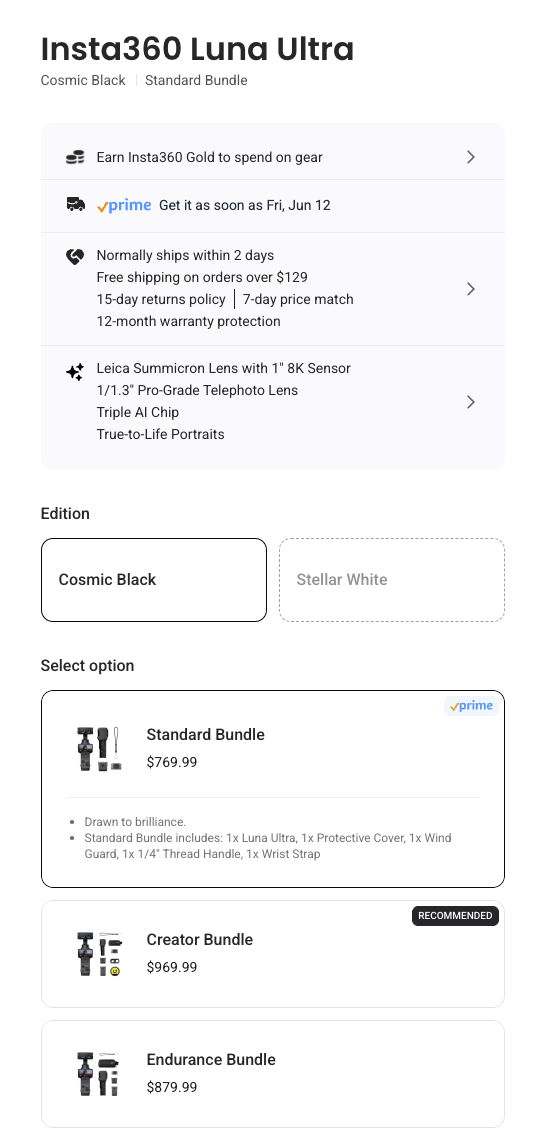
Starting at $770!! 🤣🤣🤣🤣🤣🤣🤣 Guess they saw GoPro's pricing on the Mission 1 series and said "hold my beer."

-
This is correct. Depending on the emulsion, grain is also not sized uniformly. And since you posted the Take 2 Films' tour of Kodak, it's also worth pointing out their latest film is comparing a couple of different film stocks and methods of processing them. This aligns with something that I frequently say - "film look" is meaningless as a phrase, given that different films have different characteristics - and depending on processing, can take on even more other characteristics.
-
Still no info on whether it's IMX410 (it probably is), but Kinefinity have wisely dropped the price. It's now $2,499 and that's with a built-in 220GB SSD. They also are offering a break on preorders so it's only $1,999 in the short term. IMO, $1,999 is the correct price. That puts it really close to the Nikon ZR which has a lot of fairly similar specs, but also can shoot raw internally, just at the cost of a really dumb placement for the battery/memory card. Time will tell, but overall, not a bad value at all. I hope they get some good sales. https://www.cined.com/kinefinity-vista-confirmed-at-2499-full-frame-6k-open-gate-220gb-built-in-ssd-610g-body/
-
Oh, I wasn't getting as fancy as anybody's sensor stack or anything like that. I just meant smaller lenses which didn't need to decide to have an image circle that covers S35 or any other larger sensors. The Laowa 7.5mm that you mentioned is a fantastic example of a lens designed for Micro 4/3 and I'd be shocked if its image circle would cover S35. I'd contrast that with something like a Rokinon Xeen. You can go buy one with an MFT mount, but it'll be the same design/glass that you'd find on the same model of Xeen for FF. It'll work fine, of course - but the lens is bigger and heavier than it needs to be. In that case, of course, there's an EF mount version which would make more sense on a focal reducer.