All Activity
- Today
-
 chaoomachderi1975 joined the community
 -
 ennanidif1978 joined the community
 -
 doijamviere1986 joined the community
 -
 daygutico1985 joined the community
 -
 oninanha1987 joined the community
 -
 casmutoxa1971 joined the community
 -
 That is precisely the point about limits, already laid out rather extensively in my post on the previous page... although I may have to start charging royalties if we keep returning to it ; ) Extra dynamic range is not always needed, and neither is extra resolution. But 8K allows greater cropping and reframing while retaining a 4K output, additional room for stabilisation and VFX work, and higher-resolution frame grabs. You may not need any of those things in your own work, which is perfectly fair. But that is quite different from saying that 8K offers no valid practical advantage over 4K at all ;- )
 -
 Just chiming in to say I was working with someone recently who was extremely happy with his Osmo 4p. Never having to balance a gimble ever again etc.. However, they said the one problem with this cameras is they're too light, which makes it more susceptible to up and down movements when walking. Their solution, which really made me laugh, was to mount it onto their regular camera, Blackmagic 6kPro, and use that as basically a paper weight. I'd stupidly assumed they were getting double angles of everything!
 -
From what I've read, this is basically correct. It can apparently add about 3 stops of extra highlight retention. On most modern cameras, changing ISO doesn't change the sensor gain unless you move into the territory that is handled by the next "native" ISO. The only exception I know to this is Z Cam (which is why they suffer some WB shift when changing ISO). Otherwise, for raw codecs, you are adjusting the allocation of stops/highlights in the recording - and for non-raw codecs, you are changing how the camera post-processes the raw that it read at the base ISO. So in theory, the LOFIC should help with any ISO that is set by the user. It should also be understood that it only helps with highlights and does nothing whatsoever for shadows - meaning that ETTR is probably even more of a thing with any LOFIC system than it was with most Bayer sensor setups.
-
 wyeksilvapar1986 joined the community
 -
 Minor nitpick: 8K will also be largely irrelevant in cinemas! At least near me, many of them still broadcast 2K on most of their screens, with maybe one or two set up for 4K projection. Only the most eagle-eyed audience members could even theoretically notice a difference in 4K and 8K projection at a viewing distance where they could see the entire screen at once - and outside of maybe a nature documentary, even among those viewers, it's hard to imagine them caring much. Not true. Aside from digital zoom without substantial quality loss, as you mentioned, a number of VFX use cases, especially those involving masking something out, are improved by having the highest-resolution source material available. That and in theory, you'll get better color information putting 6K or 8K on a 4K timeline, assuming the use of a Bayer sensor. Remember that it's necessary to guess at the values for 2 out of 3 colors for every pixel when debayering footage. From what I remember, and I might remember wrong, this means that the readout from Bayer sensors is effectively 4:2:2. Downsampling from 6K or 8K gives you something that is more effectively 4:4:4. As to whether that matters to you, maybe none of it does. In practice, modern debayering is very good and I'm not really sure that viewers are ever going to notice a difference in 4:2:2 and 4:4:4 once at 2K resolution or above. Correct. A 4.6K Arri is still preferred in many productions to an 8K camera from another vendor. The FX5 is going to sell a million bazillion units despite being released as a 5K camera in an era when all of the competitors are at 6K or higher (also assuming that some of the firmware weirdness and constant rebooting to change settings can be fixed). There are still cameras being released today using the same IMX410 that was in my Z Cam E2-F6 that I bought in 2018. The Ronin 4D was one of the best product ideas that DJI ever had (really, the Osmo Raw was, but the execution was too clunky). They were never going to compete with Arri in the space where people use Arri - so take a real pain point from a lot of productions (gimbals are irritating to use/balance and are often disconnected in operation from the attached camera) and fix that. Now you see the 4D showing up in all sorts of productions - because it's the best camera ever made and wins the spec sheet wars? No. But the quality is good and it's an elegant solution for some problems.
 -
 gramsuppsingma1982 joined the community
 -
 Everything you said above can be copied and pasted a decade from now when people are arguing if a 32K sensor is better than a 16K sensor. On the 32K sensor you can crop in more.. it's great for high-res frame grabs.. cropping in 9 times instead of 8 times! The problem with such discussions is they're unconnected from reality. What CAN you do with an 8K image that you CAN'T do with a 4K image? Both have enough resolution for cinema. Both have enough resolution to pull frames and print them on billboards. Both have enough resolution to win an Oscar... etc. All this is beginning to sound like people arguing they need a 150MP doorbell camera to be able to live with themselves.
 -
 emhahwarea1978 joined the community
 -
Fair enough, and I think “it really comes down to your perspective” is already much closer to what I have been saying from the beginning : ) I would only question “completely irrelevant”, 'cause and when you immediately acknowledge the principal practical justification for an 8K sensor: Cropping twice into a 4K image ; ) That is precisely where the additional detail becomes visible in the comparisons posted above, particularly with the tele shots and whenever the image is cropped and magnified. 8K is also useful for extracting high-resolution frame grabs : P So yes, I concur that the Pocket’s additional latitude may be much more valuable in a wide, uncontrolled, high-contrast exterior scene. The Pocket 4 Pro remains high on my wish list, of course : ) But in a shot requiring additional reach, reframing or magnification or yet, genuine DSMC use ; ) the Luna’s resolution may be the advantage that actually matters too : ) Which brings us back to perspective, purpose and the particular shot, rather than to any single universal verdict on the two cameras. Let alone the POV Head Tracker, detachable screen, internal 32-bit float stereo audio (all game-changers) and the rest of the Luna’s modular shooting concept ; ) E. :- )
-
 kye reacted to a post in a topic:
The GX85 "Super-16" project
kye reacted to a post in a topic:
The GX85 "Super-16" project
-
kye reacted to a post in a topic:
Smallest real 720p or 1080p P&S camera?
-
kye reacted to a post in a topic:
LUMIX L10 - announced
-
Interesting idea that the lens might be contributing to this impression, and I would tend to agree with you. In my testing I routinely found that if you change almost any variable then the aesthetic impressions of almost all the image characteristics are changed. This is one of the reasons I am so critical when people compare cameras side-by-side but don't match WB and/or don't use the same LUTs or colour pipeline, they're effectively saying "I've compared these cameras in identical conditions except for the colour which is different in every way and impacts your perception of basically every aspect of the image". My testing of YouTube suggests that for 4K uploads Prores HQ isn't much better than H264 at around 100Mbps, and maybe also 50Mbps, but it's likely to be pretty subject specific (like if you have lots of demanding shots like big fountains or rain or snow or waves moving across water etc - things with huge amounts of motion). I'd suggest experimenting, and hopefully that gives a place to start. Impacts of these sensors to the market value of videography is obviously a hugely complex topic, but in general terms if this reduces the barrier to entry then more people will come into the market and more supply without more demand means the price goes down. I'm not sure that the extra DR of these sensors really has that much impact on this though. I watched Peaky Blinders The Immortal Man on Netflix the other day and there's a wide shot taken from a long way away with a large fire on top of a hill and no other lighting in the rest of the scene, taken at the dim end of blue hour, and the fire is clipped to absolute hell, basically being just a solid yellow blob. Whatever cameras they used were fine for the rest of the film but clipped on this. The market for DR is there, but the better the tech gets the thinner the tail is. Still, if every camera had Alexa 35 level DR, that would be a nice bump in quality for all footage for sure. Temporal NR wouldn't be shown by that graph, true. I agree that the word "RAW" has less and less meaning every day of late as well! The relationship between ISO and DR is an interesting one too. I used to think that the DR during the day was higher than at night, especially if there was direct sun, but I've almost reversed my position on that since I've been shooting more at night in recent years. It might be that during the day people expect that the light and shadow sides can't both be seen at once whereas at night lighting from artificial lighting is more even, or it might be that the sun doesn't tend to be in the frame when at night the lights are almost always in the shot unless you're using quite a long lens and the background is controlled. If you think about S16 film footage the daytime footage doesn't normally look as harsh as the shots taken at night in cities where every light in the frame is absolutely blown to hell. I haven't read up about LOFIC sensors, but my impression was that they have an additional capacitor that catches the 'overflow' from the main read-out, which should increase the DR across all modes of the sensor. This assumption that it applies all the time and without any trade-offs may well not be true of course, but it sure seems to work nicely at base-ISO where they tested it!
-
You make excellent points, but it really comes down to your perspective. The detail from the 8K will be completely irrelevant, except in cinemas, where exactly zero people will ever watch this footage. The extra DR will absolutely be visible, even on smartphones, even with a film emulation applied, and especially because these cameras are designed for wide FOV shooting outdoors where there is a high probability of having huge DR (and even the sun) in the frame. We can look at images in controlled lighting, this is true. However under such conditions the vast majority of cameras from the last decade will look just fine. In fact, if the older cameras have the same bit-depth in their codecs but less DR then they might look BETTER than the modern cameras as the bits will be less stretched! So if we're going to compare modern cameras in very controlled conditions then the comparisons should include the vast hundreds of models released in the last decade or so, but if you do mention them then people go berserk because these older cameras fall short in other areas, and you can make a good argument that the controlled tests are nice but not entirely sufficient for evaluation. In which case, the stunning differences in DR between these cameras is now back in the consideration and the DJI is miles ahead of the Luna. To summarise that a bit, if you're taking everything into consideration then the DR really matters and if you're not then why aren't you comparing dozens of older cameras, and if you desperately want a tiny gimbal but only shoot in controlled conditions then isn't that a niche application so narrow that it really can't be justified to evaluate the cameras overall? In terms of me reminding people that lower DR 1080p cameras are fine for many practical tasks, this is true, but modern camera releases have basically nothing to do with practical tasks at all. There is no justification for 8K codecs. Period. The justification for 8K sensors that let you crop 2x for a 4K image is borderline but fine. Then there's 17K - seriously... Most camera discussions departed reality long ago and the discussions about this or that camera have the same rigour as discussing which super-hero can win against which other super-hero.
- Yesterday
-
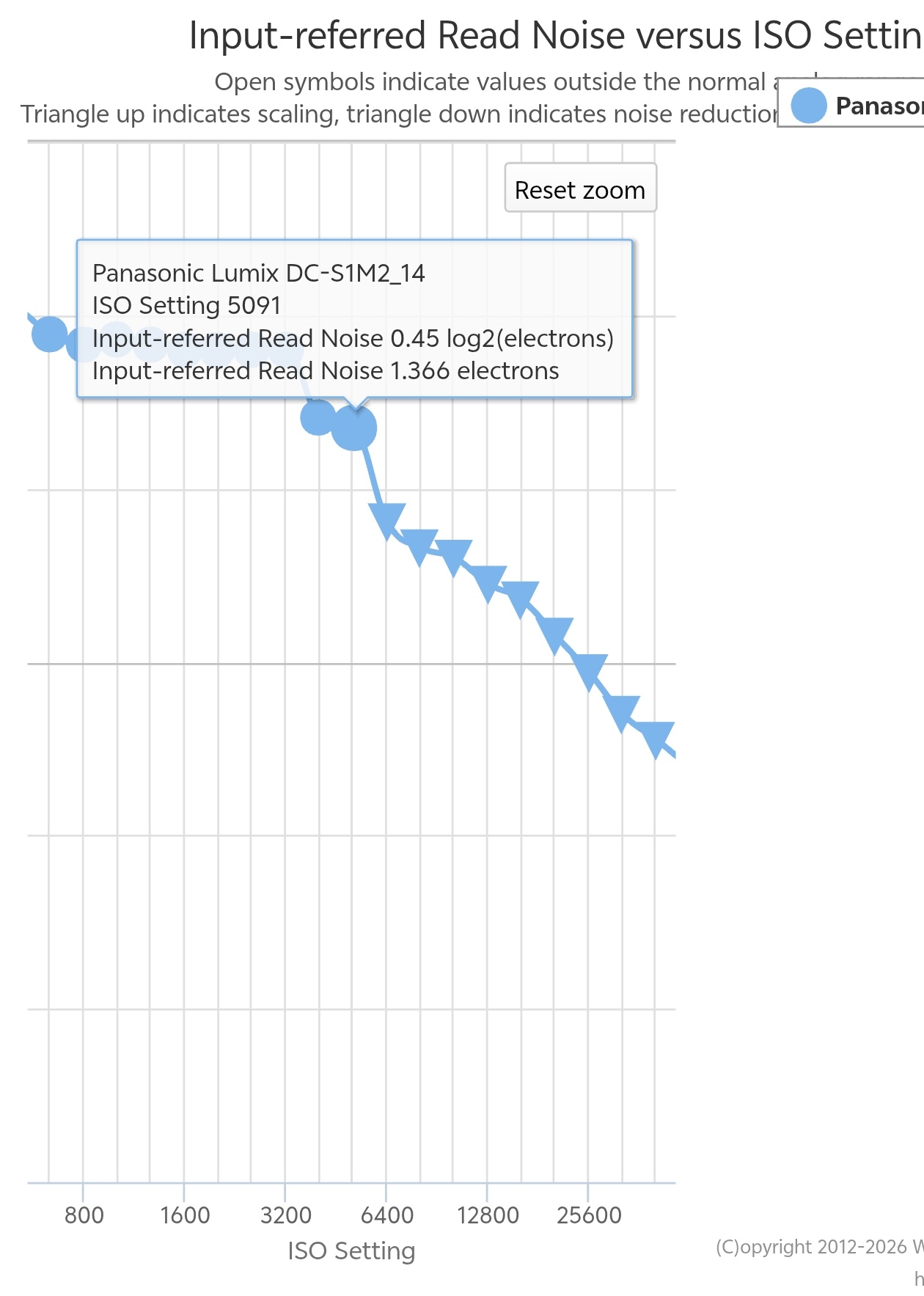
They only rely on IMATEST and it doesn't reveal everything. Especially these days that temporal NR algorithms are doing magic work. The RAW files of these devices are nothing like conventional RAW still images from a mirrorless camera, let alone their 10bit h.265 video. But even some still cameras turn on the NR on RAW from a certain ISO and above. This is S1II for example. The highest no-NR-applied ISO is ISO 5000

-
eatstoomuchjam reacted to a post in a topic:
LOFIC sensors are the future...
-
Found you another camera to play with.. Godox C100: accidentally the best new toy camera 😁
-
Maybe. It could also be how the lens renders people, that gives me the sense of artificiality. I do see a significant image (and sound) quality reduction when uploading my own video to youtube at the settings and video format recommended by youtube. I've been trying to figure out how to minimize this issue, and one way is to use the highest-quality format as an intermediate for uploading (QuickTime with Prores HQ). I've not gotten to test this enough to come to a conclusion. I think to evaluate noise reduction and other algorithmic processing done by the camera, one would need to look at subject detail also, and how faithful the details and color in the image are to the subject. This is affected by the lens in addition to digital image processing and compression, but when evaluating a fixed (non-removable) lens camera, it is fair since the user can do nothing to change the optics. Anyway, if this sensor and optics available for 1" sensors satisfy the video community then a lot of money can be saved by not having to invest in larger sensor cameras. It also means making videos of satisfactory quality (or quality that is perceived as very good by the public) will become much more accessible to the general public and thus worth less in the job market, as has become the case for still photography. However, I'm not really convinced just yet.
-
The one thing I have not tried is the e stab, but straight out of the box with zero set up other than a quick balance, on the RS4 mini with the optional tracking module, it worked superbly. Not even close to anything like overheating, but then so far, I have only really been shooting stills with it. Start up time must be fine as I have not noticed anything other than it takes a second or so for the zoom to find it’s last setting, either; 28, 50 or 75mm as I have it set. Battery life excellent. I just came back from a week long trip to Scotland and shot well over 1000 frames and battery still showing 2 bars.
-
Emanuel reacted to a post in a topic:
Smallest real 720p or 1080p P&S camera?
-
Emanuel reacted to a post in a topic:
Smallest real 720p or 1080p P&S camera?
-
I treat the LX as camera for HD delivery. From my experience, it's the best ratio between size, quality, ergonomy and used market prize for good quality HD. GM1 with a 14mm is thicker, more expensive and handheld video turns out jittery very easily due to its tiny body not being equipped with a stab. I have tested the video side with my slightly taller GM5 and it's not fun to use for video. The stabilized 12 to 32 zoom makes it thicker than I like to for considering it over a GX85. The LX15 has lens stab, which works in 4K as well for holding steady, panning and tilting. HD on it is just too brittle for my taste so I see it as a 4K4HD cam. My two cents. Nice talking to you again, kye.:) @kye
-
 Emanuel reacted to a post in a topic:
LOFIC sensors are the future...
Emanuel reacted to a post in a topic:
LOFIC sensors are the future...
-
No, @kye I do not think they are lying. Where exactly did I write such a thing?! : ) The reference to Andrew’s forum rules was precisely what I called it: a slightly amusing, good-natured bit of irony meant entirely in a friendly spirit! Nothing more than that : ) BTW, one small correction: the result is 16 stops at SNR=2 and 17.2 at SNR=1, not the other way around. The Luna’s supposed 13-stop result is not really a valid 13-stop measurement either. CineD explicitly says that the aggressive NR prevented IMATEST from distinguishing the different patches correctly, thereby invalidating the result. They will not even include those figures in their database. So yes, their test demonstrates very clearly that the current I-Log implementation is seriously problematic. No disagreement there. But charts and real-world footage are two very different things. A chart isolates one particular variable under one very particular set of conditions. It does not shoot a street, a face, movement, changing available light, colour, texture, skin, foliage, fine detail or an actual scene. This is precisely why the comparative footage posted above matters. Objective measurements are useful, of course. But only for as long as they help us evaluate an image rather than begin evaluating it on our behalf. There are limits to everything, including measurable advantages and human perception. Someone worth $1.6 billion is sixteen times richer than someone worth $100 million. A huge objective difference, no doubt. Yet if both go out to buy a pizza, chances are they will end up buying exactly the same pizza ; ) The extra wealth only begins to matter when what they want to do actually requires it. What about someone worth $160 million vs $10 million...? The same : P And so on ; ) Likewise, an 8K image contains roughly sixteen times as many pixels as a 2K image. Another enormous and objectively measurable difference. Yet once both are projected onto a cinema screen and viewed from a normal seating distance, many people may struggle to tell them apart at all. The additional resolution only becomes meaningful when the screen size, viewing distance and image content actually allow us to see it. And @kye this is especially worth remembering in your case! LOL ; ) Considering how often you have quite rightly defended 1080p as being more than sufficient in the real world : ) Which is precisely why you know that a measurable advantage does not automatically become a meaningful real-world one. Probably better than most camera lovers : ) More is more. It is not automatically more relevant forever. Four additional stops can obviously be extremely valuable when a particular scene actually requires them. I have never denied that (take a look up there! ; ) But a four-stop advantage on a latitude chart does not mean that the resulting image will look four stops better, or even necessarily better at all, in every real-world shot. And this particular latitude comparison was not even entirely like-for-like. The Luna was tested in 8K25 I-Log at around 120 Mbps, while the Pocket’s headline result came from 4K25 D-Log2. CineD did see the same aggressive NR in the Luna’s 4K wide modes, correct, but they did not repeat the complete latitude test in 4K. Nor did they test the standard profiles, which they themselves suggest may currently be the better choice. It is also worth remembering that D-Log2 is only available on the Pocket’s 20mm wide camera. The 60mm module falls back to regular D-Log, where CineD measured 11.6 stops at SNR=2 and 8 stops of exposure latitude. By comparison, the Luna’s tele camera in its valid 8K25 I-Log mode measured 9.7 stops at SNR=2 and 5 stops of exposure latitude. So the gap there is about two stops in measured dynamic range and three stops in latitude. Still a clear win for DJI, certainly, but rather less apocalyptic than the headline comparison between the two wide cameras ; ) The digitally extended 120mm view naturally derives from that same 60mm camera too, so the Pocket’s spectacular D-Log2 figures cannot be extrapolated across its complete 20mm to 120mm shooting range. So the honest conclusion is still that DJI’s 20mm D-Log2 implementation completely and utterly defeats Luna’s current I-Log implementation in this particular lab test. That is not the same as saying that one complete camera system completely and utterly defeats the other. Sometimes all the technical blah blah blah is extremely useful. Other times it is worth close to zero and can even contaminate the evaluation, especially once people have already been told which image is supposed to win before they look at the actual footage. At that point, the chart is no longer informing the eye. It is replacing it ; ) Take another look at the real-world comparisons above. The difference is certainly not “complete and utter” there. In fact, the Luna’s 8K image often appears to resolve visibly more fine detail than the Pocket’s 4K, particularly in the comparisons of tele shots or whenever the image is cropped and magnified. That may not be attributable to pixel count alone, since lens performance, sharpening, noise reduction and the complete processing pipeline all play their part. Even so, whatever the precise combination behind it, the visible result is there, and in some of those shots the result may even go the other way, depending on what each of us values in an image. In these comparisons, the Luna’s additional resolution is not merely a spec on paper. So I think we are not very far apart on the measurements themselves. We simply disagree about the amount of territory those measurements allow “completely and utterly” to occupy ; ) E. :- )
-
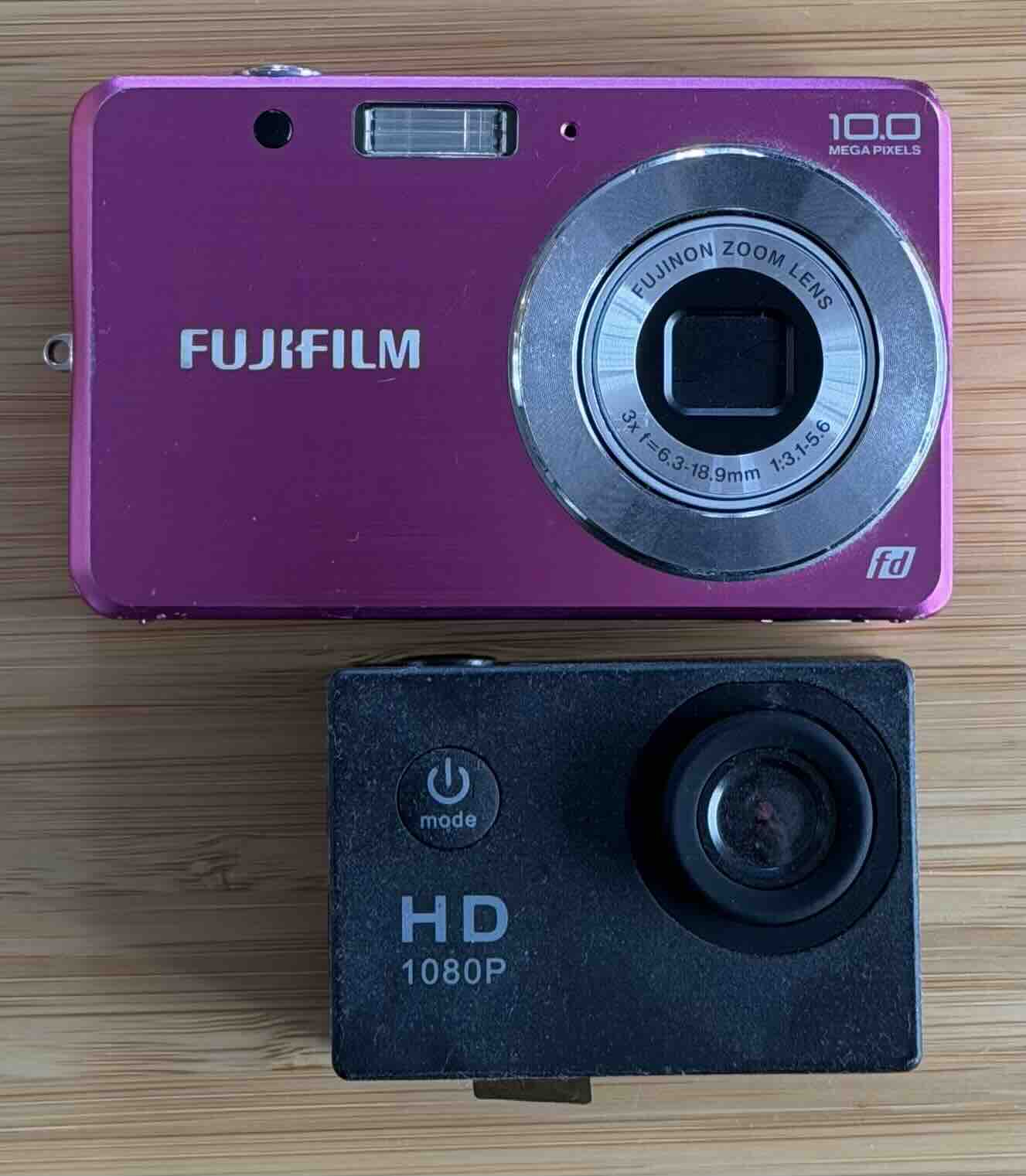
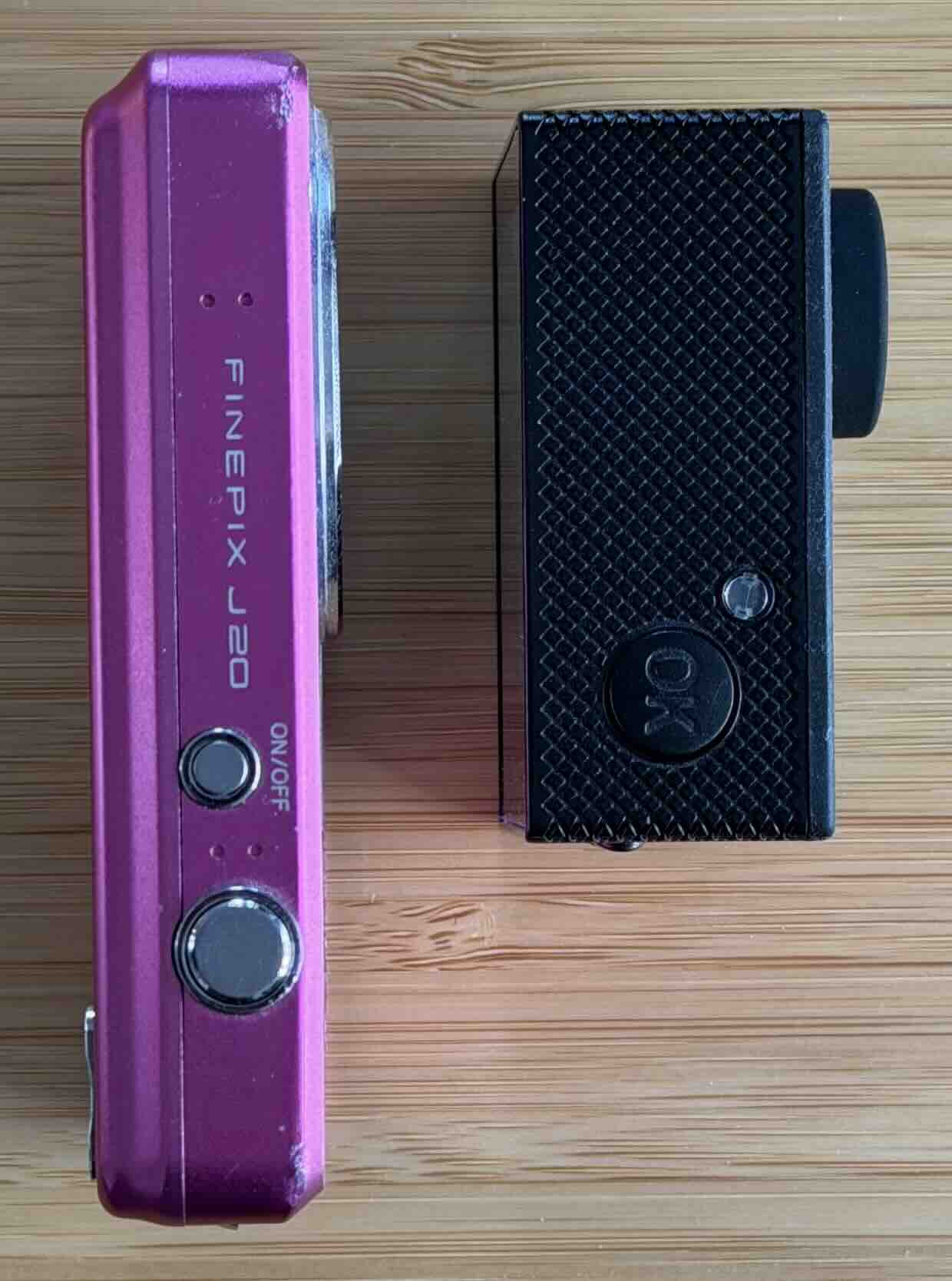
If the camera shoots 4K then you'd be silly not to, and I was really looking for the smallest 1080p camera, not the smallest 4K camera, but I did include a couple for reference so that's my fault for not being clear. I guess really this thread was a bit of a fantasy that I could trade spec for size, but we all know that's not how it works. Even 10 years ago the tech was there to make a camera with a GoPro sized body and a P&S lens on the front. I have one of my daughters old cameras - a Fujifilm J20 from 2009, which is an SD P&S but it's just under 20mm / 0.79 inches thick and has a 3x optical zoom lens. This is the J20 pictured with a fake SJ4000 action camera, which is basically the size of a GoPro. Combine these and they could have make a 1080p camera with 3x optical zoom in a body thinner than a GoPro and by making it slightly wider they could have made room for the battery and given a little grip to hold it with. Given that it might have been a big seller back then, I was hoping they'd be a forgotten classic and around for a couple of hundred, but really it's just a fantasy. The idea is the "smallest 720p or 1080p P&S camera" not the "highest resolution P&S camera". Sensible people don't want the best specifications available in the camera so large they can only just operate it, they want the nicest possible shooting experience with a camera that has the spec they need for their given situation.
- Last week
-
It Was Just An Accident (2025) by Jafar Panahi is an amazing film with sequences shot in secret in Tehran...
-
John Cassavetes, enough said:) There used to be some BTS footage and docs on youtube. I think they should be still up there. @QuickHitRecord
-
PannySVHS reacted to a post in a topic:
Narrative films shot in uncontrolled cities
-
How are battery life, overheating and startup time? @MrSMW Built? Thanks for sharing!
-
2x digital zoom was without artefacts right? 4x has to be aliasing extravaganza though!:) I could test it myself. But then, why not ask a GX afficiando like you!:) I still love mine. Got a second one so I carry two sometimes when doing a phototour. Up for a 2026 8bit challenge btw?:) Would be nice with more than two challengers though of course.:) @kye
-
Afaik the RX100 MK3 has downsampled HD and a 50Mbit codec. From my own experience HD on the LX15 feels too brittle for my taste, compared to a G6 or G7. Same goes for the GX85. @Andrew - EOSHD 4K on the LX15 is looking nice when graded. So my recommendation as well. @kye Beautiful 8bit 709 image, which makes me think we should do another 8bit challenge. It's been 7 years since the last one.:) @fuzzynormal How is focussing on the 25mm Pentax 110 lens? Looks like it would be very fiddely. Built like plastic and not so fantastic?
-
I was very impressed with the results I saw from various people testing it. The GH7 sensor is good, the lens in the L10 is also good, and V-LOG and the codecs available are more than enough, so it should be a great combo. In terms of the lack of IBIS, that's definitely a thing, but if you're able to steady it with almost anything (tripod, gimbal, monopod, even just a large handle of some kind) then it should be pretty stable.
-
One has 16 stops of DR (or 17.2 with SNR=2) with little if any NR, and the other has so much NR that the DR is measured as 13 stops for both SNR=1 and SNR=2, which is a completely ridiculous result. One has 10+ stops of latitude and the other has something like 4-5 stops of latitude. Considering that the primary purpose of these cameras is to shoot wide scenes in uncontrolled situations, DR is always a major challenge. NR is normally the issue with cameras like this too, and one has results that are remarkably good for cameras of any price, and the other is remarkable for how heavy the NR is. When the one that scores better in all of the above is the cheaper one, that's also saying something. I don't think that "completely and utterly" is overselling it at all. Hey, if someone else wants to publish lab tests on these things then I'll link to them instead. Unless you think they're lying about the lab test results, then the discussion is normally better when it involves actual objective measurements than if it doesn't involve any at all. I'm not saying that measurements are the only thing that matters, but if you're comparing two cameras that have a difference in performance of 4 stops then that's an incredible amount and when shooting outside in available light on wide angle lenses then that is something that really matters in real-world situations.
-
The CineD lab tests disagree with you about there being NR. Below I have linked to where they talk about NR test results and they say "very little if any noise reduction" (linked to timestamp): I believe your impressions about how the final images look, but Nr can happen anywhere in the pipeline, so maybe it was something done elsewhere in the process? YouTube compression is absolutely brutal on grain, acting as a pretty serious form of NR that is applied to every upload, so maybe that's part of what you're seeing too?
-
Unfortunately, not everyone cares. - EAG :- )
-
No, I have only viewed DJI's and various youtubers' material of the Pocket 4P. I assume everyone will use settings that will make the footage look its best as they would for their normal work, what would be the point of using settings that produce subideal results? Some of the youtubers did mention tweaking the settings to their preferences. A lot of cameras don't have any settings that would reduce noise reduction of their video files to zero, I would not be surprised if this is the case here as well.