
Clark Nikolai
-
Posts
186 -
Joined
-
Last visited
Content Type
Profiles
Forums
Articles
Everything posted by Clark Nikolai
-
I'm currently building a variation on the Faux Bolex project. https://github.com/lafauxbolex It's meant to recreate a Digital Bolex so it uses a machine vision camera with the same sensor (Basler Aviator avA2300-25gc Gig-E) which is 2K and has a Super16 sensor size but because I want a smaller camera, I'm using a different industrial camera whose sensor is a tiny bit more than 8mm. The Basler Ace acA1300-30gc. The DNG files it makes are 1280x960 pixels. So between 720p and 1080. I'm keeping the 4:3 aspect ratio. I'm thinking of something that you hold like a pistol as most 8mmm cameras were designed like. The FB project uses a regular size Raspberry Pi but to be smaller I'm using a Raspberry Pi Compute Module coupled with a Waveshare Nano Baseboard B for the IO. If you did something similar the machine vision camera likely would have a C-mount. You could easily put in a C to D adaptor and use D-mount lenses. https://fotodioxpro.com/products/d-c-p?_pos=1&_fid=d8b00a026&_ss=c This project saves to CinemaDNG files. A single raw file for each frame. There isn't audio implemented (yet). You can use a separate audio recorder if you want sound then sync it up later. There are some camera tests on Youtube. https://www.youtube.com/@LaFauxBolexDigitalCinemaCamera Having said that I haven't got it up and running yet. I don't have a background in programming so many things are new to me and I have other projects on the go and other cameras I can shoot with so this isn't urgent and I've set it aside for now. It involves both Python and C++. I don't have the experience to debug things properly. (I might just hire somebody to do that.) Being a passion project by an individual who is doing this on the side from working (in the film industry) and raising a family, he doesn't have time for much support. (Last I heard he had his prototype working and is out making a movie with it.) Check it out, but it is very DIY. This might not be the right project for you and one of the other Raspberry Pi camera projects like CinePi might be easier to set up and get running. The FB connects with Ethernet. Some of the dedicated cameras for the Pi connect differently and are easier to get up and running. The Raspberry Pi Global Shutter camera has a global shutter and connects to the CSI connector on the Pi. https://www.raspberrypi.com/products/raspberry-pi-global-shutter-camera/ So, warnings: A critical finicky thing is the lens to sensor distance. One micrometre can make a big difference in your focus. I recommend not messing with that. Get a camera that already has a C-mount and add a D-mount adapter. Don't try to create your own lens mount on to a bare sensor. It can be done but you'll spend weeks trying to get it right and it won't be fun. The other thing would be the sensor's physical size. It should be the size of the old 8mm film gate (which is 4.5mm x 3.3mm, 5.58mm diagonally) or a bit larger. Post on here how you're going with this. It'll be interesting to many people.
-
Thoughts on the tiny camera market (and Kodak Charmera specifically)
Clark Nikolai replied to kye's topic in Cameras
Me too. I see them and they look fun but the picture examples are so bad. The sharpening is the worst part of it (but likely to make up for the low quality lens.) Being the age I am, I don't get any nostalgia for the look of early digital cameras. I want a better image (even if it's small by today's standards.) It doesn't have to be raw but a higher bitrate JPEG would be great. The option to save two files, one raw (or log high bitrate JPEG) and a JPEG with an in camera filter applied would be good. Unlike the days of early digital cameras, there's no need to save storage space anymore. I once had a little spy pen camera, no viewfinder, only 1 megapixel. It only held 12 pictures but they were pretty good quality considering the size. It was fun because you just pointed in the general direction and clicked. Only later when you got home you found out what you got. Not a design thing, just the limitations of the time. I got it for ten bucks or something and it was totally worth it for a bit of fun a few times. It sat in a drawer for twenty years and now doesn't hold a charge. It's not worth it for me to replace the battery. -
Narrative films shot in uncontrolled cities
Clark Nikolai replied to QuickHitRecord's topic in Cameras
When I was younger I got some idea that all movies were made this way. I don't know where I got that idea but maybe heard something about the methods on TV. I was surprised that, after a long time in the indie film and video art world to then enter the world of the commercial conventional film industry and see the scripts and crew people all the work to make sure things go exactly as planned. (It kind of takes the fun out of it.) Wan Kar Wai's "look" really comes out of availablism. He was living there and went out and shot it. This was pre-handover Hong Kong where space was limited. The lights, colours and "sets" were already there. The art is in taking what's around you and framing it for a story. -
I hadn't heard of it before. Thanks. It reminds me of when the chain store Restoration Hardware first opened up in Canada. They were buying up old patents and remaking products from 100 years ago. I would have nostalgia for these things (tools, kids toys, appliances) then realized I had never seen them before. Even my grandparents didn't have these things (Canada, before the 1980s had our own manufacturing and design of goods so typical appliances and tools that everyone had were different than the US ones that Restoration Hardware remade.) It was funny how easy it was to create an environment in a store that you would get caught up in. Good store though and unique product line. Sadly, about ten years ago though they did a redesign of the company (probably for more shareholder profit) and now it's just another Bed, Bath and Beyond knock-off. There's no reason to go there anymore.
-
I do think nostalgia, even for a time someone wasn't alive for, is a big factor. Another is authenticity, the title is telling on the comparison video. Which is "more authentic?". I think with so much fake stuff out there, or over polished, commercial media, that there's naturally a desire for something real. I know a young woman, in early 20s, who last year shot in miniDV for the nostalgia and poor quality. That surprised me because I remember when miniDV was considered high quality (compared to what low budget video makers had access to previously). Things move on. There's also trends, as the saying goes, when hemlines are down they can only go up. Now that people can do 8K pristine video easily and cheaply, then low quality and dirty is a refreshing change. About 12 years ago I was searching for, and found, a pocket camera that saved in raw. It was great and I loved how I was able to edit in post nicely, etc. This year it died and so I pulled out the old jpeg-only camera from the drawer and I've been shooting with it. Now, instead of cringing when I see the jpeg artifacts, I accept it as a normal look for a cheap snapshot and kind of a style that's now "approved" by others (at least on YouTube.) The ergonomics are great too. I can have it in my side pocket and while cycling, reach down with one hand, put my hand in the wrist strap, turn it on and take pictures without stopping. You can't do that with a phone. I sometimes wish that the amazing image stabilization and other features that iPhones have was available in a little pocket camera. Anyway, I can dig all sorts of things. It's just another brush to choose.
-
These are really nice. The best is the footprint. I played around with SpektraFilm but didn't do much with it. I should try it again.
-
Probably anything you do from now on is just for fun. What ways would you implement this? If it was me it would be a two or three layers, each with a lumakey for a brightness range, then different grain size on each one.
-
In my opinion, you've made it there!
-
Bravo! I like this version the most. The grain seems more convincing somehow. (It's hard to describe why.) I think the grain could be dialled back a touch in a few of the shots but it'll depend on what you're doing with it I suppose. I'm watching it 4K which shows the grain nicely and when I switch it to 480p, there's no grain at all but the colours and levels of brightness still look like it might've been shot on film. I think you're there (or perhaps very close.) You might want to create a handful of variations on this so you can choose different ones for different content to see which one works best for any given clip.
-
Interesting about diffusion in the mids only (I think that's what you mean). It could be that film has different levels of detail in different tonal ranges. (I don't know.) These seem to have something not quite right about it to my eyes. The grain seems too fast, as in 30 FPS, not 24. Also the grain looks electronic and not chemical. Just something about it and the way it changes each frame.
-
To my eye this seems like the right amount. The shot of the coffee maker seems to have noticeable vertical gate weave that I don't see in the other shots and it was distracting. Are there adjustments for vertical separate than horizontal gate weave? If so then maybe only use horizontal. But other than that one shot it just seemed "natural" for the grainy look. By "natural" it's of course what I've come to associate with grainy film from a certain era. Later cameras were so stable that they didn't have any really.
-
Just FYI, if anyone on here is looking for one. This one is 5000 Euro. https://cinematography.com/index.php?/forums/topic/104495-for-sale-digital-bolex-d16/
-
It's really good. I'll have to watch a few times again to analyze more but my first impression is that this type amount of grain I associate with the 1970s and the cameras used back then for 16mm had some gate weave. Maybe try a touch of that and see.
-
Much better than the previous batch. I like where you're going with this. I think the grain is a bit too extreme now but it's not unrealistic. It would depend on the film stock as some film pictures are this grainy. The ones where I think don't work for me are the 5th ( the trees) and the 8th (city shot). Both of these I think the grain is too much. The one of the trees as well looks like there's more detail in the leaves than that amount of grain would show.
-
Good article. Interesting discussion of both the technical aspects as well as how they support the story. Thank you. At the bottom, the article shows the camera set ups in this image. https://www.afcinema.com/IMG/jpg/les_outils_du_tournage.jpg
-
Thank you. I'm glad people are liking it. It was a lot of work and took two years to make. Most of the time by myself, out in the city with a tripod and camera. I met a lot of people doing it since the camera looks unusual. (It's common in Vancouver to see someone filming as it's a big film production town and has six film schools but people out shooting usually have more modern squarish looking cameras.) The themes and aesthetic came out of the photography I had been doing for several years already. I had been framing buildings to make geometric shapes. This was basically adding motion to that series. The music was from a friend who had I got to know when he acted in a short I did a few years earlier. https://testcardmusic.bandcamp.com It hasn't had a festival screen it yet but it did get an award in Sevilla, Spain. https://www.instagram.com/seviff.spain/p/DUTcVcGDLq7/?img_index=16
-
Pretty cool. I found this article about the cameras used in each of the films at Cannes. It's pretty interesting. This film is shown. (Alphabetical under M. About two-thirds of the way down. ) https://www.indiewire.com/gallery/cannes-2026-cameras-lenses-arri-alexa-35/screenshot-231/ There's a picture of the director holding a camera. It's so rigged up that it's hard to see but looks like a Digital Bolex with the PL mount. It says they used two of them, a PL mount one and a C mount one. The second one not rigged up and hand held. Looks like they used a variety of lenses too. In the picture it looks like a vintage Angenieux zoom. There's mention of a TV lens and CCTV primes. Here's a quote. That's been my experience as well. I shot 16mm some decades ago on a 1970s Bolex and a 1930s Victor (that had been fished out of a dumpster behind an NFB office.) so I'm familiar with that and of course many different video cameras over the years. The Digital Bolex is closer to a 16mm camera than to a video camera in both how you operate and how the image looks.
-
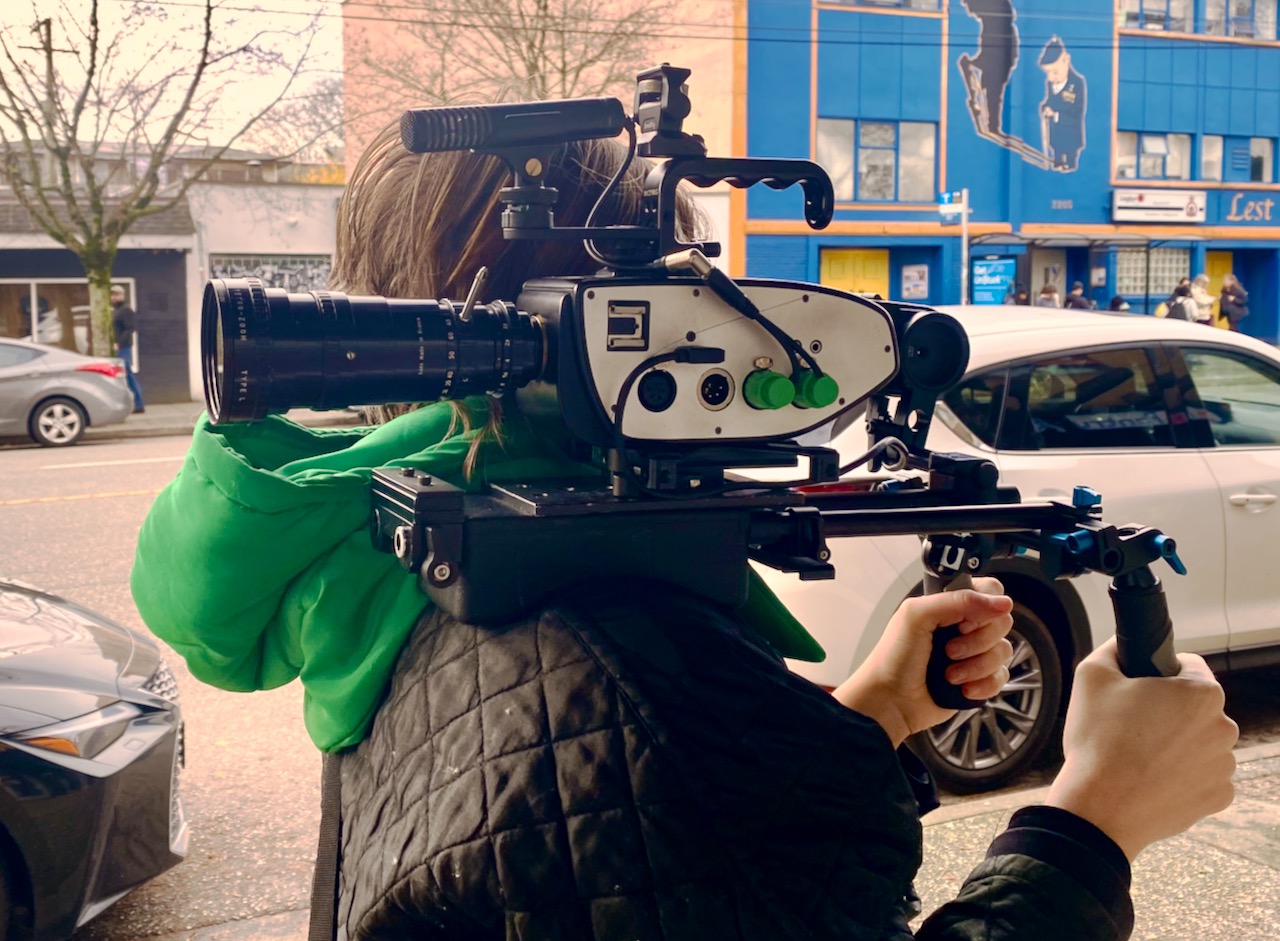
I use it both for my own films as well as I get hired to do music videos and events. I just finished a feature length experimental film shot entirely with it called Shapes, Colours, Patterns. (There's a trailer for it on my Tumblr. https://clarknikolai.tumblr.com ) I'm very happy with it, and of course the image from that camera is gorgeous. Something I've discovered with the Digital Bolex's footage, is that it looks the best projected rather than shown on an LCD screen. I'm now working on a new project. It's a narrative, collectively written, performed and crewed by myself and three other artists. It's set in the present day in east Vancouver where three artists are working on their art projects. The characters are based on the people involved and their real lives (but fictionalized so we have more freedom.) We're using French New Wave and Availablism methods. Quick half-day shoots. It's self funded, using what we have around us, the equipment we already own, locations we already have, etc. (I think so far all we've spent on it was some coffees.) I plan to enter it in to film festivals when it's done. Here's a picture with the camera mounted backwards on the shoulder rig. This is so the camera operator can walk forward while the talent is behind them and they don't need a spotter. It's tricky to learn how to move but it's going okay. It works fine with a wide lens but not easy when zoomed in (as you'd expect.) We have to flip the image in the monitor or it's disorienting.

-
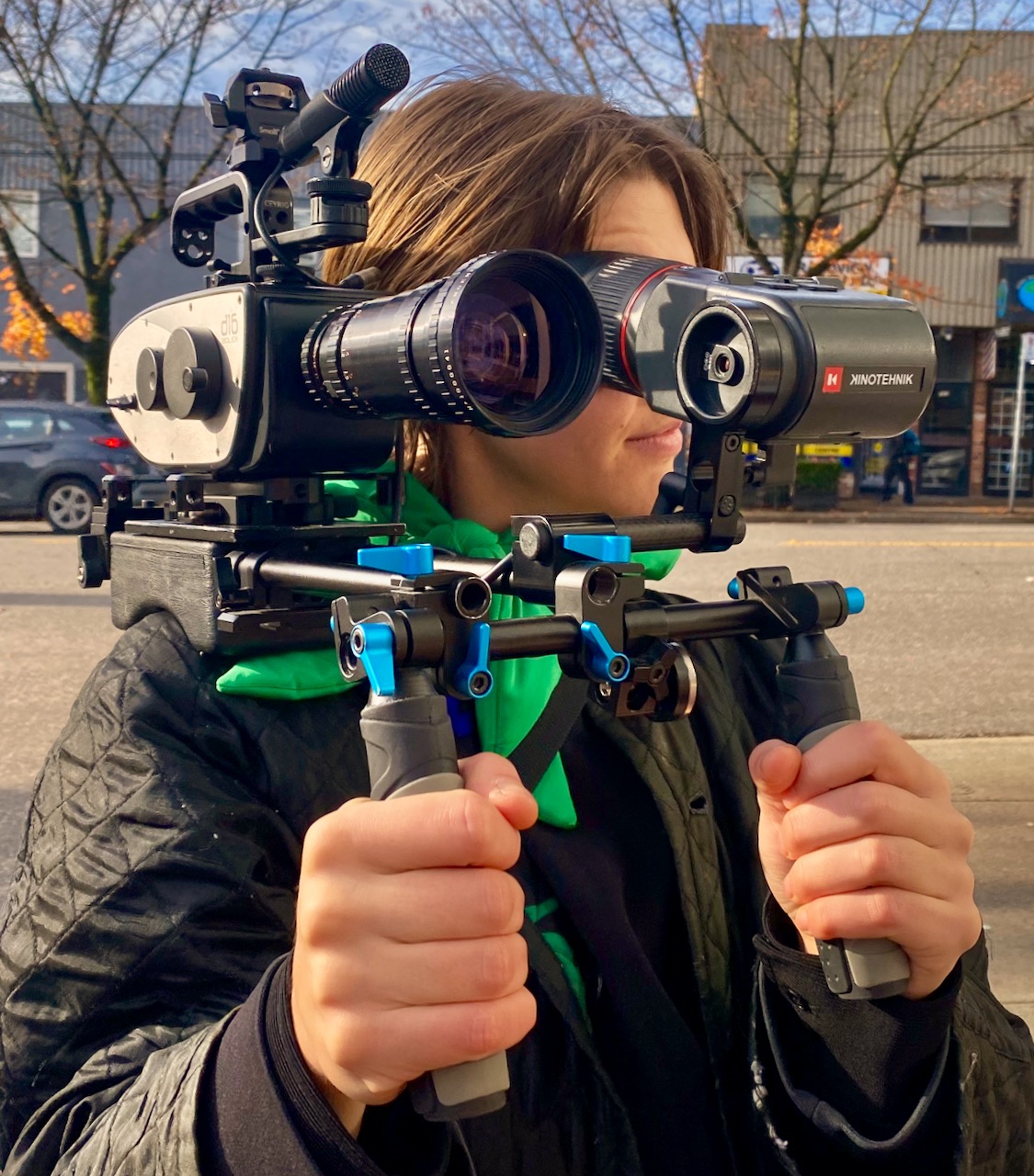
Here's a pic from a shoot I did last December. I don't know the brand of the shoulder rig (as I got it used on Craigslist), the EVF is the (sadly discontinued) Kinotehnik LCDVFE. The camera attaches to the rig with a Niceyrig quick-release plate (that has feet). The lens is a vintage Angenieux 17-68mm zoom with a screw on wide angle adapter, on top is a Niceyrig top handle holding an Audio-Technica stereo mic and a monitor mount. A bit hard to see is an attachment that goes below the rails between the shoulder pad and the grips for two wireless mic receivers.
-
So true. Our training and experience give us an eye for composition and framing. Last winter when I was in Mexico, as a tourist, I started shooting with my iPhone. I thought it was boring so I used an app that replicates grainy, dirty Super8 and shot with that. I realized that I also needed shoot like another person. I needed naïveté in my shooting, so I chose "1960s dad with his Super8 camera". So, I did things like shoot the waves in the ocean with a slow pan to the shore, signs, cars going by, etc. It was refreshing not to have to be so perfect all the time. (Now unfortunately I have to edit it and the footage is not exciting me, but that's a different story.)
-
Right. Recently I did some transfers from films for someone. Most were from the 1950s but some were 1960s and '70s. It's noticeable how the film stock improved. When they switched to Super 8 it was very much better having the larger area used for the image but it was more than that. Even the Regular 8 from the 1960s was better than earlier stocks. The collection came with the original boxes that were returned in the mail from the lab and it's the same stock and ASA, but manufactured 10 years later. Hope you're having fun figuring this out. I love this kind of thing.
-
Nice stuff. I like this project. Discovering what the elements are that you like about film and training your eye to notice the tiny things that give it away that it's not film. These are all good but I like the second batch here the most. The grain is high in a still but might be okay when moving. The shot of the button on the pole is the one that to me shows that it's not film. I can see that there's more resolution there than the grain would be giving, making the grain look like an overlay. (Maybe add a tad blur to the image, or use a smaller grain effect?) I find using vintage zoom lenses meant for 16mm cameras to just naturally give that look. When you zoom in it's a lever that you move, which looks different than turning a lens ring or a motor turning a lens. How a camera's shape and weight affects your camera work is important for the look. Some Super16 cameras were shoulder mount so maybe get something that replicates that type of movement. I now have a shoulder rig for my D16 and it gives a different feel to the footage's movement than pistol grip type of shooting. I prefer it really. I don't use the pistol grip ever. (Too bad because the grip looks cool.) Another thing, which probably doesn't apply for your project, is what someone in the past would have shot and what they would have concentrated on and framed. That's another thing altogether. Are you thinking of also shooting so that it looks like it was shot in the past or is it replicating someone in the present day shooting film?
-
These are really nice. I've been to Japan once but these don't remind me of it much. I was staying in a suburb and didn't go out at night much. It looks like I missed some great things. You know when it's night time like this, I don't even notice lens imperfections much. It just seems natural when under that kind of light.
-
Seems impressive. Checking out their press release there's some great stuff. It says raw photo saving but only a mention of high bitrate video, not what codec it uses. Lots to love with this one. https://gopro.com/en/us/news/gopro-announces-three-cameras-mission-1-2026
-
How about doing a music video for a musician?