
Andrew - EOSHD
-
Posts
15,776 -
Joined
-
Last visited
Content Type
Profiles
Forums
Articles
Everything posted by Andrew - EOSHD
-

2013 vs 2026 in camera mods and software
Andrew - EOSHD replied to Andrew - EOSHD's topic in Cameras
Computing was once about a machine always waiting for the inputs from a human, in a deterministic way, it sits and waits - you enter the inputs. Coding was like this, you write all the code, you look stuff up on stack overflow and cut and paste algorithms occasionally and then with a lot of testing and iteration you get what you want after many many months. For those whose skill was 90% this and 10% ideas its obvious they'll want to carry on the old way and that they're on the defensive about the new way. For those with 10% coding skills and 90% ideas it's working out much better. 1. You can't say "AI gives a false sense of having super powers" as a blanket statement 🙂this applies only to those who lack technical thinking, ideas, taste, purpose and so on. As a blanket statement, it falls down. It's also very easy to get out of date with your experience of the tools - they can evolve in extreme ways in a matter of weeks, as was case of Claude Opus 5.0 and 5.5, the step to 5.5 was a massive step change so all the people basing their judgement of AI's capabilities on 5.0 were out of date over night. 2. I agree it removes the need to "deeply understand how systems work and click together" but only in the details, not the broader picture. It is better at understanding how systems work and click together than most humans on this planet, at this point. What you need now is the type of brain that can take the new way and run with it rather than a mind that gets bogged down in the details or tries to duplicate what the AI is better at. Coming from a position of ideas and imagination is great, because you don't feel on the defensive about your syntax skills and whether its better than you at your main job or not... Ideas people don't feel threatened by it and are happier to let Claude get down to business without constantly micro managing and looking over its shoulder... or worse, looking at the code. We have to face facts. Computing is never going back to human comprehension, writing or reading of millions of lines of code, our minds are no longer the best tool for this. The capability of the AI to understand more complex problems than a professional programmer or even a whole team of them means you can be much more ambitious. Between February and October in one year, I went from making a teleprompter app for the iPad, to porting Quake to the S9 and developing an NLE, and an F1 sim. My coding skills didn't change, they're still in the pre-2026 days, but my tool use did. It has lifted me up from the muddy field and put me on the road at 200mph to finished products. There are some like the lead dev of Magic Lantern that simply refuse to take the wins, but everyone is entitled to their own principals and beliefs. I'd just prefer to be on that 200mph road to amazing software, than to still be stuck in the mud figuring out how to get a 1100D to write a .txt file to an SD card. -
Magic Lumix - Panasonic S9 and GX80 officially hacked
Andrew - EOSHD replied to Andrew - EOSHD's topic in Cameras
I just need a "TONEH!" sound FX when pressing the shutter button. https://www.youtube.com/watch?v=aQ8VodC19-g -
Magic Lumix - Panasonic S9 and GX80 officially hacked
Andrew - EOSHD replied to Andrew - EOSHD's topic in Cameras
I won't be releasing it until: At least $100,000 in donations And at least 5 credits from YouTubers amounting to 1m views. -
A little something I've been working on for EOS R8...
Andrew - EOSHD replied to Andrew - EOSHD's topic in Cameras
"But why?!" God it annoys me. Has the general knowledge got that decrepit that they don't understand what a proof of concept is any more? It also pisses me off that he uses my clip and doesn't credit, but I expect nothing less from the click weasels in 2026. -
A little something I've been working on for EOS R8...
Andrew - EOSHD replied to Andrew - EOSHD's topic in Cameras
I had the same thoughts when I started using Claude and then a follow-up thought that wasn't quite as nice!! -
Magic Lumix - Panasonic S9 and GX80 officially hacked
Andrew - EOSHD replied to Andrew - EOSHD's topic in Cameras
I tried Deepseek Flash 4.1, and it was alright... You can't take a janky knife into a gun fight though... The camera's life depends on it. Still a massive gap to the frontier US models. -
Magic Lumix - Panasonic S9 and GX80 officially hacked
Andrew - EOSHD replied to Andrew - EOSHD's topic in Cameras
Here's the recipe, I'm going to lay it out in totality for the click weasel snapgrammers who definitely always credit their sources. 1. Download Claude and stick it up your fucking arse. 2. Buy an S9, your first Lumix camera 3. (The real secret was Le Chonk, the French AI model) 4. Sit back and let the youtube ad revenue flow in -
Magic Lumix - Panasonic S9 and GX80 officially hacked
Andrew - EOSHD replied to Andrew - EOSHD's topic in Cameras
I misread that as cripple hammer and chisel -
Magic Lumix - Panasonic S9 and GX80 officially hacked
Andrew - EOSHD replied to Andrew - EOSHD's topic in Cameras
Does that fit in the hotshoe? -
Magic Lumix - Panasonic S9 and GX80 officially hacked
Andrew - EOSHD replied to Andrew - EOSHD's topic in Cameras
Connect it to HDMI and bingo you have a games console
-
Magic Lumix - Panasonic S9 and GX80 officially hacked
Andrew - EOSHD replied to Andrew - EOSHD's topic in Cameras
Pretty much anything you can dream of and can write in C code or Arm64. It even has a bluetooth host and USB HID capability which means all sorts of accessories can be accommodated with custom functionality. Steam Controller 2 as a follow focus anyone? 🙂 -
Magic Lumix - Panasonic S9 and GX80 officially hacked
Andrew - EOSHD replied to Andrew - EOSHD's topic in Cameras
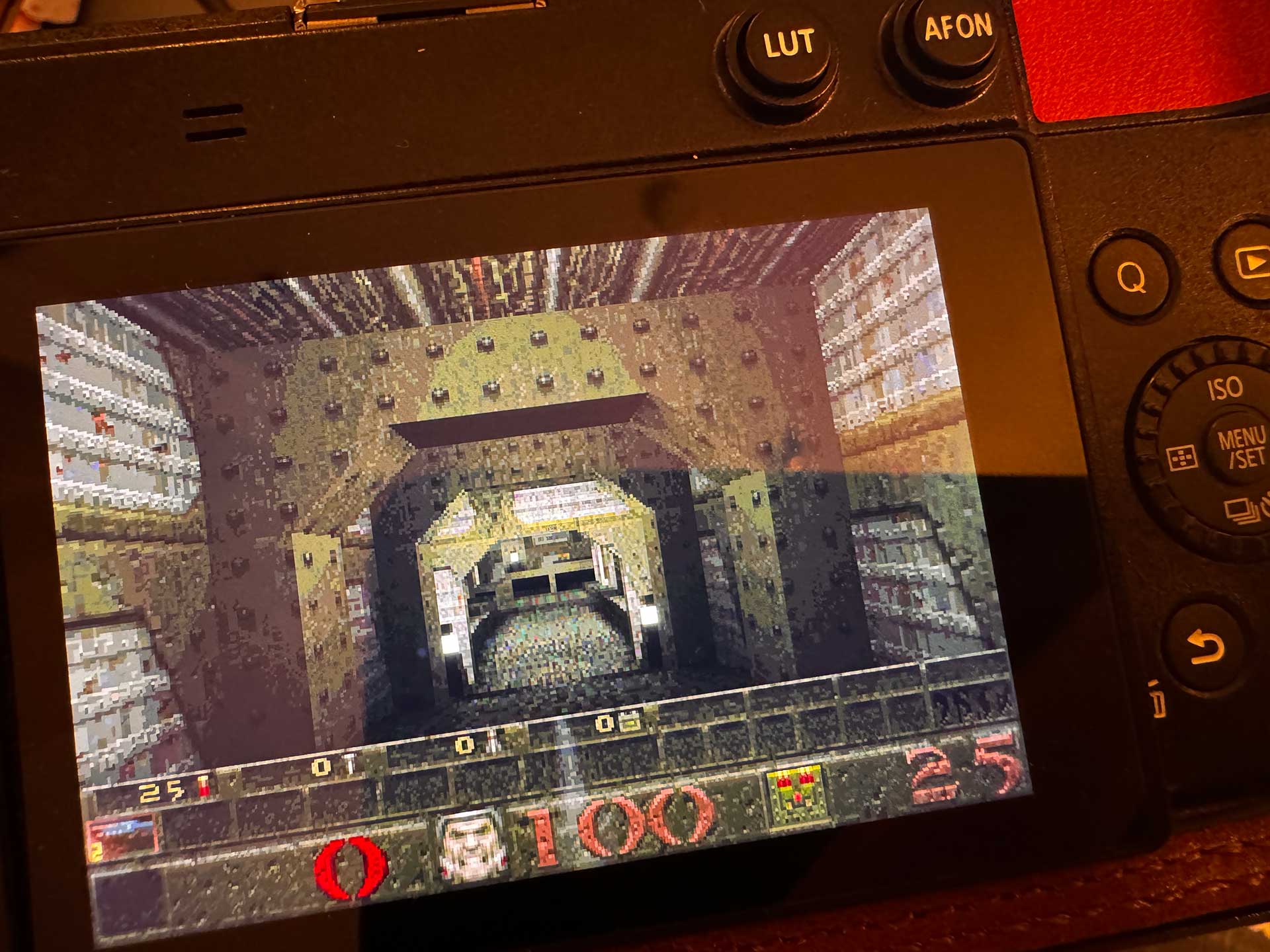
GX9 is on the to-do list. Quake on the S9 is a proof of concept, a way to understand all the CPU and camera systems. I have it so the shutter button shoots the shotgun. It's very satisfying 🙂 It is now reliably 60fps without screen tearing or long load times, and the Pana UI gets out the way. So it's now understood how to draw on screen, how to disable default key actions and override them with our own control scheme, how to manage DMA memory and read/writes to the card, that's why a complex game is better than taking baby steps with basic 'hello world' stuff or menu tweaks, and so on. My LLM now has a comprehensive understanding of the ROM, the CPU, RAM, DMA, physical controls and so on. 5 years of work done in a single week. Next up is audio, I'd like to get Quake's SFX working before the YouTube video gets shot of it all working. Then starting work on adding camera features and actually useful stuff is much easier, having laid all the foundations in a solid way with Quake. It boots automatically from SD card as well, without any need to enable service mode. So very nice to use. Installing / enabling it for first time however is not a neat package yet. It'll remain closed source for a few months then I'll assess again. If I gave it all out now I'd have to take on an unacceptable level of legal risk and email work, from people complaining that it isn't 100% reliable yet and don't want any bricked cameras billed to my Greggs sausage roll account. Once it's further down the road it should see light of day as long as Panasonic don't have me assassinated and Tony fucking Northrup doesn't do it first with Claude Vulture 7.8 on a spare weekend whilst sat in the bath. -
Magic Lumix - Panasonic S9 and GX80 officially hacked
Andrew - EOSHD replied to Andrew - EOSHD's topic in Cameras
Skipped Doom on the S9... Went straight to Quake at 60fps. It makes the EOS R5 look like a bit of a potato. Blog post and YouTube video coming soon. -
Magic Lumix - Panasonic S9 and GX80 officially hacked
Andrew - EOSHD replied to Andrew - EOSHD's topic in Cameras
Nothing about it was easy 🙂 I can assure you that much!! -
Magic Lumix - Panasonic S9 and GX80 officially hacked
Andrew - EOSHD replied to Andrew - EOSHD's topic in Cameras
When you run code in RAM you can do pretty much anything like Magic Lantern or the Sigma Fp hacks, so raw video, open gate and V-LOG for the GX80 is definitely on the cards. The S9 has a 64bit CPU so plenty of power to play with there. Got to explore the hardware now and build the first proper feature for it so keep an eye on the blog for further developments! -
2013 vs 2026 in camera mods and software
Andrew - EOSHD replied to Andrew - EOSHD's topic in Cameras
Exactly it's a multiplier not a remove the human from the loop clanker. More people should embrace it! -
With the help of our AI friends, the first Panasonic hack since the GH2 has arrived. So far the S9 and GX80 have the hack. It auto-executes code from the card at boot, enabling the same kind of range of mods Magic Lantern does but on Lumix cameras for the first time. It takes compiled C code binaries and Arm64 code. The CPU is extremely powerful... 64bit vs the 32bit EOS R5. More info soon. GM5 and GX9 to follow
- 32 replies
-
- 10
-

-

-
2013 vs 2026 in camera mods and software
Andrew - EOSHD replied to Andrew - EOSHD's topic in Cameras
Don't worry nothing will be worth releasing at this rate anyway, as the social media influencers would have flooded the market with magic lantern based bait for free and sucked up all the attention out the room. Mario (NES version) on 200D has millions of views on Instagram. Mario 64 on a camera never hacked before (R8 and R5)... Crickets. If this has taught me a lesson, it is that the internet is no longer about merit. -
2013 vs 2026 in camera mods and software
Andrew - EOSHD replied to Andrew - EOSHD's topic in Cameras
They are both Arm64. That doesn't give an M1 Mac permission to bypass Nintendo's encryption, that's a separate issue. -
2013 vs 2026 in camera mods and software
Andrew - EOSHD replied to Andrew - EOSHD's topic in Cameras
Well, that's your choice isn't it? It doesn't mean to say others won't, but this is why a degree of professionalism and doing software as a livelihood matters because if its just engineered as influencer bait and flung out for free, you're more likely to end up with a brick. On the other hand if the source is trusted and the risk is assessed as being very low, I'd pay for that personally especially if it enables a feature on a camera in a world first that's useful. It also depends what type of mod it is... Does it flash firmware? Or does it enable an existing service mode to run scripts off a card? This is where a bit of knowledge from the customer helps so they can understand the risk being diving in with some Instagrammer's free shit. As for vibe coding... Depending on the combination of what type of human and what type of AI model wrote the code, the quality of the vibe coded version is a very wide spectrum... It can wind up being much better than the human slop code and better than some of the human professional code as well. OK So we agree that real knowledge and thought are worth paying for. How do you square that with "Imagine if Magic Lantern came with a pricetag!" then? Especially those pros who used it for paid work in the mid 2010s and delivered raw Cinema DNG to paying clients, without even so much as a donation to those who put the hard work in. I am skeptical - the software needs to break the encryption or emulate what the Switch hardware decoder does. -
2013 vs 2026 in camera mods and software
Andrew - EOSHD replied to Andrew - EOSHD's topic in Cameras
That could be an interesting way of doing it. Influencers open sourcing stuff for attention has done a lot of damage to expectations. If a mod or software is relatively low effort (like most free stuff is) and unsupported, of course giving it away will drum up attention for clicks...For anything of high quality, the dev has to take on the legal risk, the bricking risk, and the customer support emails - it's a full time job. -
Very nice shots 👍
- 1 reply
-
- 1
-
-
2013 vs 2026 in camera mods and software
Andrew - EOSHD replied to Andrew - EOSHD's topic in Cameras
I expect you still need the private keys to break encryption so they run without the Switch's ROM's encoder/decryption service. This is nothing like how Magic Lantern worked. You should be grateful there are people willing to take that risk. And at least they make the effort to understand the legal side, unlike the armchair internet experts. Yes I agree, how dare they run a business in communist camera town. ---- The same people whinging about an indie dev selling a genuinely amazing tool for $5 are the ones who happily pay Adobe $50 per month on a subscription, the monster which their dumb attitude towards software licenses created in the first place. I have never seen such an entitled generation of users in my life when it comes to software. Every smartphone app is now freemium junk, that relies on gating features behind a subscription because nobody wants to pay the $5 one off up front. Open source and free is the fastest way to find the bottom of the software quality barrel. If you can't pay the devs, yet expect them to answer customer support requests 100 times a day, how do you expect them to keep grinding at the millstone and updating the project? Why do you think so much of the open source stuff gets abandoned by the main devs? Even Magic Lantern at one point too? I just think the whole attitude is fucking stupid to be honest. -
Progress report The GF1 in a world first is hacked and runs apps automatically after boot-up, with an autoexec.bin file on the card. Onto the GH1 and GH2 next. Efforts for the GX80 are ongoing.
-
I've resurrected the GH1, GH2, GF1 hack project today and aim to port ptools to Mac OS. I also want find out if apps and code can run off the SD card like it does on Canon's cameras with autoexec.bin If so, we can go far beyond just patching firmware parameters for bitrates! Also looking into GX80. I can enter service mode on my GX80 and G9 II but they are much, much more locked down than the GH1 was. After the GH2, Panasonic went ape shit and tightened everything up - much more so than Canon and Sony did. It might also be possible to flash custom firmware, that enables an app store type thing - running code off the card with modded firmware. This is riskier as flashing buggy firmware still in development to test it in-camera does risk a bricking moment. That's why it might be necessary to make an emulator first or at least use an ARM emulator to test stuff on the Mac before flashing to the camera. It helps to understand the risks clearly, for all camera hack projects. Here they are from least to most severe: [NO ALARM BELLS. Least risky] - The Canon stuff is lowest risk, the official firmware has an official Canon feature that runs code off the card in-camera, the only firmware adjustment is a parameter to set it to do so (its like setting a Lumix into service mode with a key combo, but writes a flag via the firmware updater). This is a lovely way of doing custom camera features - but labours under the misconception of the uneducated users who think that it's illegally hacked custom firmware - in fact it's more like an app store for a phone. [JUST A FIRE DRILL. A bit more scary but rare] - The risk of crashing a camera mid-EPROM write, cameras might update or save menu settings to the EPROM and if you're extremely unlucky and your app running in the background for some reason crashes the camera during that brief moment you could end up with corrupted ROM data. This is what Magic Lantern warn about but its never happened to me in all of 15+ years, seems very rare for others too. Also add to this category - probing shit via USB. [QUIET ALARM BELLS should be ringing especially if using a lower-tier LLM for the modded firmware or code] - The in-between solution - small changes to the firmware machine code, a recompiled binary flashed to the camera to enable some path in like a service mode or auto-execution of code from the card. That does require a customised firmware flashed to the camera and so needs real care not to fuck it up. [BIG FUCKING LOUD BELLS. Not something I would try on an expensive camera, but I would experiment this way on a beaten up old one] - The all-out custom firmware route - all the mods and apps are flashed to the firmware so they run from the ROM, it's very risky as anything buggy that might interfere with the booting of the camera might lock you out-forever and need a re-flash of the firmware ROM at an official service centre, or even a mainboard replacement.